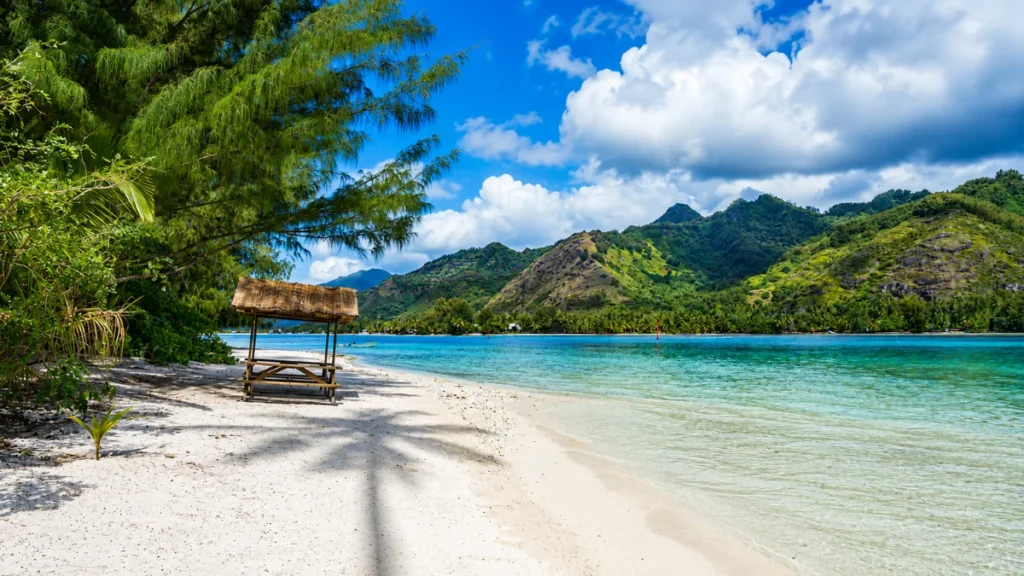
Many travelers search for Tahiti with one big question in mind: is the island still worth visiting if they are not staying in expensive overwater bungalows or luxury resorts? It is a fair concern because Tahiti is often shown online through polished honeymoon photos, high-end resort views, and perfect lagoon scenes.
Tahiti can still be worth visiting without a luxury resort stay if you enjoy natural scenery, Polynesian culture, local food, mountain views, black-sand beaches, and a slower island rhythm. The trip will feel less polished than resort marketing suggests, but it can also feel more real, grounded, and personally meaningful.
The decision feels difficult because most travel images show only one side of French Polynesia. Travelers often see luxury suites, private decks, and resort lagoons, but not the everyday island atmosphere, local neighborhoods, markets, roadside food trucks, transport limits, or realistic travel costs.
This article explains is Tahiti worth visiting without staying in luxury resorts, what the island actually feels like outside the resort bubble, who it suits best, what tradeoffs to expect, and how to decide if this kind of Tahiti trip is truly worth the journey for you.
The Real Pacific Travel Reality Check
Tahiti is not a cheap destination, even when you avoid luxury resorts. Flights to French Polynesia can be expensive, imported goods often cost more, and transport around the islands may require more planning than travelers expect.
This matters because some visitors assume skipping a luxury resort will suddenly make Tahiti feel like a low-cost tropical holiday. In reality, accommodation savings can be meaningful, but food, tours, car rental, ferries, and island logistics still need a realistic budget.
Like many Pacific destinations, Tahiti also has a slower rhythm. Travel plans may depend on ferry schedules, road conditions, weather changes, business hours, and relaxed island timing. This is part of the experience, not something to fight against.
Tahiti becomes easier to enjoy when travelers understand that it is a real island with local life, daily routines, traffic, markets, schools, homes, and working communities. It is not only a resort backdrop.
What Many Travel Articles Miss About Tahiti
Many articles and travel videos present Tahiti mainly as a luxury gateway to French Polynesia. They often focus on high-end resorts, romantic stays, and polished lagoon photos. That version of Tahiti exists, but it is not the whole story.
Outside the resort setting, Tahiti feels more practical, local, and lived-in. You may spend time at markets, small restaurants, black-sand beaches, lookout points, waterfalls, food trucks, and coastal roads where the mountain scenery feels close and dramatic.
This is what many travelers miss when they judge Tahiti only by resort standards. A non-luxury Tahiti trip is less about being served inside a beautiful property and more about experiencing the island itself.
Tahiti Without Luxury Resorts: Expectation vs Reality
Travelers often arrive with an image of Tahiti shaped by honeymoon advertising and social media. The real experience can be just as memorable, but it may feel different from what people expect.
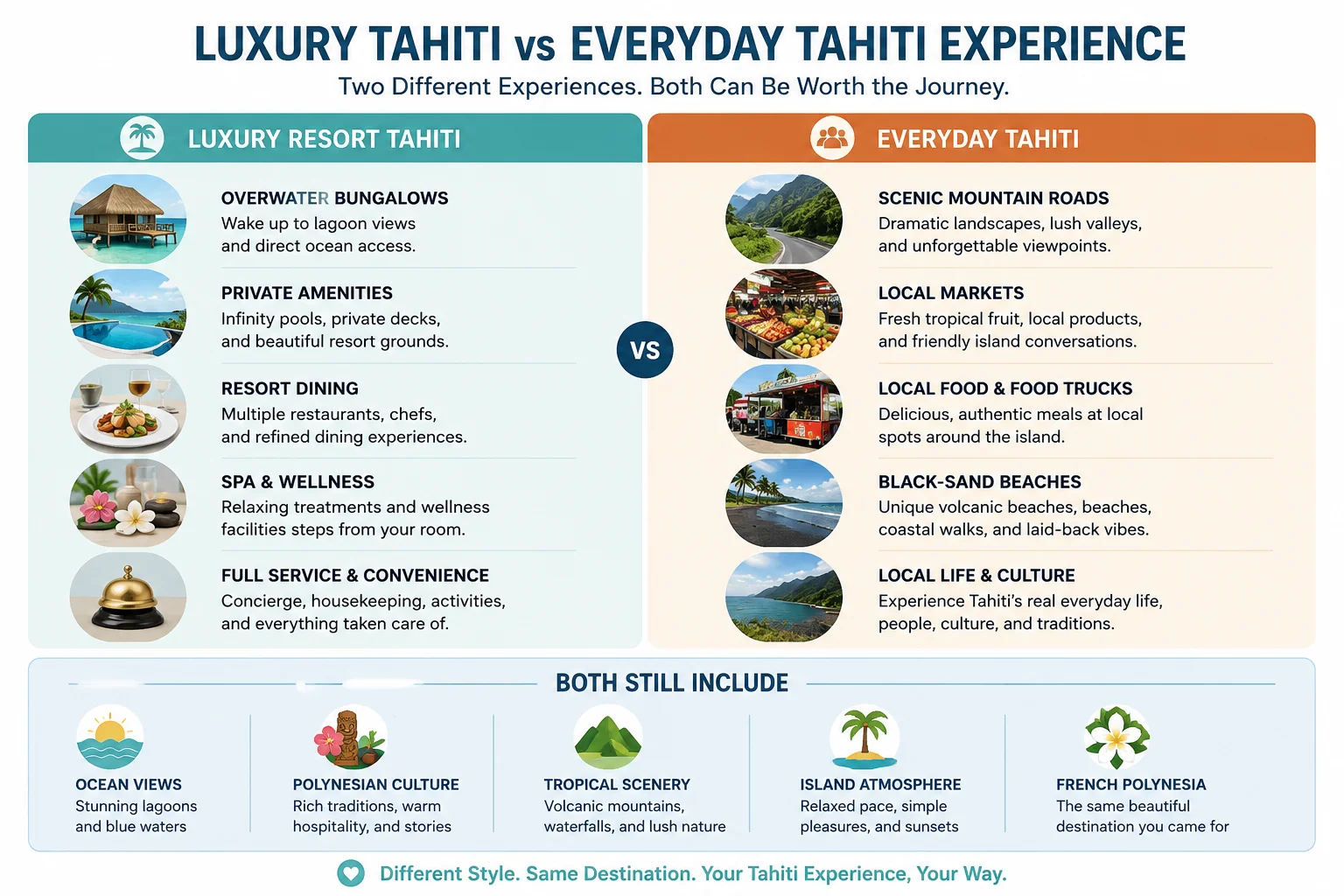
| What Travelers Often Expect | What Tahiti Often Feels Like |
|---|---|
| Luxury everywhere | A mix of resorts, local neighborhoods, markets, roads, and everyday island life |
| Perfect beaches at every turn | Beautiful coastal areas, black-sand beaches, volcanic scenery, and working waterfronts |
| A private honeymoon atmosphere | A more lived-in island with families, commuters, shops, schools, and local routines |
| Easy island movement at all times | Transport that needs planning, especially if you are connecting to Moorea or other islands |
| Cheap travel once resorts are avoided | Lower accommodation costs, but still higher food, transport, and activity costs than many expect |
This difference is important. Tahiti is not disappointing because it feels more real than resort photos. For many travelers, that more grounded feeling is what makes the trip more interesting.
What Tahiti Actually Feels Like Outside Resorts
Outside luxury resorts, Tahiti often feels relaxed, tropical, local, and slightly rougher around the edges than some visitors expect. It is scenic, but not always polished. It is beautiful, but not artificial.
The island atmosphere is strongly shaped by its mountains. Even when you are driving through busier areas, the green volcanic peaks create a dramatic backdrop. This gives Tahiti a different feeling from flatter beach-focused islands.
The pace is slower than many mainstream destinations. Mornings may involve bakeries, markets, coastal roads, or quiet ocean views. Evenings may feel simple, with food trucks, small restaurants, or a relaxed walk near the water.
Local interactions can also feel more natural when you stay outside resort spaces. Guesthouses, small hotels, markets, and local food places may give travelers a better sense of everyday Polynesian life.
Is Tahiti Still Beautiful Without an Overwater Bungalow?
Yes. Tahiti’s beauty does not depend on luxury accommodation.
The island’s strongest appeal often comes from its landscape: volcanic mountains, coastal roads, waterfalls, lush valleys, black-sand beaches, changing skies, and views across the water toward Moorea.
An overwater bungalow can create a special experience, but it is not the only way to enjoy French Polynesia. Many travelers remember a scenic drive, a local meal, a ferry ride, a waterfall stop, or a quiet ocean view just as strongly as a hotel room.
Many travelers are surprised that some of their favorite memories come from simple moments rather than expensive accommodation. A mountain viewpoint, a quiet beach, a roadside food stop, or a ferry ride across the water often becomes more memorable than the hotel itself.
If you are comparing different French Polynesian islands, you may find Tahiti vs Bora Bora: Which Island Offers More Value? helpful because it explains how Tahiti and Bora Bora feel different in real travel situations.
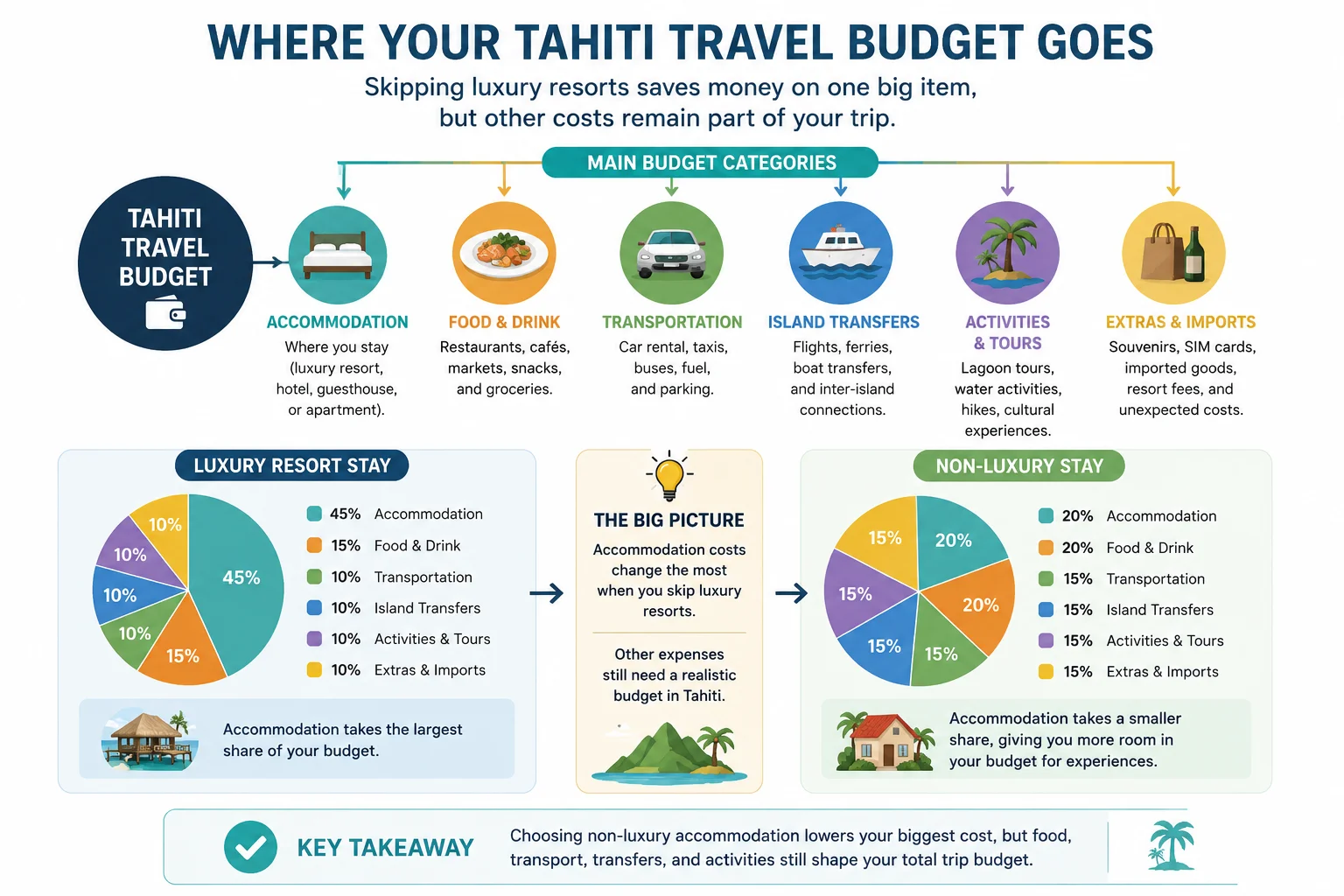
How Much Can You Save by Skipping Luxury Resorts?
Accommodation is one of the biggest cost differences in Tahiti. Choosing a guesthouse, small hotel, apartment, or pension can reduce your trip cost significantly compared with luxury resort stays.
| Accommodation Type | Budget Feeling | What to Expect |
|---|---|---|
| Luxury resort | Highest cost | Polished service, stronger resort atmosphere, and premium comfort |
| Boutique hotel | Moderate to high cost | More comfort than simple stays, but usually less expensive than luxury resorts |
| Small hotel | Mid-range | Practical comfort with easier access to local areas |
| Guesthouse or pension | More budget-friendly | Simple, local, and often more personal |
| Apartment rental | Good value for longer stays | Useful for self-catering, families, and travelers who want more independence |
Even with cheaper accommodation, Tahiti is still not usually an ultra-budget destination. Imported food, tours, fuel, rental cars, and island transfers can still feel expensive.
For a wider view of Pacific travel costs, you may also find How Much Does a Bora Bora Trip Actually Cost? useful when comparing French Polynesia travel budgets.
What You Gain and Give Up by Skipping Luxury Resorts
The best way to decide whether non-luxury Tahiti is right for you is to think in terms of tradeoffs. Skipping luxury resorts does not only mean spending less. It also changes the feel of the trip.
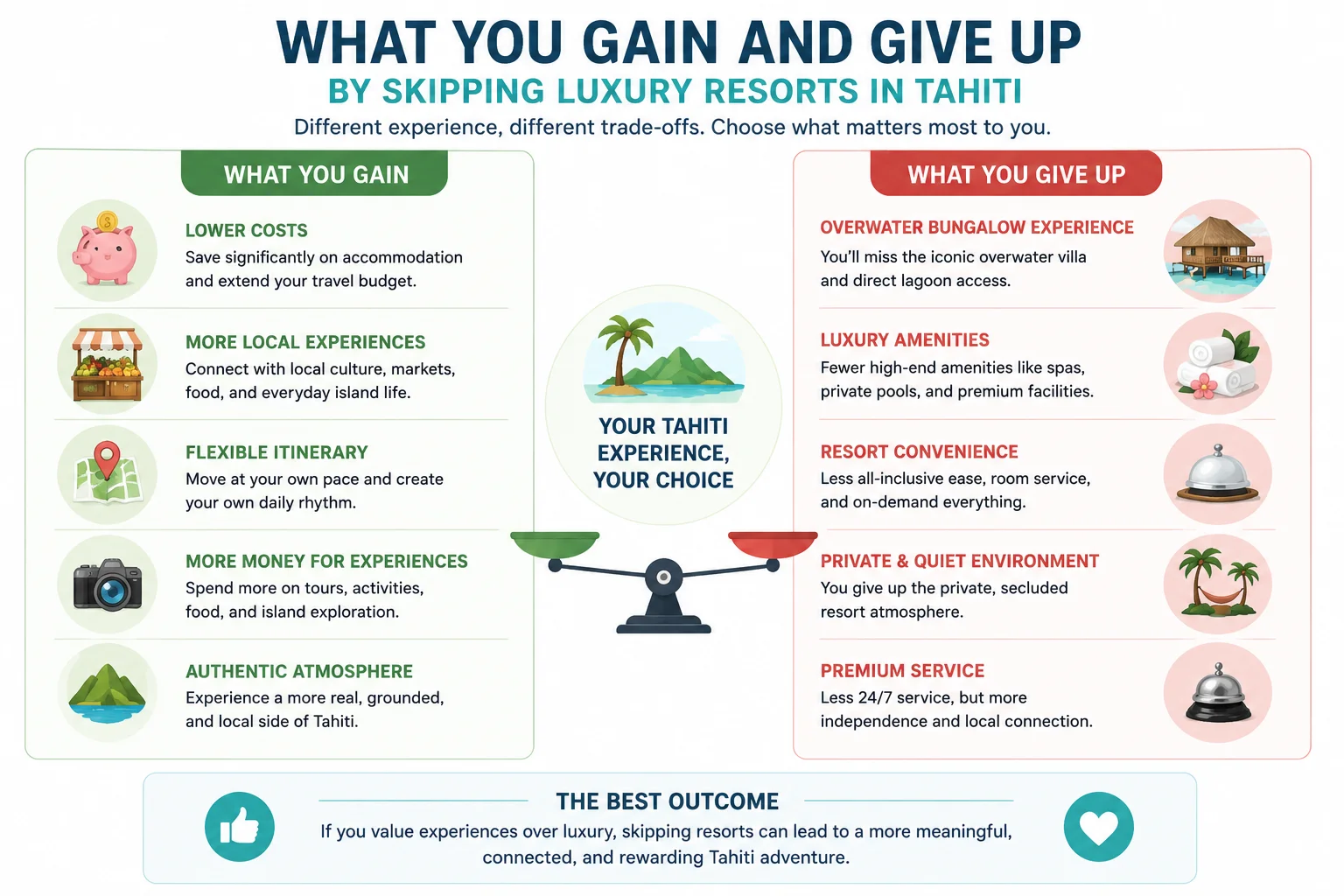
| What You Gain | What You Give Up |
|---|---|
| Lower accommodation costs | The overwater bungalow experience |
| More local interaction | Full-service resort convenience |
| More flexible daily rhythm | Private resort beaches and polished spaces |
| More money for food, tours, and island exploration | Luxury amenities and high-end service |
| A more grounded sense of Tahiti | The controlled resort atmosphere many travelers imagine |
This tradeoff is not automatically good or bad. It depends on what kind of trip you want. Some travelers feel more connected to Tahiti outside resorts, while others genuinely want the comfort, privacy, and ease of a luxury stay.
Who Enjoys Non-Luxury Tahiti Most?
Tahiti without luxury resorts suits travelers who are curious, flexible, and comfortable with a more independent style of travel. It is especially rewarding for people who want to understand the destination beyond the polished tourism image.
| Traveler Type | How Tahiti May Feel | Fit Level |
|---|---|---|
| Independent travelers | Interesting, flexible, and more local | Strong fit |
| Budget-conscious couples | Worthwhile if expectations are realistic | Good fit |
| Culture-focused travelers | More meaningful outside resort spaces | Strong fit |
| Luxury honeymooners | May feel less special without resort comfort | Mixed fit |
| Fast-paced sightseers | May feel too slow after a few days | Weaker fit |
| Travelers wanting easy convenience | May find logistics more tiring | Mixed to weak fit |
If you are also considering nearby islands, What Makes Moorea Feel More Relaxing Than Bora Bora? can help you understand whether Moorea may offer a softer and easier island pace.
Best For and Not Ideal For
Non-luxury Tahiti can be a very good choice, but it is not ideal for every traveler. The experience works best when your expectations match the island’s more local and independent feel.
Best For
- Travelers who care more about scenery and culture than resort luxury
- Couples with realistic budgets
- Independent travelers who enjoy exploring at their own pace
- Visitors interested in markets, local food, and everyday island life
- Travelers combining Tahiti with Moorea or Bora Bora
- People who enjoy dramatic mountain scenery and slower travel
Not Ideal For
- Travelers expecting luxury service at budget prices
- Visitors who want a fully polished resort bubble
- People who dislike planning transport and daily logistics
- Nightlife-focused travelers
- Travelers expecting every beach to look like a postcard
- Visitors who want constant activities and fast sightseeing
Tahiti becomes more rewarding when you choose it for the right reasons. It is not only a luxury destination. It is also a real Pacific island with culture, scenery, daily life, and a strong sense of place.
Practical Travel Insights
A non-luxury Tahiti trip can feel smoother when you plan with real island conditions in mind.
- Stay at least 4 to 6 days if Tahiti is your main destination.
- Consider adding Moorea if you want easier lagoon scenery and a quieter island feel.
- Book guesthouses, pensions, or apartments early during popular travel periods.
- Budget extra for food, transport, car rental, and island tours.
- Use self-catering where possible if you want to control costs.
- Do not judge Tahiti only by resort photos before you arrive.
- Leave flexibility for weather changes and slower island timing.
If you are comparing Tahiti with more famous luxury destinations, Bora Bora vs Moorea: Which Is More Worth It? may help you understand how nearby islands differ in value and atmosphere.
Common Traveler Misunderstandings
One common misunderstanding is thinking Tahiti is only a place for luxury honeymoons. While luxury travel is a major part of French Polynesia’s image, Tahiti also works for independent travelers, families, culture-focused visitors, and people using it as a base for nearby islands.
Another misunderstanding is assuming that avoiding resorts makes Tahiti cheap. It makes the trip cheaper, but not always cheap. Tahiti is often better described as less expensive rather than cheap.
Travelers also sometimes expect Tahiti to feel like Bora Bora. Tahiti is busier, more local, more practical, and more lived-in. Bora Bora often feels more resort-focused and lagoon-centered. Tahiti feels more like a real island where tourism and everyday life sit side by side.
Finally, some visitors expect perfect weather every day. Tahiti has tropical weather, which means sunshine, humidity, passing rain, changing skies, and seasonal variation can all be part of the trip.
Seasonal and Local Context
Tahiti can be visited throughout the year, but the season can affect the mood of the trip. The drier months often feel more comfortable for sightseeing, beach time, ferry travel, and outdoor activities.
The warmer and wetter months may bring more humidity and rain, but they can also feel quieter depending on timing. This does not mean travel is impossible. It simply means travelers should keep flexible expectations.
School holidays, international travel periods, and French Polynesia event seasons can also affect prices and accommodation availability. If you are not staying in luxury resorts, booking earlier can help you find better-value guesthouses and apartments.
For travelers comparing Pacific destinations by cost and timing, How Expensive Is Fiji Really in 2026? and Is Fiji Expensive Compared to Hawaii? may offer useful budget context.
Pacific Worth Note: I think Tahiti becomes easier to understand when travelers stop seeing it only as a luxury image. The resorts may be beautiful, but the island itself has its own atmosphere: mountains, markets, traffic, food, rain, ocean views, and local life. For some travelers, that realness is what makes the journey feel more worthwhile.
Frequently Asked Questions
Is Tahiti worth visiting without staying in luxury resorts?
Yes, Tahiti can still be worth visiting without luxury resorts if you enjoy scenery, culture, local food, independent travel, and a slower Pacific island atmosphere. The experience will feel less polished, but often more real.
Can you visit Tahiti on a moderate budget?
Yes, but Tahiti is still not usually a cheap destination. Guesthouses, pensions, small hotels, and apartments can reduce accommodation costs, but food, transport, and activities still need a realistic budget.
Do you need an overwater bungalow to enjoy Tahiti?
No. An overwater bungalow can be special, but Tahiti’s mountains, coastal scenery, markets, waterfalls, local food, and island atmosphere can still make the trip memorable without one.
Is Tahiti better than Bora Bora for budget travelers?
Tahiti is generally easier for budget-conscious travelers than Bora Bora because there are more accommodation types, food options, and local transport choices. Bora Bora is usually more resort-focused and expensive.
How many days should you spend in Tahiti without staying in a resort?
Most travelers should consider 4 to 6 days if Tahiti is the main destination. If you are also visiting Moorea or Bora Bora, 2 to 4 days in Tahiti may be enough depending on your itinerary.
Final Thoughts
So, is Tahiti worth visiting without staying in luxury resorts? For many travelers, yes. But it depends on what you want from the trip.
If you want perfect resort polish, private luxury, and full-service comfort, then skipping luxury accommodation may leave you feeling like something is missing. In that case, a resort stay may be part of the experience you genuinely value.
But if you want dramatic scenery, local atmosphere, Polynesian culture, food markets, ocean views, black-sand beaches, and a more grounded Pacific travel experience, Tahiti can still feel very worthwhile without luxury resorts.
The most important point is expectation. Tahiti outside resorts is not the fantasy version often shown online. It is slower, more local, more practical, and more real. For the right traveler, that can make the journey feel not only more affordable, but also more meaningful.
The travelers who usually enjoy Tahiti most are not necessarily those who spend the most money, but those who arrive with expectations that match what the island genuinely offers.
Leave a Reply