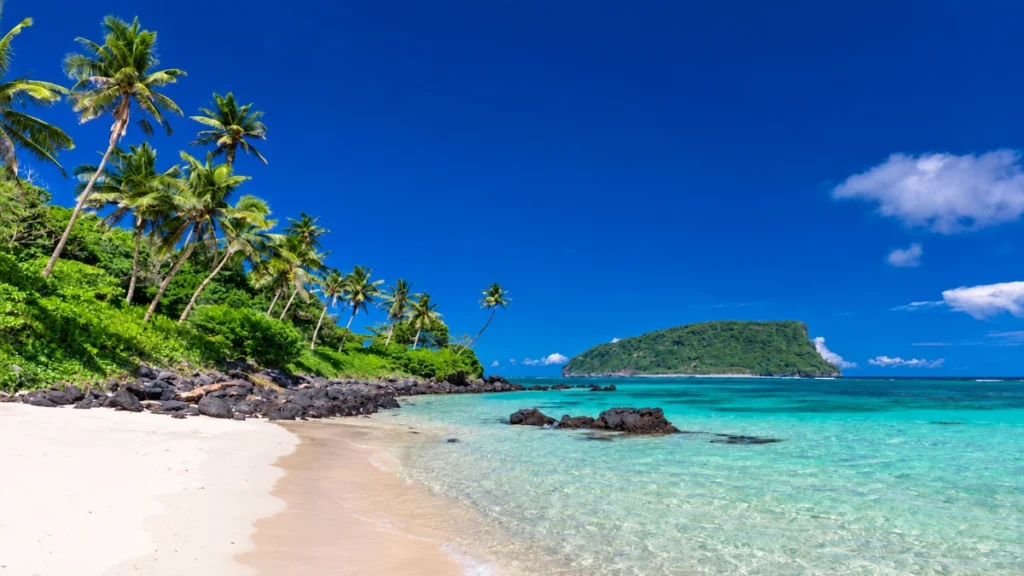
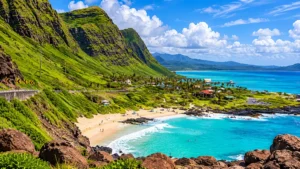
Hawaii is often the first Pacific destination travelers think about when they want beaches, dramatic scenery, warm weather, resorts, food, and plenty of things to do. But Hawaii can also be expensive, busy in popular areas, and more developed than some travelers expect from an island escape. That naturally leads to another question: could another Pacific island actually give you a more rewarding trip?
There is no single Pacific island that is better value for every traveler. Fiji may feel more worthwhile for an easy resort escape, Samoa for culture and a slower local atmosphere, Rarotonga for a relaxed small-island holiday, and Moorea for dramatic lagoon-and-mountain scenery. Hawaii still has a major advantage for convenience, variety, restaurants, sightseeing, and tourism infrastructure.
The difficulty is that Pacific islands are often compared as if they offer different versions of the same holiday. They do not. A destination that feels perfect for a couple wanting quiet resort days may feel too slow for someone who enjoys road trips, restaurants, shopping, and a full sightseeing schedule.
This article looks at which Pacific island is more worth it than Hawaii by focusing on what different destinations genuinely feel like, what travelers gain and give up, how budgets and logistics change the experience, and which island may suit your personal travel style best.
Which Pacific Islands Can Feel More Worth It Than Hawaii?
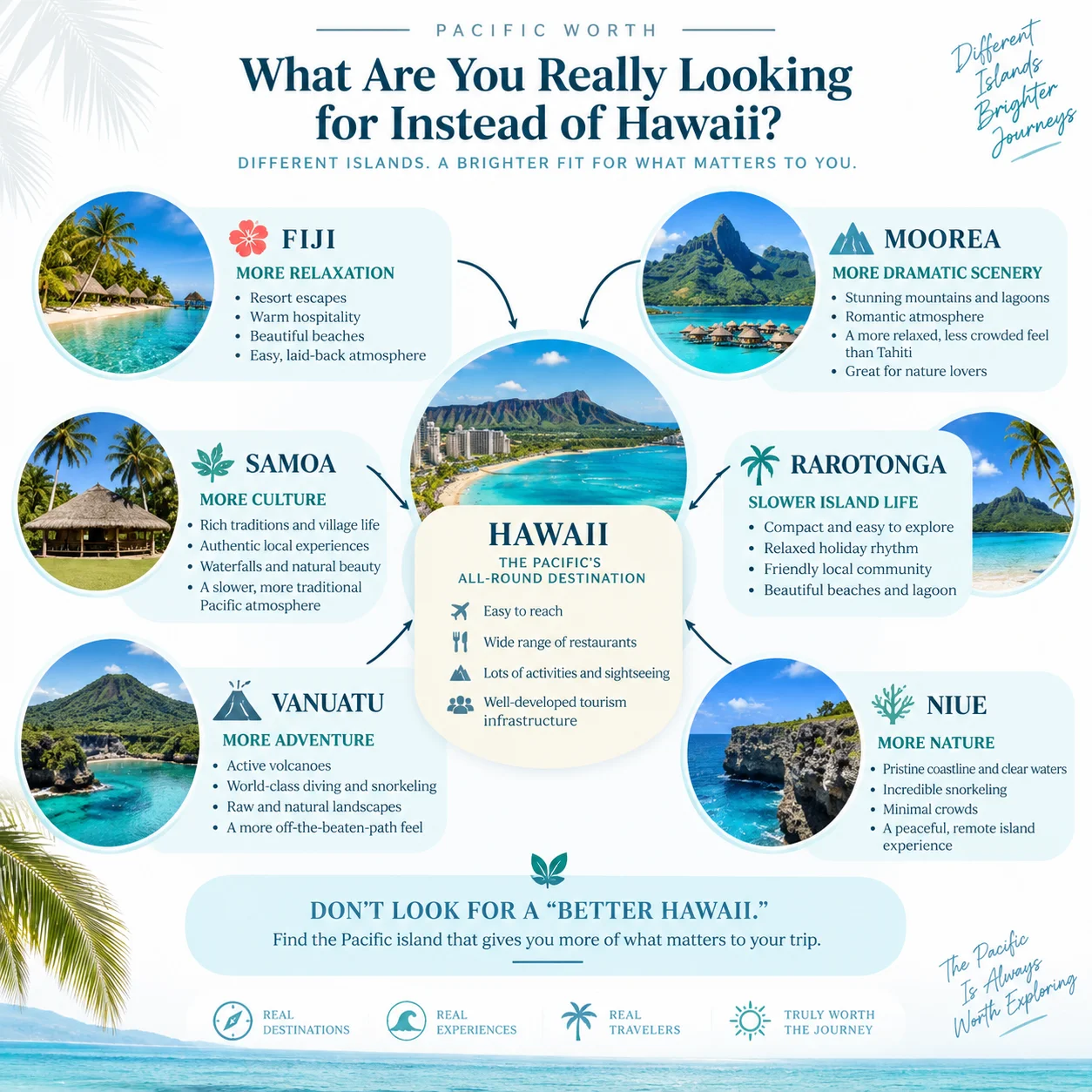
The strongest Hawaii alternatives for many travelers are Fiji, Samoa, Rarotonga in the Cook Islands, and Moorea in French Polynesia. However, each becomes more worthwhile for a different reason.
| Destination | May Feel More Worth It If You Want | Main Tradeoff |
|---|---|---|
| Fiji | Resort relaxation, family-friendly stays, and slower holiday days | Resort meals, transfers, and outer-island logistics can increase costs |
| Samoa | Culture, village life, road trips, and a less polished island experience | Less tourism infrastructure and fewer high-end resort choices |
| Rarotonga | A compact, easygoing island where the whole trip feels slower | Far fewer attractions and sightseeing options than Hawaii |
| Moorea | Lagoon scenery, mountains, romance, and a visually memorable escape | French Polynesia can become expensive quickly |
| Hawaii | Convenience, restaurants, shopping, sightseeing, and variety | Popular areas can feel busy, developed, and expensive |
The better question is not simply which island beats Hawaii. It is what part of the Hawaii experience are you hoping to improve?
If you want more relaxation, Fiji may suit you better. If you want culture to feel more visible in everyday life, Samoa becomes more interesting. If you want a small island where you can stop planning so much, Rarotonga may feel more rewarding. If scenery is the main reason you are traveling, Moorea can make a strong case.
The Real Pacific Travel Reality Check
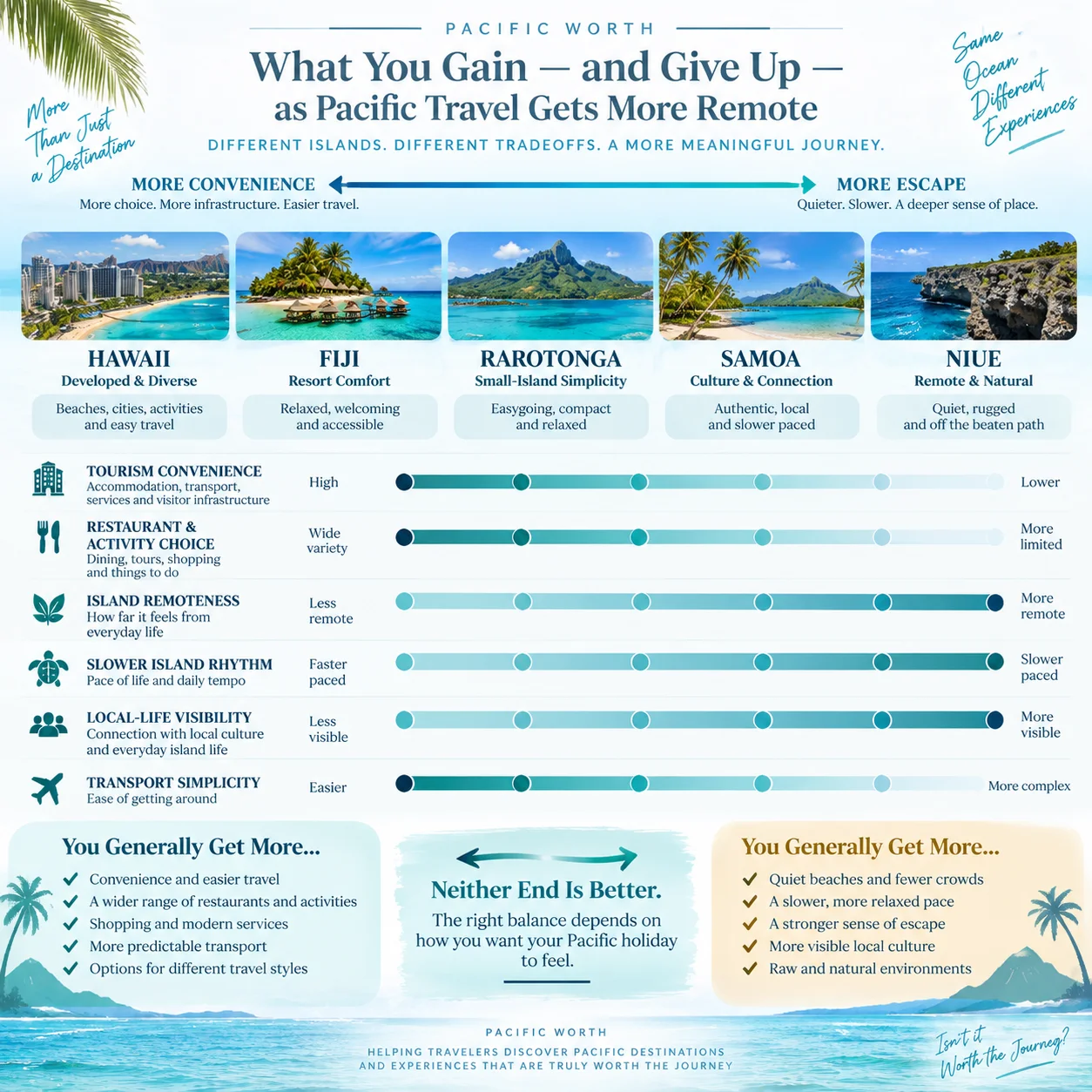
Hawaii is unusual in the Pacific because it combines island scenery with a high level of tourism infrastructure. Depending on the island, travelers can have highways, rental cars, large supermarkets, international hotel brands, shopping areas, nightlife, organised attractions, and a wide range of restaurants within relatively easy reach.
Many smaller Pacific destinations work differently. Roads may be slower. Boat or domestic flight transfers may be necessary. Restaurant choices can narrow quickly outside main tourism areas. Imported food and goods may cost more than expected. Sunday can noticeably change the rhythm of some islands, and weather can affect flights, ferries, lagoon tours, or other activities.
That does not automatically make smaller islands worse. In many cases, the slower logistics are connected to the same qualities travelers are looking for: fewer crowds, quieter evenings, less development, a stronger sense of remoteness, and fewer reasons to rush.
The important thing is to choose those tradeoffs consciously rather than arriving with Hawaii-style expectations.
What Many Hawaii Alternative Articles Miss
Many destination comparisons focus on beaches, hotel prices, flight costs, and activities. Those details are useful, but they do not completely explain whether you will enjoy spending a week somewhere.
A quiet island may look wonderful online but feel too quiet once you arrive. A busy Hawaiian destination may look overly developed in photographs but feel wonderfully convenient when you are traveling with children. A remote resort may sound romantic until you realise that most meals, activities, and transfers need to happen through the resort.
Less touristy does not automatically mean better. More developed does not automatically mean worse.
The real question is whether the compromises of the destination interfere with the experiences you personally care about.
When Fiji Can Feel More Worth It Than Hawaii
Fiji is probably the easiest alternative to recommend to travelers who like the idea of Hawaii but want their holiday to feel more like a dedicated tropical escape.
One of the biggest differences is pacing. A Hawaii itinerary can easily become busy because there are so many roads to drive, restaurants to try, walks to do, towns to explore, and attractions competing for your time.
A Fiji resort holiday can remove many of those decisions. You may wake up, have breakfast, swim, snorkel, sit by the water, join one activity, have lunch, read for a while, and watch the afternoon disappear without feeling that you missed something important.
For travelers who arrive already tired, that simplicity can have real value.
The experience changes depending on where you stay. Denarau feels polished and convenient. Coral Coast resorts can be self-contained and family-oriented. Offshore islands can create a much stronger sense of separation from everyday life.
If Fiji is your strongest alternative, our comparison of Hawaii vs Fiji for First-Time Pacific Travelers looks more closely at the practical differences. You may also find Why Do Some Travelers Prefer Fiji Over Hawaii? useful if relaxation and atmosphere are your main priorities.
The Fiji Tradeoff
Fiji is not automatically a cheap alternative. Resort meals, private transfers, domestic flights, boat transfers, and activities can make the total higher than the first accommodation price suggests.
The safest way to compare value is to calculate the entire holiday rather than comparing room rates. Our guide to whether Fiji is expensive compared to Hawaii explores this in more detail.
When Samoa Can Feel More Worth It Than Hawaii
Samoa offers a different kind of value. Travelers who want the destination itself to feel more culturally visible may find Samoa more rewarding than a highly developed resort environment.
Driving around Upolu is not simply about moving between tourist attractions. Villages, churches, family homes, roadside activity, plantations, coastline, and community spaces become part of what you see throughout the day.
This can make the journey feel less separated from everyday island life.
Samoa should not be treated as a cheaper, quieter version of Hawaii. It is a culturally distinct destination with its own rhythm, traditions, infrastructure, and expectations.
Accommodation can be simpler. Services may require more patience. Sundays can feel particularly quiet. Tourism does not always surround you in the same way it may in Hawaii or a large Fiji resort.
For some travelers, these things are limitations. For others, they are exactly what makes Samoa memorable.
If Samoa is new to you, read Is Samoa Worth Visiting for First-Time Pacific Travelers?. Travelers deciding between Samoa and Fiji may also find Samoa vs Fiji for Cultural Experiences helpful.
When Rarotonga Can Feel More Worth It Than Hawaii
Rarotonga becomes attractive for almost the opposite reason Hawaii does: it is small.
The island is compact enough that your mental map can become simple fairly quickly. The coastal road circles the island, the mountainous interior is always nearby, and lagoon life shapes much of the visitor experience.
After a few days, you may stop feeling like you need to figure the destination out.
That can create a surprisingly relaxing holiday.
Rarotonga has restaurants, cafés, accommodation, activities, markets, and tourism services, but the destination can still feel much smaller and gentler than Hawaii’s major tourism areas.
This combination makes it particularly appealing to couples and slow travelers who want enough convenience to explore independently without needing a full itinerary.
Our comparison of the Cook Islands vs Hawaii for a Slower Island Experience goes deeper into this difference.
The Rarotonga Tradeoff
Smallness can become a strength or a weakness depending on your personality.
If you enjoy swimming, reading, driving short distances, having relaxed meals, and returning to familiar places, the island can feel wonderfully manageable.
If you need a long list of new attractions every day, Hawaii offers far more variety.
When Moorea Can Feel More Worth It Than Hawaii
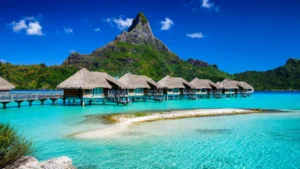
Moorea is one of the strongest alternatives for travelers whose main reason for considering Hawaii is dramatic tropical scenery.
The combination of steep green mountains, bays, and lagoon water creates a strong sense that the landscape itself is part of the experience. You do not need to be constantly moving between famous attractions to feel that you are somewhere visually distinctive.
Moorea generally feels smaller, quieter, and more lagoon-focused than Hawaii. A slow drive, a swim, a lagoon excursion, or simply sitting somewhere with a mountain view can become a meaningful part of the day.
That is very different from judging value by how many attractions you can fit into an itinerary.
The Moorea Tradeoff
French Polynesia can be expensive depending on flights, accommodation, transport, food, and activities. Moorea may therefore offer better emotional value rather than simply better financial value.
A traveler who has saved specifically for a scenic and romantic Pacific journey may find Moorea more worthwhile than a busier Hawaiian trip. Another traveler who values restaurant choice, shopping, and sightseeing variety may feel the opposite.
If French Polynesia interests you, our comparison of Bora Bora vs Moorea: Which Is More Worth It? can help explain how different island choices change both the atmosphere and budget.
What About Vanuatu, Tonga, and Niue?
Other Pacific destinations can also feel more worthwhile than Hawaii, but they tend to suit more specific travel styles.
Vanuatu can appeal to travelers who value adventure, landscapes, cultural experiences, and a less polished tourism environment. It may feel more raw and exploratory, but that also means travelers should be comfortable with infrastructure and transport that can feel less predictable than Hawaii.
Tonga can suit travelers seeking a quiet Pacific trip, cultural atmosphere, and seasonal whale experiences. It generally makes less sense as a direct Hawaii replacement for someone primarily wanting resort convenience and extensive sightseeing.
Niue is even more distinctive. It is small, remote, nature-focused, and strongly shaped by its rugged coastline and surrounding ocean rather than a traditional broad sandy-beach resort image. Travelers interested in this style of trip may find Is Niue Worth Visiting for Nature Lovers? useful.
These islands show why Hawaii becomes less useful as a comparison once you move toward smaller and more remote Pacific destinations. They are not trying to offer the same travel experience.
When Hawaii Is Still the Better Choice
It would be misleading to suggest that travelers should automatically choose somewhere quieter just because Hawaii is famous or developed.
Hawaii remains difficult to beat for travelers who want many different experiences in one trip.
You can combine beaches with hiking, restaurants, history, road trips, shopping, surfing, nightlife, organised attractions, and different landscapes without dealing with the same level of remote-island logistics found elsewhere in the Pacific.
That convenience can be especially valuable for families, short trips, first-time international travelers, people with limited mobility, or anyone who simply does not want transport and meal planning to dominate the holiday.
Development is sometimes described as one of Hawaii’s weaknesses. In reality, it is also one of Hawaii’s biggest strengths.
The mistake is assuming that every traveler wants the same balance between development and escape.
Expectation vs Reality When Comparing Hawaii Alternatives
Travelers often begin with a simple idea: find somewhere quieter, cheaper, or less touristy than Hawaii. Once you arrive, the experience can be more complicated.
| What Travelers May Expect | What the Experience May Actually Feel Like |
|---|---|
| Fewer tourists automatically means a better holiday | Quietness can feel peaceful to one traveler and too empty to another |
| Smaller islands should be cheaper | Imports, transfers, flights, and limited accommodation can increase costs |
| Remote means untouched paradise | Remoteness also affects transport, food choices, internet, and convenience |
| Hawaii is crowded everywhere | Crowd levels vary greatly by island, location, and season |
| Fiji is only about resorts | The experience changes significantly between main tourism areas and outer islands |
| Samoa is a cheaper Hawaii | Samoa has a very different cultural atmosphere and tourism style |
| More activities means better value | Slow travelers may value having fewer obligations and more unplanned time |
These differences are why expectations matter so much. A destination can deliver exactly what it promises and still feel disappointing if you expected it to work like somewhere else.
Which Island Fits Your Travel Style?
The simplest way to choose is to identify what you would be most disappointed not to have.
| Your Main Priority | Strong Candidate | Why |
|---|---|---|
| Easy resort relaxation | Fiji | Strong resort choice and naturally slower holiday rhythm |
| Cultural atmosphere | Samoa | Everyday local life feels more visible during the journey |
| Small-island simplicity | Rarotonga | Compact scale makes the holiday easy to understand |
| Lagoon and mountain scenery | Moorea | The landscape becomes a central part of the trip |
| Adventure and rawer travel | Vanuatu | More outdoors-focused and less polished |
| Remote nature | Niue | Quiet, small-scale, and strongly ocean-focused |
| Family convenience | Fiji or Hawaii | Accommodation and tourism infrastructure make planning easier |
| Sightseeing and variety | Hawaii | Smaller islands struggle to match the range of experiences |
| Shopping and nightlife | Hawaii | Much broader selection |
A useful way to think about value is that it is not simply the lowest price. It is the amount of the experience you personally care about compared with the money, travel time, and effort required to reach it.
This is why an island with fewer activities can still feel like better value to a slow traveler.
Which Pacific Island Is More Worth It Than Hawaii for Australian Travelers?
For Australian travelers, Fiji deserves particular consideration because travel time and accessibility can strongly influence whether a short Pacific holiday feels worthwhile.
A destination may look cheaper on the ground but become less attractive after international flights, long connections, domestic flights, boat transfers, and extra hotel nights are added.
For a one-week holiday, easier access can sometimes matter more than small differences in accommodation price.
Fiji offers a broad range of resorts and works for couples, families, and first-time Pacific travelers. Samoa, Vanuatu, and the Cook Islands can also be excellent choices depending on departure city, airfare, season, and preferred atmosphere.
Our guide to which Pacific islands are easiest to reach from Australia can help if flight practicality is an important part of your decision.
How Weather and Season Affect Whether an Island Feels Worth It
Pacific weather deserves more attention in destination comparisons because the same island can feel very different at different times of year.
No tropical destination can guarantee perfect blue-sky weather every day. Wet and dry patterns vary across the Pacific, and even generally favorable months can include humidity, passing rain, wind, or cloudy periods.
Parts of the South Pacific also experience seasonal cyclone risk, while school holidays and peak tourism periods can increase both prices and crowds.
Shoulder seasons can sometimes provide a calmer atmosphere and better accommodation value, but this may come with greater weather uncertainty.
The better question is therefore not simply which island has the best weather. It is which combination of weather probability, price, crowd level, and travel atmosphere best suits your trip.
Best For and Not Ideal For
Consider Fiji Instead of Hawaii If You Are:
- Looking primarily for resort relaxation
- Traveling as a family or couple
- Comfortable spending several days around one resort or island
- Wanting your holiday to feel slower
Consider Samoa Instead of Hawaii If You Are:
- Interested in local culture and village life
- Comfortable with simpler tourism infrastructure
- Enjoying independent road trips and natural places
- Looking for a destination that feels less polished
Consider Rarotonga Instead of Hawaii If You Are:
- A couple or slow traveler
- Looking for a compact island experience
- Happy with fewer major attractions
- Wanting enough convenience without a large tourism environment
Consider Moorea Instead of Hawaii If You Are:
- Prioritizing scenery, lagoons, and mountains
- Planning a romantic or slow-paced trip
- Comfortable with higher French Polynesian travel costs
- More interested in atmosphere than constant sightseeing
Hawaii May Still Be Better If You Are:
- Looking for large restaurant and accommodation choices
- Wanting shopping and nightlife
- Planning a busy sightseeing itinerary
- Traveling with people who value convenience
- Wanting beaches, cities, road trips, food, and activities within one holiday
Common Traveler Misunderstandings
One common misunderstanding is assuming all Pacific islands provide roughly the same holiday at different prices. In reality, their atmosphere, tourism development, cultural environment, accessibility, and daily pacing can be very different.
Another misunderstanding is that a less developed island automatically provides a more authentic experience. Culture exists in heavily visited destinations too, while staying somewhere remote does not automatically create meaningful local interaction.
Travelers may also assume quieter destinations are empty everywhere. Popular beaches, markets, cruise ship days, resorts, and main tourism areas can still become busy.
Perhaps the biggest misconception is that you need to find a Pacific island that is objectively better than Hawaii.
You do not.
You only need to find the island that is better suited to the trip you actually want.
Pacific Worth Note: I think this comparison becomes much easier when we stop asking which island looks better in photographs. A destination can be spectacular and still feel wrong for the way you like to travel. I would rather choose the island whose pace, compromises, and everyday atmosphere fit the trip I want than the one that wins the most comparisons online.
Frequently Asked Questions
Which Pacific island is more worth it than Hawaii?
There is no single answer for every traveler. Fiji may feel more worthwhile for resort relaxation, Samoa for cultural atmosphere, Rarotonga for a slower small-island escape, and Moorea for lagoon and mountain scenery. Hawaii is often stronger for convenience, restaurants, sightseeing, shopping, and overall variety.
Is Fiji more worth it than Hawaii?
Fiji can feel more worthwhile if you mainly want resort relaxation, slower days, and a South Pacific atmosphere. Hawaii usually offers more independent activities, restaurants, road trips, shopping, and sightseeing. The better choice depends on what you want your days to contain.
What is the best Pacific island alternative to Hawaii?
Fiji is one of the easiest all-round alternatives. Samoa is stronger for travelers prioritizing culture, Rarotonga for a compact and slower island holiday, and Moorea for dramatic lagoon-and-mountain scenery.
Which Pacific island is cheaper than Hawaii?
There is no reliable answer based only on destination. Flights, season, accommodation, meals, transfers, and activities can completely change the total. Fiji or Samoa may sometimes cost less, but remote logistics and resort costs can reduce the difference. Compare the total trip cost rather than hotel prices alone.
Is Hawaii still worth visiting if other Pacific islands are quieter?
Yes. Quietness is only an advantage if you enjoy quiet travel. Hawaii’s infrastructure, food choices, landscapes, activities, and convenience can make it a better fit for travelers who want variety rather than complete escape.
Final Thoughts
So, which Pacific island is more worth it than Hawaii? The answer depends less on which island is objectively better and more on what kind of travel experience you are trying to create.
For a relaxing resort holiday, Fiji is one of the strongest choices. For culture and a slower local rhythm, Samoa can feel more rewarding. For a small and manageable island escape, Rarotonga deserves serious consideration. For dramatic lagoon-and-mountain scenery, Moorea may deliver the emotional experience some travelers imagine when dreaming about the Pacific.
Hawaii, however, may still be the better choice if you value convenience, restaurants, shopping, extensive sightseeing, tourism infrastructure, and the ability to experience many different things within one holiday.
Pacific islands should not be ranked as interchangeable versions of paradise. Their pace, culture, development, accessibility, atmosphere, and everyday travel experience can be remarkably different.
The most worthwhile destination is not automatically the cheapest, the quietest, the most famous, or the least developed.
It is the island whose strengths matter most to you and whose tradeoffs you are happiest to live with once you arrive.
Leave a Reply