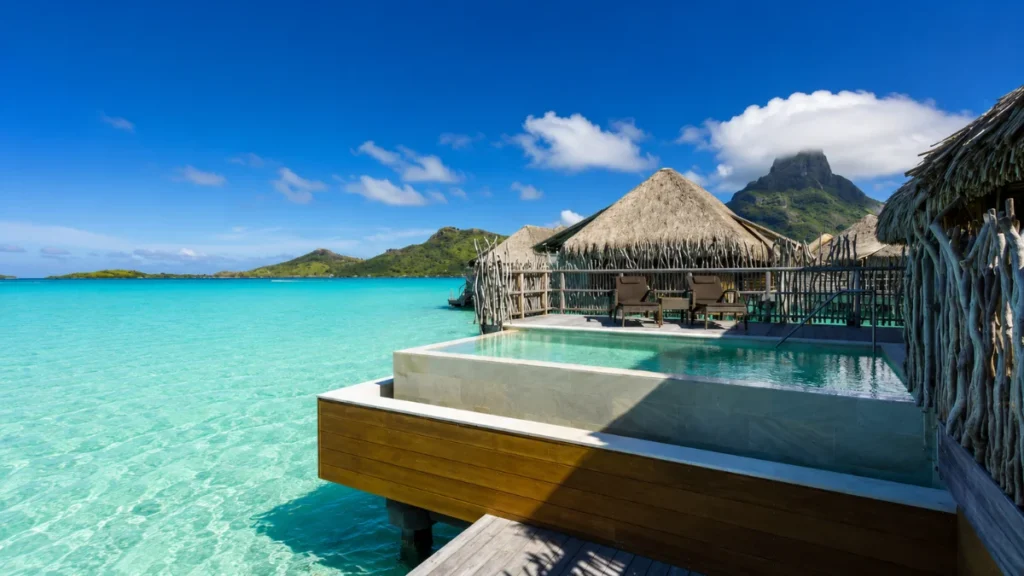
A short trip to French Polynesia can feel difficult to justify. International flights are often expensive, the islands are remote, and many travelers worry that four, five, or seven days will disappear into transfers before the holiday has properly begun.
French Polynesia can be worthwhile on a short trip when you keep the itinerary simple, choose one main island or one easy island pairing, and allow at least four usable nights. It is less rewarding when several islands are compressed into a rushed schedule, because transfers can consume the time and calm that make the destination memorable.
The decision is complicated by the way French Polynesia is usually presented. Social media often compresses the experience into overwater villas, bright lagoons, and perfectly still mornings. Real travel also includes long arrival days, changing weather, expensive meals, domestic connections, and stretches of quiet that will feel restorative to some travelers and too slow to others.
This article looks honestly at whether French Polynesia is worth visiting on a short trip, what different trip lengths actually feel like, which islands make the most sense, how budget and transfers affect value, and who is most likely to return home feeling the journey was worthwhile.
Is French Polynesia Worth Visiting on a Short Trip?
Yes, French Polynesia can be worth visiting on a short trip, but the answer depends more on itinerary design than on the number of nights alone. Five nights based on one island can feel calmer and more complete than seven nights divided across three islands.
A short visit works best when the purpose is clear. You may want a few deeply scenic days in Moorea, a special lagoon stay in Bora Bora, or a slower combination of Tahiti and Moorea. It works less well when the trip becomes a race to collect famous island names.
The destination is not built around fast sightseeing. Its value comes from atmosphere: the colour and scale of the lagoons, quiet mornings, mountain views, warm local interactions, boat journeys, unhurried meals, and the gradual feeling of being somewhere far removed from ordinary routines.
For that reason, a short French Polynesia vacation should feel selective rather than ambitious. The goal is not to see everything. It is to experience one part of the destination properly.
The Real Pacific Travel Reality Check
French Polynesia is spread across a vast area of the Pacific. Most international journeys begin on Tahiti, and travelers continuing to islands such as Bora Bora usually need a domestic flight. Moorea is closer and can be reached from Tahiti without the same level of domestic flight planning, which is one reason it suits shorter itineraries.
Arrival and departure days rarely feel like full holiday days. Immigration, baggage collection, airport transfers, ferry or domestic flight connections, hotel check-in, and jet lag can reduce the amount of usable time. A trip advertised as six days may offer only four genuinely open days once travel is considered.
Transport is usually manageable, but it is not endlessly flexible. Domestic schedules, ferry times, hotel transfers, and boat connections need to fit together. A delayed arrival or weather change can have more impact on a compact itinerary than on a longer stay.
Costs also feel different in a remote island destination. Imported food, resort meals, domestic flights, transfers, and lagoon activities can add up quickly. Shortening the trip reduces accommodation costs, but it does not remove the major cost of reaching French Polynesia in the first place.
None of this means a short trip is a poor idea. It means the itinerary should respect the realities of Pacific travel. Simplicity creates value; rushing usually reduces it.
What Many Travel Articles Miss
Many travel articles focus on what you can fit into a day. In French Polynesia, that can be the wrong way to measure a trip. A schedule filled with viewpoints, tours, restaurants, and island transfers may look efficient, but it can leave little space for the destination’s slower emotional appeal.
The islands also feel different from one another. Tahiti can feel active, practical, and locally lived-in. Moorea often feels accessible, green, relaxed, and varied. Bora Bora can feel more polished, lagoon-centred, romantic, and resort-driven. A short trip becomes much more satisfying when the island atmosphere matches what the traveler actually wants.
Another point often missed is that “worth it” is personal. A traveler who values dramatic scenery, water-based experiences, quiet evenings, and a strong sense of remoteness may find five days deeply memorable. Someone seeking nightlife, inexpensive dining, constant sightseeing, and spontaneous transport may feel the same trip offers limited value.
A pattern that appears repeatedly in traveler accounts is that people are more likely to regret moving too quickly than staying on one island for an extra night. The memories they describe most clearly are often not the number of islands visited, but the moment the trip finally slowed down enough to feel real.
French Polynesia is not automatically worthwhile because it is famous. It becomes worthwhile when expectations, budget, pace, and island choice align.
French Polynesia on a Short Trip: Expectation vs Reality
Travelers often imagine that a short visit will be a concentrated version of everything French Polynesia represents. In reality, the experience is usually more selective. You may have time for one island atmosphere, one major lagoon experience, and a few memorable slow moments rather than a complete tour of the destination.
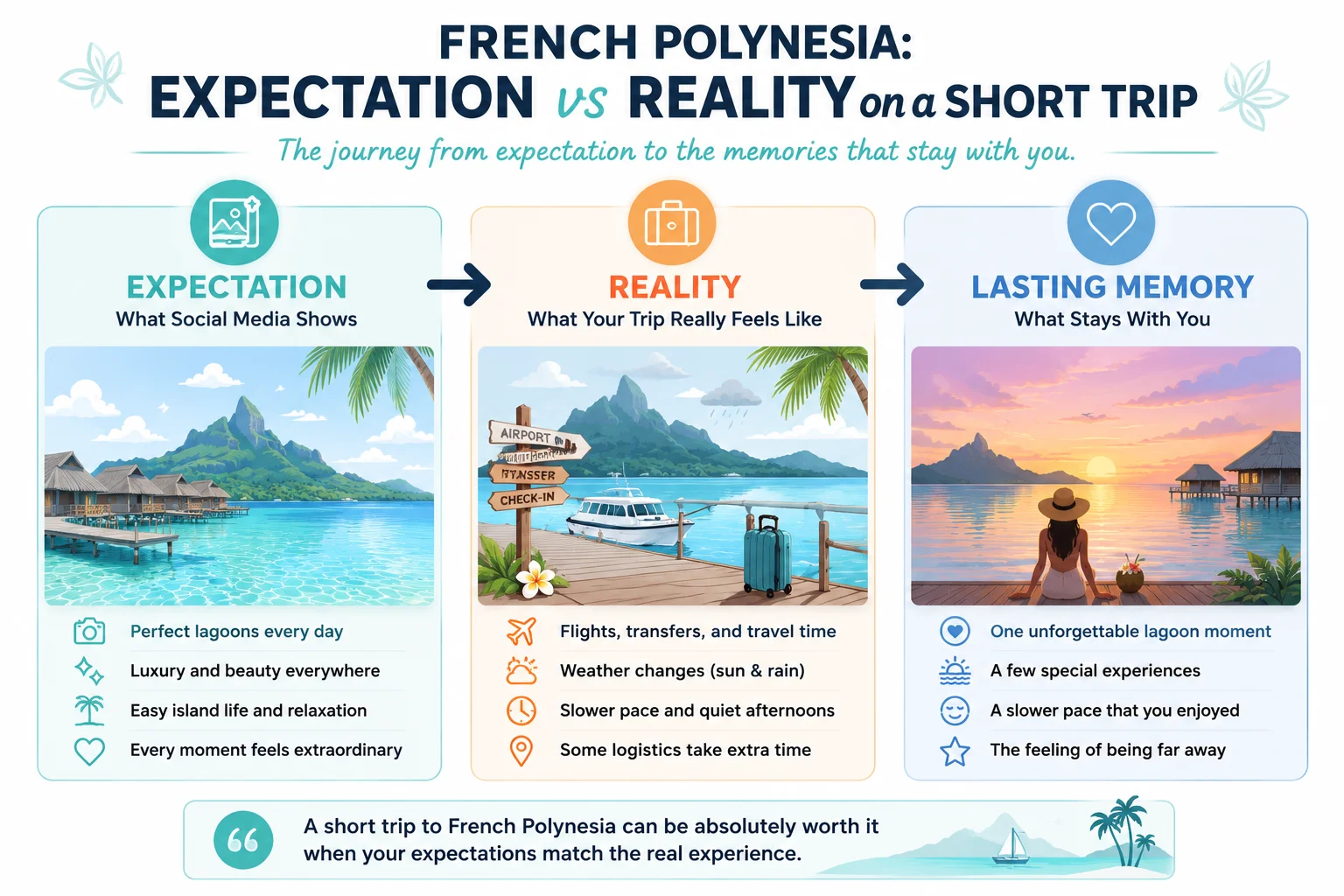
| What Travelers Often Expect | What a Short Trip Often Feels Like |
|---|---|
| Several islands in one easy itinerary | One main island, or two carefully paired islands, usually feels more comfortable |
| Every day will look like a perfect resort photo | Bright lagoon moments may be mixed with cloud, wind, rain, transfers, and ordinary island life |
| Shorter travel means a much cheaper holiday | Fewer hotel nights help, but international flights and transfers remain major costs |
| Bora Bora is essential | Moorea or Tahiti may deliver better overall value when time is limited |
| A busy itinerary will make the journey feel worthwhile | Fewer plans often create a stronger sense of place and a more relaxing memory |
Social media rarely shows the waiting, packing, airport movement, changing skies, or the cost of moving between islands. It also does not always show the quieter value of staying still: returning to the same beach, recognizing the view from your accommodation, or having enough time for a spontaneous local conversation.
What a Short French Polynesia Trip Actually Feels Like
A well-planned short trip often feels calm, vivid, and slightly dreamlike because the scenery changes so quickly from ordinary travel environments. Mountain ridges rise sharply behind lagoons, water colours shift with depth and weather, and even routine transfers can feel scenic.
The atmosphere is usually quieter than many first-time visitors expect. Outside busier parts of Tahiti, evenings can be peaceful. Resort areas may feel polished and private, while smaller guesthouses and local neighbourhoods can feel more personal, simple, and connected to everyday island life.
French Polynesia often feels more remote than Fiji or Hawaii. That remoteness can create a powerful sense of escape, but it also means fewer casual alternatives when a restaurant is closed, a tour is full, or transport does not match your preferred time.
The weather mood matters too. Under bright sun, the lagoons can look intensely clear and colourful. Under cloud, the islands can feel softer, greener, and more dramatic. Passing rain does not necessarily remove the beauty, but travelers expecting continuous postcard conditions may need to adjust.
Local interactions can be warm and understated. The experience is not always highly social in the way some Fiji resort holidays can feel. French Polynesia may stay in the memory more through scenery, atmosphere, privacy, and quiet moments than through constant group energy. Our comparison of Fiji vs French Polynesia: Which Feels More Memorable? explores this difference in more detail.
How Different Short Trip Lengths Feel
The number of nights matters, but usable time matters more. An evening arrival followed by an early departure can make a five-night booking feel closer to three full days.
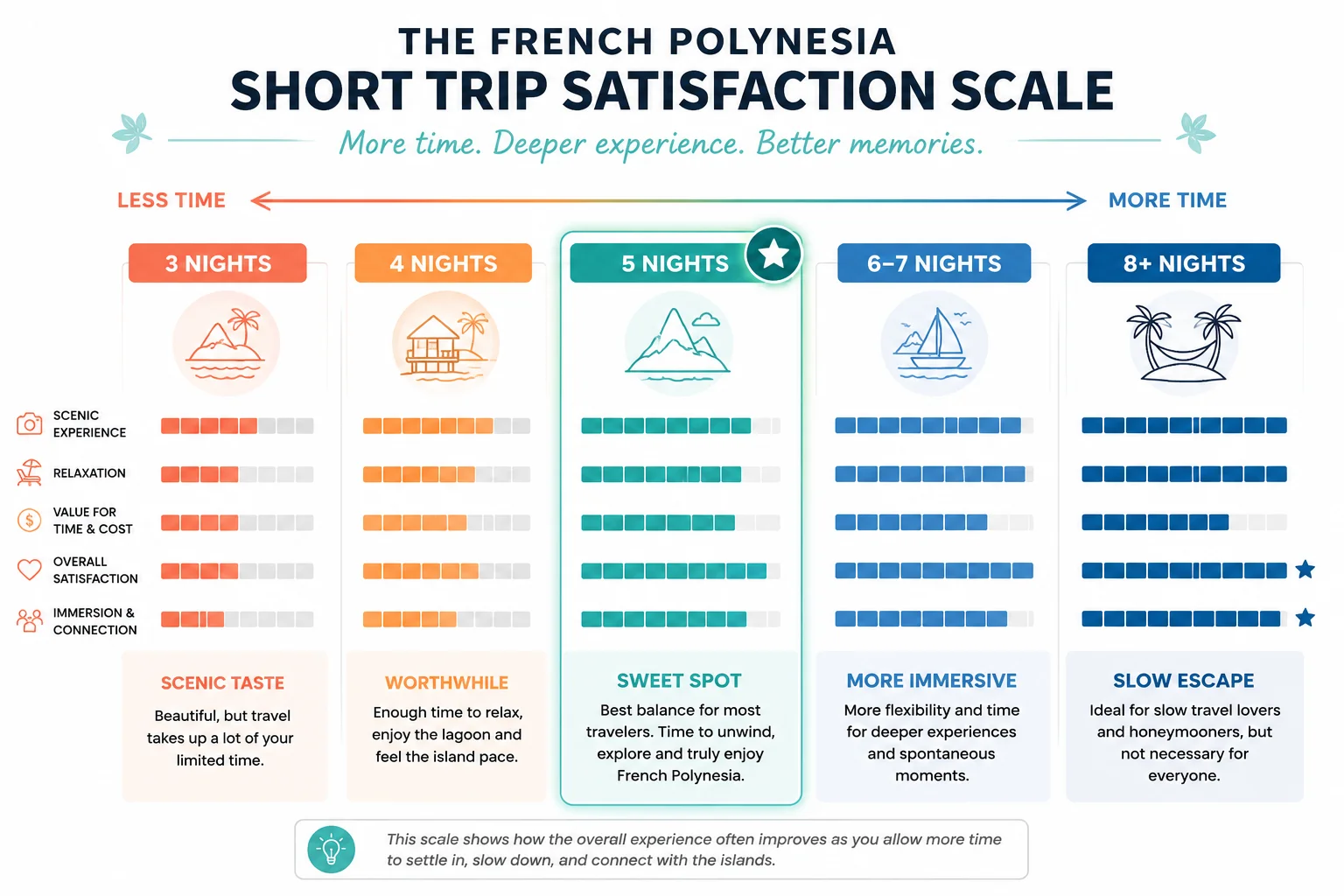
| Trip Length | Realistic Island Plan | What It Often Feels Like |
|---|---|---|
| 3 nights | Tahiti only, or a tightly planned Moorea stay | A scenic taste, but travel can dominate the experience |
| 4 nights | One island | Compact but worthwhile when transfers are simple |
| 5 nights | One island, or Tahiti plus Moorea | A good short-trip balance with time to slow down |
| 6 to 7 nights | One island deeply, or two islands carefully | More complete, flexible, and less vulnerable to one disrupted day |
| 8 to 9 nights | Two islands comfortably | Still relatively short, but much more settled and immersive |
Three Nights
Three nights is possible, but it should usually be treated as a stopover or a focused extension rather than a full French Polynesia holiday. It may work for travelers already passing through the region, but it is difficult to justify as a stand-alone long-haul journey unless flight access is unusually convenient.
With only three nights, staying near your arrival point or choosing a simple Moorea plan makes more sense than adding Bora Bora. The trip can still be beautiful, but it may feel as though you have only just arrived when it is time to leave.
Four to Five Nights
Four to five nights is the practical minimum for many travelers. It gives enough time for one lagoon or island tour, one or two unplanned days, some local food, and a genuine sense of the island’s pace.
Five nights in Moorea can feel varied because the island offers mountain scenery, lagoon activities, road access, beaches, viewpoints, and local places to eat. Five nights in Bora Bora may feel more resort-focused and visually dramatic, but usually at a higher cost.
Six to Seven Nights
A week is where French Polynesia begins to feel less like a rushed visit and more like a real holiday. Travelers can spend the whole week on one island or combine Tahiti and Moorea without making every transfer feel urgent.
Bora Bora can also fit into a one-week trip, although adding it usually increases both cost and logistical pressure. Travelers deciding how much time to give the island may find How Many Days Do You Really Need in Bora Bora? helpful.
Which Islands Work Best for a Short Visit?
Not every French Polynesian island suits a compact itinerary equally. The best choice depends on how much transfer time you are willing to accept and whether you want variety, resort relaxation, culture, scenery, or lagoon experiences.
| Island | Short-Trip Strength | Main Tradeoff | Best Suited To |
|---|---|---|---|
| Tahiti | International arrival point, local life, markets, food, waterfalls, and easier logistics | Less like the quiet lagoon escape many travelers imagine | Very short stays, cultural interest, practical stopovers, and travelers wanting a more lived-in feel |
| Moorea | Easy pairing with Tahiti, strong scenery, beaches, activities, and accommodation variety | Some areas feel busier and less exclusive than Bora Bora | First-time visitors, couples, independent travelers, and value-conscious short trips |
| Bora Bora | Iconic lagoon, romantic atmosphere, polished resorts, and a strong sense of occasion | Higher costs and an additional domestic connection | Honeymoons, special celebrations, resort travelers, and lagoon-focused stays |
| Huahine | Quiet, local, green, and less polished | Less convenient for travelers wanting famous resort experiences or broad activity choice | Repeat visitors, slower travelers, and those seeking a more understated island atmosphere |
Tahiti for the Simplest Logistics
Tahiti is often treated only as a gateway, but it can make sense when the trip is extremely short. It offers markets, local restaurants, mountain scenery, waterfalls, black-sand beaches, and a stronger sense of daily Polynesian life than a self-contained resort island.
The tradeoff is expectation. Travelers imagining overwater bungalows and a quiet turquoise lagoon may feel Tahiti is more urban, active, and practical. Our article Is Tahiti Worth Visiting Without Staying in Luxury Resorts? explains why the island can still be rewarding beyond its role as an arrival point.
Moorea for the Best Short-Trip Balance
Moorea is often the strongest choice for a first short trip because it combines dramatic mountain scenery, lagoon access, road-based exploring, beaches, guesthouses, resorts, and simpler connections from Tahiti.
It can feel less polished than Bora Bora in places, but that can work in its favour. Travelers are more likely to move around independently, see ordinary island life, stop at roadside places, and experience a wider range of settings within a limited number of days.
Bora Bora for a Focused Special Trip
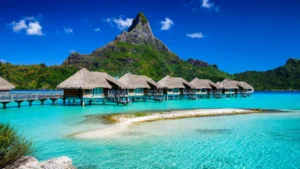
Bora Bora can absolutely be worth including when the trip is built around it. The lagoon is the central experience, and the island often feels calm, romantic, polished, and visually extraordinary.
However, it is not automatically the best use of limited time or money. The domestic connection, transfers, resort prices, and quieter activity range mean it works best when the traveler actively wants a lagoon-and-resort experience. For a fuller comparison, see Bora Bora vs Moorea: Which Is More Worth It?.
Should You Visit One Island or Two?
For four nights, one island is usually the better choice. For five to seven nights, Tahiti and Moorea can form a realistic pairing because the transfer is relatively simple. Combining Moorea and Bora Bora in a short itinerary is possible, but it creates more packing, airport time, check-ins, and schedule dependence.
Two islands can be worthwhile when they offer clearly different experiences. Tahiti may provide local life and food, while Moorea provides a slower lagoon-and-mountain stay. Moorea and Bora Bora can provide contrast between a more varied, independent island and a more polished, resort-centred one.
The danger is treating movement as an achievement. Each island transfer interrupts the rhythm. On a short trip, the hours spent checking out, traveling, waiting, and checking in can matter more than travelers expect.
A useful rule is to avoid changing islands unless you will have at least three nights in the second destination. Anything shorter may feel like an expensive transfer for a brief impression.
Does a Short Trip Offer Good Value?
A short trip lowers the total cost, but it does not always create strong value per day. International flights remain expensive whether you stay four nights or ten. Domestic flights, airport transfers, and some tours also carry fixed costs that become harder to justify when spread across fewer days.
Accommodation style has a major effect. A short stay in a modest guesthouse on Moorea may feel financially sensible because the traveler can spend on one or two meaningful activities. A short stay in a high-end Bora Bora resort can become expensive very quickly, especially when meals and transfers are tied to the resort environment.
| Budget Decision | How It Affects a Short Trip | More Realistic Approach |
|---|---|---|
| Adding several islands | Raises domestic transport and transfer costs | Choose one island or one simple pairing |
| Booking only luxury resorts | Can make every extra night feel financially heavy | Mix a guesthouse or standard hotel with one special stay |
| Eating every meal at a resort | Reduces flexibility and increases daily spending | Choose accommodation near local food options where possible |
| Booking an activity every day | Adds cost and can make the trip feel rushed | Select one or two high-value experiences and leave space for the island itself |
| Choosing the cheapest flight connection | May create longer layovers and reduce usable holiday time | Compare total journey time, not only the fare |
The best value is not always the lowest total price. It is the itinerary that gives enough usable time, the right atmosphere, and at least one experience you will remember without creating financial stress.
Travelers comparing French Polynesia with other one-week Pacific options may also find Which Pacific Islands Are Best for a One-Week Trip? useful.
Who Is a Short Trip Best Suited To?
A short French Polynesia trip suits travelers who can enjoy depth without needing variety. It rewards people who are comfortable spending a morning by the lagoon, repeating a favourite view, having an early evening, and allowing the destination to feel quiet.
It also suits travelers adding French Polynesia to a wider journey, couples marking a special occasion, Australians and New Zealanders with more manageable flight access, and travelers who understand that they are paying partly for remoteness and atmosphere.
It may be less satisfying for travelers using most of their annual leave on a long-haul journey from Europe or North America unless they can stay closer to a week. The further the journey, the more important it becomes to protect usable time after arrival.
Best For and Not Ideal For
French Polynesia can create a strong short-trip memory, but only when its pace and costs suit the traveler.
Best For
- Couples wanting a quiet and scenic escape
- Travelers comfortable focusing on one island
- People who value lagoons, mountain scenery, snorkeling, and boat experiences
- Travelers who enjoy calm evenings and slower days
- Visitors planning a special celebration or memorable stopover
- Travelers willing to spend more for remoteness and atmosphere
Not Ideal For
- Travelers who want several islands in only a few days
- Visitors on a very strict budget
- People seeking nightlife, shopping, and constant entertainment
- Travelers who become frustrated by limited transport choices
- Visitors expecting perfect weather throughout a compact stay
- Long-haul travelers with fewer than four usable nights after flights
A Realistic Short-Trip Planning Approach
The strongest short itineraries are built around usable time rather than the number printed on a booking confirmation. Count the days after arrival, before departure, and between any island transfers.
- Choose one island for trips of four nights or fewer.
- Consider Tahiti and Moorea for five to seven nights if you want two settings without a complicated domestic flight plan.
- Choose Bora Bora only when its lagoon and resort atmosphere are central to the reason for traveling.
- Leave at least one day without a fixed tour so weather or fatigue does not control the whole itinerary.
- Compare accommodation location as carefully as price, because nearby food and transport options can change the experience.
- Pre-book essential transfers, but avoid filling every hour.
- Budget separately for domestic travel, meals, tours, and airport or boat transfers.
- Use arrival and departure nights strategically rather than expecting them to feel like full sightseeing days.
A realistic five-night trip might mean one night on Tahiti after arrival followed by four nights on Moorea. A seven-night trip might mean two nights on Tahiti and five on Moorea, or three nights on Moorea followed by four in Bora Bora if the budget and flight timing support it.
The right itinerary does not need to look impressive on paper. It needs to feel good while you are actually traveling.
Many short-trip disappointments come from planning for maximum coverage rather than maximum usable time. In practice, travelers often remember one relaxed lagoon day, one memorable meal, or one unhurried island drive more clearly than a tightly scheduled list of stops.
What One Week Actually Looks Like
A seven-night booking can sound generous, but the usable holiday time becomes clearer when the travel sequence is shown visually. This is especially important for visitors arriving after a long international journey or adding a second island.
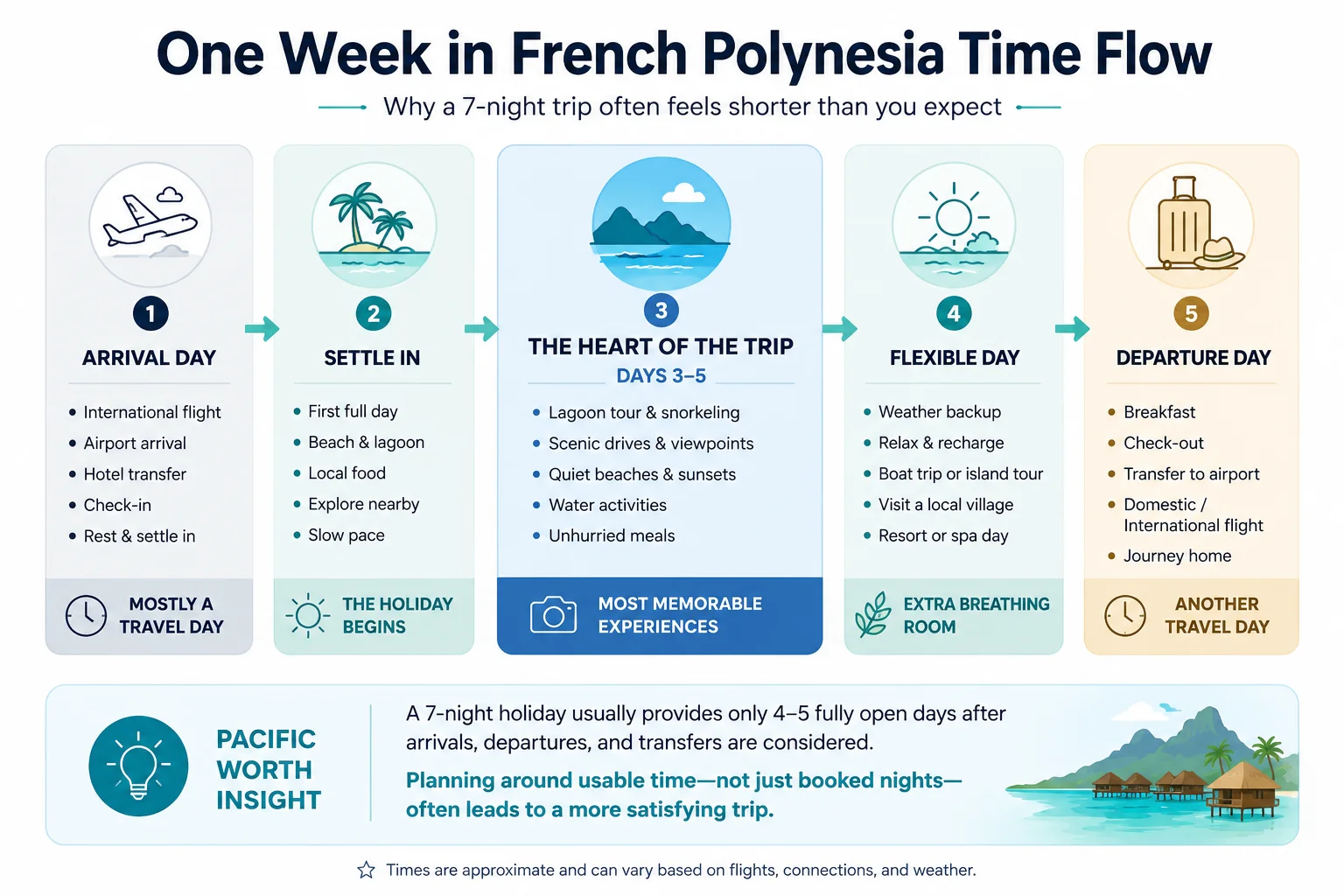
| Day | Realistic Use of Time | How It May Feel |
|---|---|---|
| Day 1 | International arrival, baggage, transfer, check-in, and recovery | Mostly a transition day rather than a full holiday day |
| Day 2 | First full island day | The trip begins to feel settled |
| Days 3–5 | Main lagoon, island, food, and relaxation experiences | The strongest and most memorable part of the short trip |
| Day 6 | Final flexible day or second-island experience | Useful protection against weather, fatigue, or schedule changes |
| Day 7 | Check-out, transfer, airport, and departure | Usually not a complete sightseeing day |
This is why a one-week trip can still feel compact. Seven nights may provide only four or five fully open days, especially when an island transfer is included. The visual is not meant to discourage a short trip; it helps travelers plan those days more honestly.
A Quick Pacific Comparison for One-Week Travelers
| Destination | What a One-Week Trip Often Prioritizes | Usually Best For |
|---|---|---|
| French Polynesia | Atmosphere, lagoons, scenery, privacy, and a slower sense of escape | Couples, scenic travelers, and people comfortable doing less |
| Fiji | Resort variety, warm social energy, activities, and easier family-friendly choices | Families, first-time Pacific travelers, and visitors wanting a broader activity mix |
| Hawaii | Convenience, sightseeing variety, dining, beaches, and stronger infrastructure | Travelers wanting flexibility, road trips, and a faster-paced island holiday |
This comparison does not make one destination better than another. It shows why French Polynesia can feel worth the journey for travelers seeking atmosphere and remoteness, while Fiji or Hawaii may feel more practical for those wanting convenience, activity variety, or easier logistics.
Common Traveler Misunderstandings
One common misunderstanding is that French Polynesia is a single island experience. It is a large destination made up of islands with different atmospheres, transport needs, price levels, and styles of tourism.
Another is that Bora Bora must be included for the trip to count. Bora Bora is visually remarkable, but Moorea may offer a more rounded short holiday with easier movement, more accommodation variety, and a broader sense of island life.
Travelers also sometimes assume a short stay will solve the cost problem. It reduces the number of hotel nights, but flights and transfers remain. A slightly longer stay in simpler accommodation may provide better value than a compressed luxury itinerary.
Perfect weather is another unrealistic expectation. French Polynesia is tropical, and cloud, humidity, showers, wind, and seasonal variation are normal. A short trip should include enough flexibility that one wet or windy day does not feel like the entire holiday has failed.
Finally, island hopping is not always the best way to create variety. Staying on Moorea and exploring different coasts, viewpoints, beaches, and local areas may feel more varied than repeatedly moving between airports and hotels.
Seasonal and Local Context
French Polynesia generally has a drier, cooler period and a warmer, wetter period, but tropical weather does not follow a perfect schedule. Drier months can bring more comfortable conditions and stronger demand, while wetter months can feel greener, quieter, more humid, and less predictable.
Season matters more on a short trip because there is less time for conditions to change. A week gives some flexibility if a lagoon tour is moved. Three or four nights provide much less room.
School holidays and popular travel periods can raise accommodation prices and reduce availability. Shoulder periods may offer a calmer atmosphere, although travelers should still plan for variable weather rather than expecting a guaranteed bargain with perfect conditions.
Whale-watching seasons, diving conditions, lagoon visibility, and surf conditions can also shape which island or activity feels most worthwhile. These are useful factors, but they should support the itinerary rather than overload it.
Pacific Worth Note: I think a short trip to French Polynesia becomes more meaningful when travelers stop trying to prove they have seen enough. One island experienced with time and attention can leave a stronger memory than several famous places visited in a hurry.
Frequently Asked Questions
Is French Polynesia Worth Visiting on a Short Trip?
Yes, it can be worthwhile when you have at least four usable nights, keep the itinerary simple, and choose an island that matches your priorities. A rushed multi-island schedule is less likely to provide good value.
What is the minimum number of days for French Polynesia?
Four to five nights is a practical minimum for most travelers. Three nights can work as a stopover, but may feel too short after international travel and transfers.
Is five days enough for Tahiti and Moorea?
Five days can work if the schedule is simple. Many travelers would be better spending one arrival night on Tahiti and the remaining nights on Moorea rather than trying to explore both islands extensively.
Should I choose Moorea or Bora Bora for a short trip?
Moorea usually offers better short-trip flexibility, easier access, varied scenery, and broader accommodation choices. Bora Bora is better when the lagoon, romance, and resort experience are the main purpose of the journey.
Is French Polynesia too expensive for only one week?
It can still be worthwhile for one week, but value depends on flight cost, accommodation style, and island transfers. One island or a simple Tahiti–Moorea itinerary often provides better value than adding several domestic flights.
Final Thoughts
So, is French Polynesia worth visiting on a short trip? For the right traveler, yes. A focused stay of four to seven nights can deliver dramatic scenery, lagoon experiences, quiet island atmosphere, and a genuine feeling of distance from everyday life.
The strongest short trips do not try to cover all of French Polynesia. They choose one main island, protect usable time, allow for weather and transport, and accept that the destination’s appeal is slower than a conventional sightseeing holiday.
That is also why travelers often return describing a feeling rather than an itinerary: the colour of the lagoon, the quiet after sunset, or the relief of having nowhere else to be that day.
Moorea is often the most balanced choice for first-time visitors with limited time. Tahiti can suit a very short or more locally focused visit. Bora Bora can be worth the extra cost and connection when its lagoon and resort atmosphere are the main reason for traveling.
The journey may feel less worthwhile if you are chasing several islands, expecting low prices, or hoping for nonstop entertainment. It can feel deeply worthwhile if you value scenery, stillness, water, thoughtful experiences, and a trip that is memorable because of how it felt rather than how much you managed to fit into it.
Leave a Reply