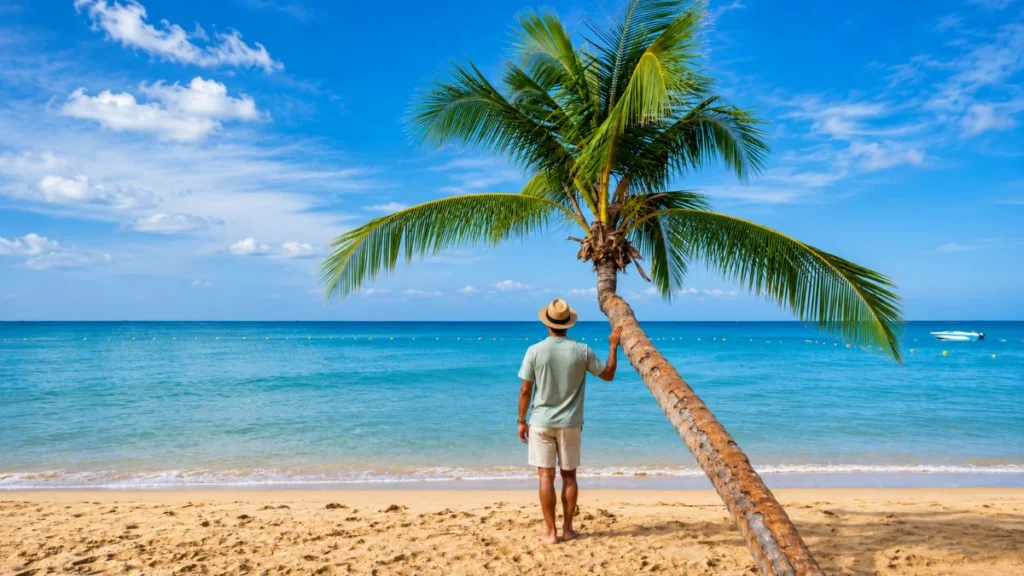
Many travelers compare Tonga and Samoa because both seem to promise the kind of quiet tropical travel that feels far away from crowded resorts and busy holiday destinations. Both can offer warm weather, island scenery, relaxed days, and a slower Pacific rhythm.
Tonga is usually the better choice for travelers who want deep quiet, fewer crowds, and a more remote Pacific feel. Samoa is often better for travelers who still want a peaceful tropical trip, but with easier planning, more cultural interaction, and a little more comfort around them.
This comparison can feel confusing because travel photos often make Tonga and Samoa look similar. Blue water, palm trees, empty-looking beaches, and tropical sunsets can hide the real differences in atmosphere, transport, accommodation, local interaction, and daily pacing.
This article compares Tonga and Samoa in a realistic way, looking at what each destination genuinely feels like, who each one suits best, and which kind of quiet tropical trip may be more worth the journey for you.
Tonga vs Samoa: Quick Comparison
If you are choosing between Tonga and Samoa for a quiet tropical holiday, it helps to begin with the broad personality of each destination. Both can feel peaceful, but the feeling is not exactly the same.
| Factor | Tonga | Samoa |
|---|---|---|
| Overall Atmosphere | Remote, quiet, slow, and less developed for tourism | Relaxed, cultural, welcoming, and easier to settle into |
| Best For | Travelers wanting solitude, fewer crowds, and a stronger sense of disconnection | Travelers wanting quiet travel with culture, comfort, and simpler logistics |
| Quiet Feeling | More isolated and still | More social, local, and culturally calm |
| Travel Ease | Can require more patience and flexibility | Usually easier for first-time Pacific travelers |
| Accommodation Feel | Simple, smaller-scale, and often understated | More varied, with beach fales, guesthouses, resorts, and family stays |
| Crowd Levels | Usually very low | Usually low, but more visitor-friendly in popular areas |
| Best Trip Mood | Disconnecting, slowing down, and accepting remoteness | Resting, exploring gently, and experiencing local culture |
This table does not mean one destination is better. It simply shows how different kinds of quiet travel can feel.
The Real Pacific Travel Reality Check
Quiet Pacific travel can be deeply rewarding, but it is not always smooth in the way some travelers expect. Flights may be limited, transport may move slowly, weather can shift quickly, and island services may not operate with the same urgency found in larger tourism destinations.
This slower rhythm is part of what makes Tonga and Samoa feel different from heavily developed tropical holiday spots. The quietness often comes with fewer crowds, fewer distractions, and less pressure to rush from one attraction to another.
At the same time, visitors should expect some practical tradeoffs. Imported goods can be expensive. Some accommodation may be simple. Transfers can require planning. Internet service may not always feel fast or reliable, especially outside main areas.
The travelers who enjoy Tonga and Samoa most are usually not trying to control every hour of the trip. They allow room for weather, local timing, slower meals, quiet afternoons, and unplanned moments.
What Many Travel Articles Miss About Quiet Island Travel
Many travel articles describe quiet island destinations as if peace always means empty beaches and perfect silence. That is only one version of quiet travel.
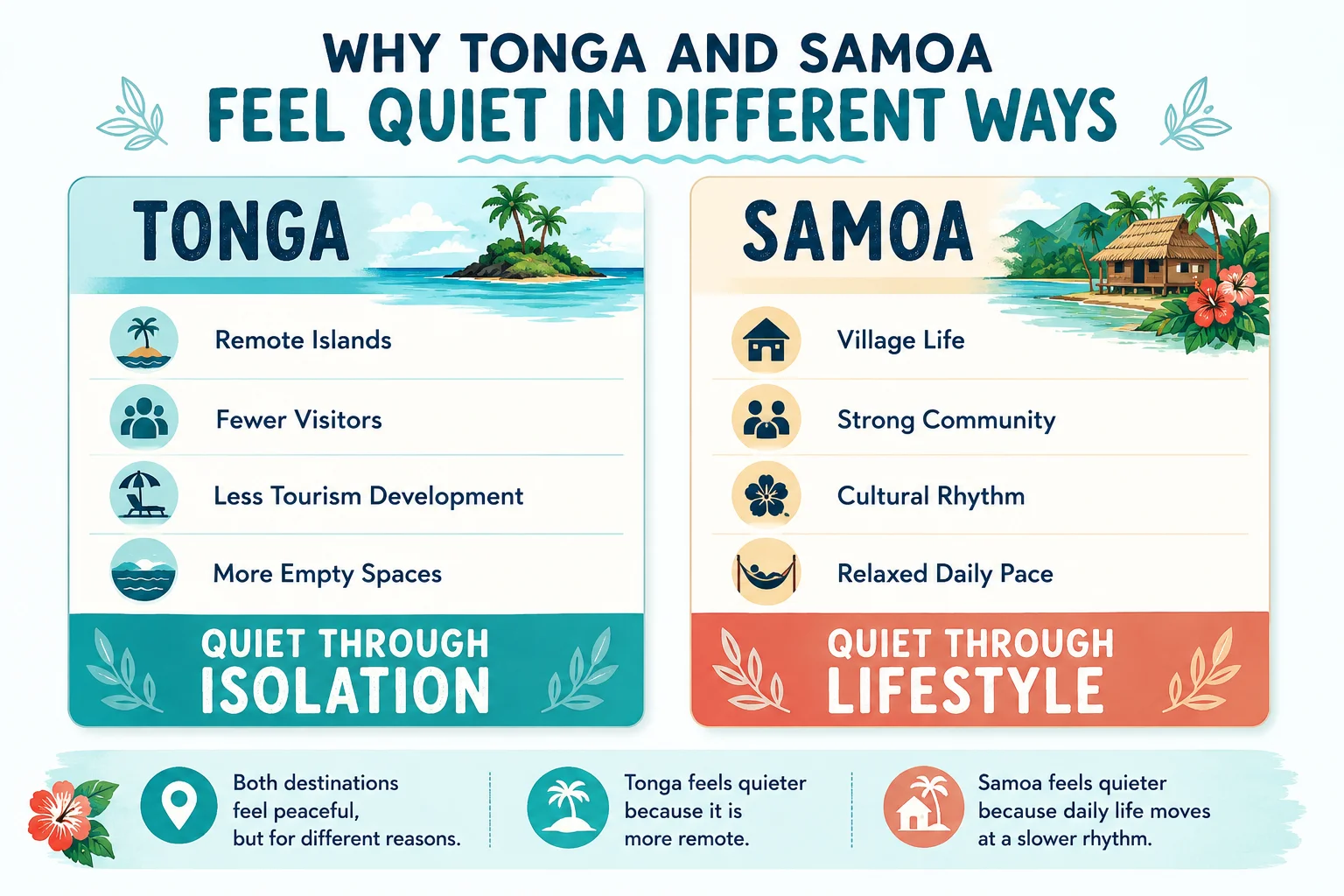
In Tonga, quiet often comes from remoteness. There may be fewer visitors, fewer polished tourist areas, and a stronger feeling of being away from mainstream travel. This can feel peaceful, but it can also feel very simple.
In Samoa, quiet often comes from rhythm. Village life, family routines, church days, beach fales, local food, and relaxed travel routes create a calm feeling that is not completely isolated. Samoa can feel peaceful without feeling empty.
This difference matters because some travelers want solitude, while others want calm with culture and comfort nearby.
Tonga vs Samoa Expectation vs Reality
Travelers often expect both destinations to offer the same kind of tropical peace. In reality, Tonga and Samoa can create very different emotional experiences.
| What Travelers Often Expect | What the Experience Often Feels Like |
|---|---|
| Both islands will feel almost the same | Tonga often feels more remote, while Samoa often feels more cultural and accessible |
| Quiet travel means doing almost nothing | Quiet travel can include village life, coastal drives, swimming, markets, and slow local routines |
| Empty beaches will be easy to find everywhere | Tonga may offer stronger solitude, while Samoa may combine beaches with local community life |
| Transport will be simple and quick | Island transport can require patience, especially in more remote areas |
| Resorts will define the whole trip | The real feeling often comes from the wider island atmosphere, not only where you stay |
| Weather will stay perfect every day | Tropical weather can shift, even during better travel months |
This does not make either destination disappointing. It simply means expectations matter. A traveler expecting polished resort convenience may judge these islands differently from someone seeking slower, more grounded Pacific travel.
Atmosphere and Feel: The Biggest Difference
Tonga often feels quieter in a more remote and stripped-back way. There may be fewer visitors, fewer commercial distractions, and a deeper sense of distance from mainstream tourism. For some travelers, that is exactly the appeal.
The pace in Tonga can feel very slow. Days may involve simple meals, quiet roads, local villages, coastal views, and long periods where not much seems to happen. This can feel restorative if you are ready for it.
Samoa feels calm too, but usually with more movement around you. Villages, beach fales, markets, churches, waterfalls, swimming holes, and roadside life create a gentle sense of activity. It is not busy in a big-city way, but it often feels more socially present than Tonga.
This makes Samoa a strong choice for travelers who want peaceful travel without feeling too far from culture, people, and basic visitor services.
Why Tonga and Samoa Feel Quiet in Different Ways
The quietness in Tonga often comes from space, distance, and fewer visitors. The quietness in Samoa often comes from rhythm, culture, and a slower daily pace.
This difference is important because a traveler who loves Samoa may not automatically love Tonga, and a traveler who loves Tonga may find Samoa slightly more active than expected.
If your idea of quiet travel is waking up with very few plans and spending long hours in stillness, Tonga may feel closer to what you want. If your idea of quiet travel includes local culture, gentle exploring, and a relaxed but not empty atmosphere, Samoa may feel more natural.
A Typical Day in Tonga vs Samoa
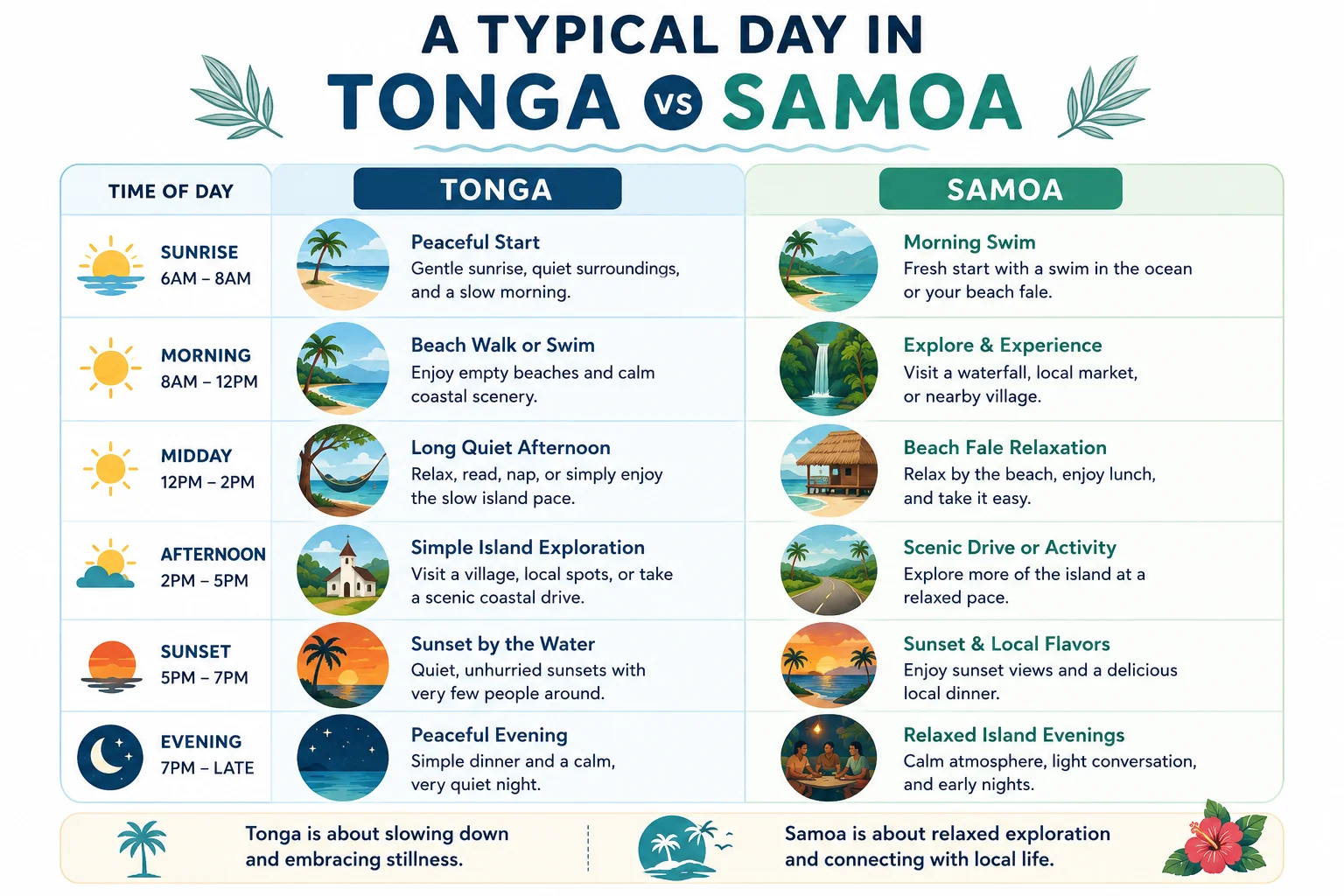
A typical quiet day in Tonga may feel simple and slow. You might take a quiet beach walk, visit a local area, rest during the warmest part of the day, and have a simple dinner without much nightlife or noise around you.
A typical quiet day in Samoa may feel a little fuller. You might swim in the morning, visit a waterfall or local market, drive through villages, relax at a beach fale, and end the day watching the light change over the coast.
| Part of the Day | Tonga | Samoa |
|---|---|---|
| Morning | Slow breakfast, quiet beach, or coastal walk | Swimming, local breakfast, village drive, or market visit |
| Midday | Rest, simple exploring, or quiet time near the water | Waterfall, swimming hole, beach fale, or scenic drive |
| Afternoon | Unhurried local movement and very little pressure to do more | Gentle exploring mixed with rest and local scenery |
| Evening | Simple dinner and a very quiet night | Relaxed meal, coastal sunset, and calm social atmosphere |
| Overall Feeling | More still and remote | More culturally active but still relaxed |
This is where the choice becomes clearer. Tonga may suit travelers who want to slow down deeply. Samoa may suit travelers who want quiet days with more gentle variety.
Beaches and Coastal Atmosphere
Both Tonga and Samoa can offer beautiful coastal scenery, but the feeling around the beaches can be different.
In Tonga, beaches can feel quieter and more removed from visitor activity. There may be fewer people around, which can create a stronger feeling of solitude. This is ideal for travelers who want to escape the feeling of being part of a tourist crowd.
In Samoa, beach experiences are often connected to beach fales, villages, families, and local routines. You may still find calm beach time, but it can feel more socially connected than isolated.
If your perfect tropical day means seeing very few people, Tonga may be more appealing. If you enjoy quiet beaches with a sense of local life nearby, Samoa may feel more rewarding.
Culture and Local Interactions
Samoa often stands out for travelers who want a quiet trip with strong cultural presence. Local customs, family structure, village life, churches, and traditional routines shape the atmosphere in a visible way.
This does not mean Samoa feels like a staged cultural show. Much of the cultural feeling comes from ordinary daily life. Roadside villages, local shops, Sunday routines, and family-run stays all help create the destination’s personality.
Tonga also has a strong cultural identity, but for many travelers the destination’s quietness and remoteness are the main feeling they notice first. Cultural experiences may feel less packaged and less tourist-facing.
If you want calm travel with easier cultural visibility, Samoa may suit you better. If you want a quieter destination where local life feels less shaped by tourism, Tonga may be more appealing.
If Samoa is already on your shortlist, our article on Is Samoa Worth Visiting for First-Time Pacific Travelers? may help you understand the destination more clearly.
Resorts, Stays, and Comfort Expectations
Neither Tonga nor Samoa should be judged only by luxury resort standards. Both destinations can offer comfortable stays, but the overall accommodation feeling is often simpler and more locally grounded than many high-end tropical destinations.
Tonga’s accommodation scene may feel smaller and less developed. This can support the quiet atmosphere, but it also means travelers should check recent reviews carefully and avoid assuming every stay will have polished resort-style service.
Samoa usually offers a wider range of accommodation, including beach fales, guesthouses, family-run places, and resorts. This makes it easier for many travelers to match their comfort level and budget.
For quiet tropical travel, the best stay is not always the most expensive one. It is often the one that matches how much comfort, privacy, local feeling, and convenience you want.
Budget Expectations for Real Travelers
Quiet does not always mean cheap. Both Tonga and Samoa can involve costs that surprise travelers, especially when flights, transfers, imported food, tours, and accommodation are added together.
| Budget Area | Tonga | Samoa |
|---|---|---|
| Accommodation | Often limited in range, with fewer choices in some areas | Usually more varied, with more options for different budgets |
| Food Costs | Can feel expensive when relying on imported goods or limited options | Can vary depending on whether you eat locally or mainly at resorts |
| Transport | May require more patience and planning | Usually easier to manage for first-time visitors |
| Activities | Often slower and simpler, with fewer packaged options | More variety in natural, cultural, and coastal experiences |
| Budget Predictability | Can be harder if moving between islands or remote areas | Usually easier to estimate for a straightforward trip |
| Best Budget Approach | Travel slowly, keep plans simple, and avoid over-moving | Choose local stays, plan transport well, and avoid overloading activities |
Samoa may feel easier for travelers trying to manage costs because there are generally more accommodation and activity choices. Tonga can still be worthwhile, but it rewards travelers who are comfortable with fewer options and slower planning.
Which Destination Fits Your Travel Style?
The best choice depends less on which destination looks better and more on the kind of quiet you want to experience.
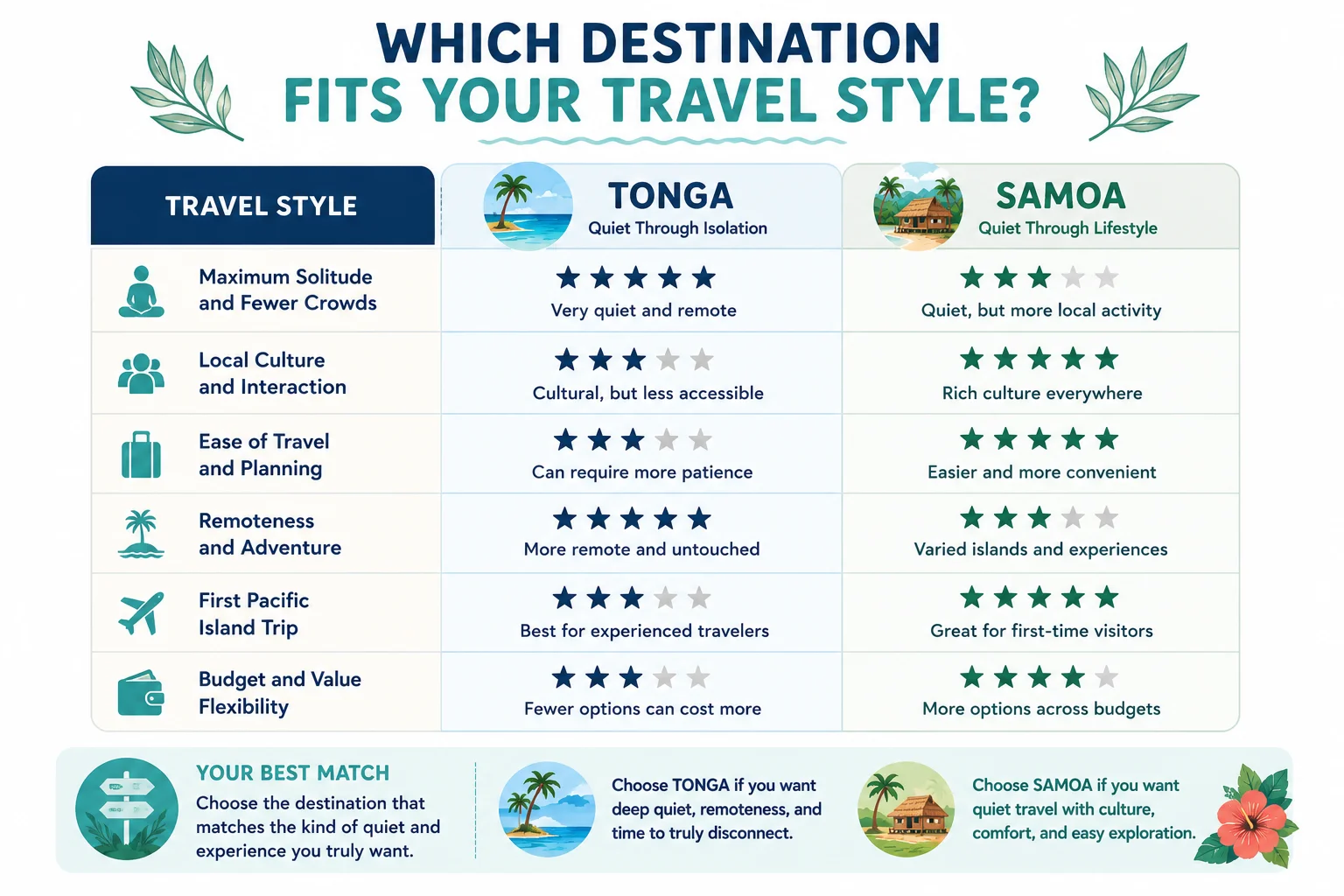
| If You Prefer… | Better Match |
|---|---|
| Maximum solitude and fewer visitors | Tonga |
| Quiet travel with cultural experiences | Samoa |
| Simpler planning and more accommodation variety | Samoa |
| A more remote and disconnected feeling | Tonga |
| Beach time with local life nearby | Samoa |
| Very slow days with fewer distractions | Tonga |
| A first Pacific island trip that still feels calm | Samoa |
| A less polished and quieter destination feel | Tonga |
This traveler-fit approach is often more useful than asking which island is objectively better. Different travelers relax in different ways.
Best For and Not Ideal For
Both destinations can be worth visiting, but they are not ideal for every traveler. Matching the destination to your personality helps prevent disappointment.
Tonga Is Best For
- Travelers who want a very quiet tropical destination
- People who enjoy remote places and fewer visitor services
- Couples who want slow days without much noise or activity
- Travelers who want to disconnect from busy routines
- Visitors who are comfortable with simpler accommodation and fewer choices
- Travelers who do not need constant tours, restaurants, or nightlife
Tonga May Not Be Ideal For
- Travelers who want polished resort convenience everywhere
- People who feel uncomfortable with limited tourism infrastructure
- Visitors with very tight schedules
- Travelers who want many restaurants, shops, and organized activities nearby
- Anyone expecting a luxury-heavy tropical destination
Samoa Is Best For
- Travelers who want quiet travel with more cultural interaction
- First-time Pacific visitors who want a softer entry into island travel
- Families, couples, and solo travelers who want relaxed daily variety
- Visitors who enjoy beach fales, villages, markets, waterfalls, and coastal drives
- Travelers who want calm without feeling too isolated
- People who want more accommodation and planning flexibility
Samoa May Not Be Ideal For
- Travelers seeking complete isolation every day
- People who want totally empty beaches everywhere
- Visitors expecting nightlife or large tourism districts
- Travelers who dislike village-based routines and slower island timing
Practical Travel Insights
Once you understand the difference in atmosphere, planning becomes easier. The goal is not to choose the destination that sounds more impressive. The goal is to choose the destination that fits your patience, budget, and preferred travel rhythm.
- Choose Tonga if your main priority is solitude, remoteness, and deep quiet.
- Choose Samoa if you want quiet travel with culture, local life, and easier planning.
- Allow at least 7–10 days for either destination if you want the trip to feel unhurried.
- Avoid overloading your itinerary with too many transfers or activities.
- Check recent accommodation reviews carefully, especially for transport and food access.
- Expect some imported goods and tourism services to cost more than in larger countries.
- Leave room for weather changes, slow timing, and relaxed island routines.
If timing matters for your Samoa plans, our article on What Is the Best Time to Visit Samoa for Good Weather? may help you plan with more realistic weather expectations.
Common Traveler Misunderstandings
One common misunderstanding is assuming that the quietest destination is always the best choice. Some travelers enjoy deep solitude, while others start to feel restricted when there are too few services, activities, or social spaces.
Another misunderstanding is thinking that Samoa is not quiet because it has more visitor infrastructure. Samoa can still feel very peaceful, but its quietness is often mixed with village life, family routines, and cultural atmosphere.
Some travelers also assume Tonga is only worth visiting during whale season. Whale experiences are a major reason people know Tonga, but the destination’s quieter atmosphere can appeal beyond that period too. For more context, you may find our article on Is Tonga Worth Visiting Beyond Whale Season? helpful.
Finally, many travelers underestimate how much mood matters. If you arrive wanting polished convenience, both destinations may feel slower than expected. If you arrive wanting space, culture, and a softer rhythm, both can feel deeply worthwhile.
Seasonal and Local Context
Tonga and Samoa both have tropical climates, which means warm weather, humidity, and changing conditions are part of the travel experience. Even in better travel months, rain showers can happen.
The drier months are usually more comfortable for beaches, drives, outdoor activities, and general travel. Wetter months can still be enjoyable, but travelers should expect more humidity, heavier showers, and possible interruptions.
Cyclone season is also worth considering when planning a Pacific trip. This does not mean travel is impossible, but it does make travel insurance, flexible plans, and realistic expectations more important.
Local events, school holidays, church days, and limited transport schedules can also affect how a trip feels. In Samoa especially, Sundays can feel very quiet and culturally distinct. In Tonga, the slower pace may feel even more noticeable if your plans depend on limited services.
Pacific Worth Note: I think the quiet difference between Tonga and Samoa is not just about how many people are around. Tonga often feels quiet because it is more remote, while Samoa often feels quiet because daily life has a slower rhythm. That small difference can change the whole feeling of a trip.
Frequently Asked Questions
Is Tonga quieter than Samoa?
Generally, yes. Tonga often feels quieter, more remote, and less developed for tourism. Samoa is still relaxed, but it usually has more visitor services, cultural activity, and easier travel options.
Is Samoa better for first-time Pacific travelers?
For many first-time Pacific travelers, Samoa may feel easier because it offers quiet travel with more accommodation variety, cultural experiences, and simpler planning.
Which is better for couples, Tonga or Samoa?
Tonga may suit couples wanting solitude and deep quiet. Samoa may suit couples wanting a calm trip with more cultural experiences, scenic drives, waterfalls, and beach fale stays.
Does Tonga feel too remote?
It depends on the traveler. Some people love Tonga’s remote feeling, while others may find the limited services and slower logistics harder than expected.
Which destination is better for quiet tropical travel?
Tonga is usually better for maximum quiet and remoteness. Samoa is often better for quiet travel with culture, comfort, and easier visitor planning.
Final Thoughts
Tonga vs Samoa for quiet tropical travel is not a simple question of which island is more beautiful. Both can be beautiful, peaceful, and worth the journey, but they create different kinds of quiet.
Tonga often feels more remote, more still, and more disconnected from mainstream tourism. It may suit travelers who want solitude, simple days, and fewer distractions.
Samoa often feels calm, cultural, and easier to move through. It may suit travelers who want quiet travel with local life, scenic variety, and a little more comfort around them.
The better choice depends on what peaceful travel means to you. If you want deep quiet, Tonga may be the stronger match. If you want quiet with culture and easier planning, Samoa may feel more rewarding.
In the end, the most worthwhile Pacific trip is not always the quietest one. It is the one whose atmosphere matches the way you genuinely want to travel.
Leave a Reply