Choosing between Vanuatu and Fiji can be surprisingly difficult when you want more than a quiet resort holiday. Both destinations offer reefs, tropical landscapes, waterfalls, cultural experiences, and active days outdoors, but the adventure feels different once you arrive. Flights, island transfers, guided excursions, weather, and accommodation costs also matter when your holiday time and budget are limited.
Vanuatu is usually the stronger fit for travelers who want rawer, more unusual experiences such as an active-volcano journey, blue holes, wreck diving, rugged island exploration, and a greater sense of being somewhere less polished. Fiji is generally better for travelers who want a wider choice of organized activities, easier resort logistics, established diving, rafting, hiking, surfing, ziplining, and enough comfort to balance active days with relaxation.
Online travel imagery can make both destinations look like variations of the same tropical escape. What it rarely shows is how much planning is involved, whether the adventure feels independent or organized, how long transfers consume, how weather changes activity plans, and whether the destination still feels satisfying during the quieter hours between excursions.
This comparison of Vanuatu vs Fiji for Adventure Travelers looks beyond activity lists. It explains how each destination genuinely feels, what kinds of adventures stand out, how budgets and logistics differ, and which island experience is more likely to suit your confidence level, travel style, and expectations.
Vanuatu vs Fiji at a Glance
The clearest difference is not that one destination has adventure while the other does not. Both can produce active, memorable trips. The difference is how accessible, varied, comfortable, and unusual those adventures tend to feel.
| Adventure Factor | Vanuatu | Fiji |
|---|---|---|
| Overall adventure style | Rawer, more unusual, less polished, and strongly shaped by specific islands | Broader, more organized, more accessible, and easier to combine with resort comfort |
| Signature experiences | Active-volcano trips, blue holes, wreck diving, jungle landscapes, and remote cultural experiences | White-water rafting, soft-coral diving, surfing, hiking, ziplining, river journeys, and island-based water activities |
| Ease of planning | Requires more careful coordination when combining Efate, Tanna, Santo, or outer islands | Usually easier to arrange through established resorts, operators, and major tourism regions |
| Best for beginners | Good when based on one island, but some headline experiences involve more travel and uncertainty | Strong choice because travelers can select activities by comfort and confidence level |
| Independent feeling | Often stronger, especially outside major resort areas | Possible, although many popular experiences feel more structured and tourism-ready |
| Adventure plus relaxation | Possible, but the balance depends heavily on the island and accommodation chosen | Easier to create within one resort region or island combination |
| General traveler fit | Curious explorers, experienced divers, volcano-focused travelers, and visitors comfortable with flexible plans | First-time Pacific travelers, active couples, families, mixed-interest groups, surfers, hikers, and divers |
Vanuatu may deliver the more unusual story. Fiji may deliver the more complete adventure holiday. A traveler who wants to stand near an active volcanic landscape may feel that Vanuatu offers something Fiji cannot replace. A traveler who wants several different activities without constantly changing islands may find Fiji more rewarding.
The Real Pacific Adventure Travel Reality Check
Adventure travel in the Pacific is not always fast, seamless, or highly predictable. Weather can change sea conditions, domestic flights may be limited, roads can be rough away from main centres, and an activity that looks close on a map may require a longer transfer than expected.
This matters particularly in Vanuatu because the country’s best-known experiences are spread across different islands. Efate offers Port Vila, waterfalls, lagoons, cultural activities, and day tours. Tanna is associated with Mount Yasur and a more remote island atmosphere. Espiritu Santo is known for blue holes, beaches, jungle, and wreck diving. Trying to experience all three within a short trip can turn the holiday into a chain of check-ins, domestic flights, and weather-dependent connections.
Fiji also requires location awareness. A resort near Nadi does not automatically place you close to the Upper Navua River, Taveuni hiking, world-class surf breaks, or the strongest diving areas. Fiji’s tourism network is generally more developed, but the country is geographically varied. The right adventure trip still depends on choosing the correct region rather than booking any resort and assuming everything will be nearby.
Both destinations move at a slower island rhythm. Operators may adjust plans around local conditions, boat departures can depend on the sea, and imported equipment or replacement parts are not always immediately available. Travelers who leave some flexibility usually cope better than those who build a tightly timed itinerary with no room for changes.
If your first question is whether the journey to Vanuatu is justified at all, Is Vanuatu Worth the Flight from Australia? offers a useful starting point by looking at what the destination gives travelers in return for the travel time, cost, and smaller-scale infrastructure.
What Many Adventure Comparisons Miss
Most adventure comparisons count activities. They may list diving, hiking, kayaking, surfing, waterfalls, and cultural tours, then declare whichever destination has the longer list the winner. That approach misses how an active holiday actually feels.
An activity can be memorable because it is extreme, but it can also be memorable because of the landscape, the people involved, the journey required to reach it, or the sense that the experience belongs specifically to that destination. Vanuatu’s strongest advantage is distinctiveness. Some of its defining experiences feel difficult to reproduce elsewhere. Fiji’s strongest advantage is range. It gives travelers more ways to adjust the intensity of the trip without abandoning comfort.
Adventure also includes the hours outside the main excursion. After the hike, dive, rafting trip, or boat journey, do you want a polished resort, a reliable restaurant selection, and an easy poolside afternoon? Or are you comfortable with a simpler evening, fewer choices, and the feeling that the island itself matters more than the accommodation?
That difference can shape satisfaction more than the activity list. A confident explorer may accept rougher logistics because the experience feels rare. A first-time adventure traveler may enjoy Fiji more because the activities feel exciting without making the entire holiday demanding.
Vanuatu vs Fiji: Two Different Styles of Adventure
The first visual should explain the central decision quickly: Vanuatu tends to concentrate its appeal in unusual, place-specific experiences, while Fiji provides a wider spectrum of active travel with more developed support around it.
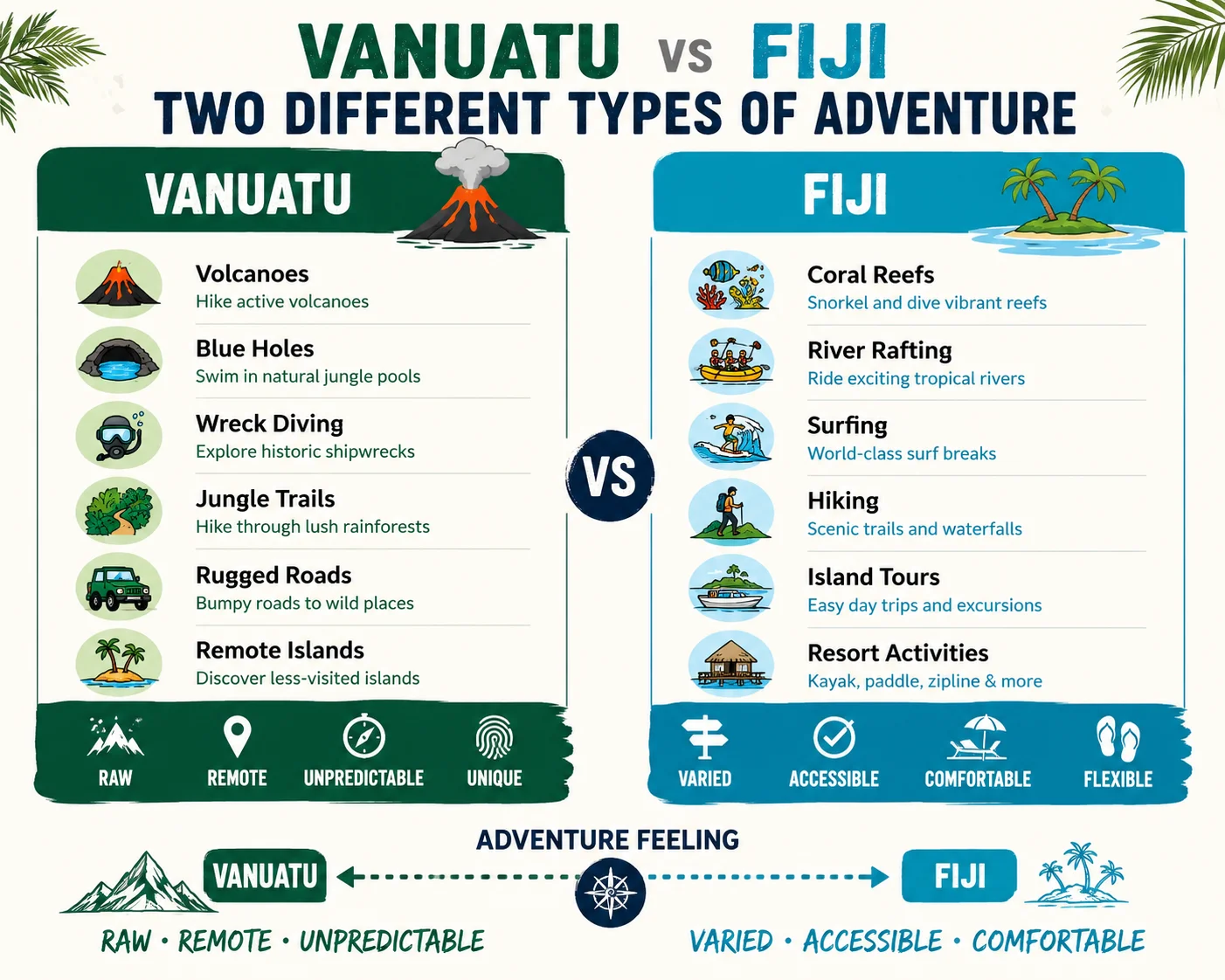
| Adventure Dimension | Vanuatu Often Feels | Fiji Often Feels |
|---|---|---|
| Core character | Raw, remote, distinctive, and exploratory | Varied, organized, social, and comfortable |
| Planning style | Choose the island around the experience you want most | Choose a region that gives you a practical mix of activities |
| Typical emotional reward | “I experienced something unusual and difficult to forget.” | “I did more than expected without the trip feeling exhausting.” |
| Tradeoff | Greater distinctiveness can come with more transfers and fewer backup options | Greater convenience can make some experiences feel more packaged |
| Best pace | Slow, focused, and built around one or two major experiences | Flexible, with active days balanced by beaches, resorts, and recovery time |
The visual is useful because it does not repeat a list of activities. It shows the emotional and practical difference between the two trips. Vanuatu is often about going farther for a defining experience. Fiji is often about fitting several worthwhile experiences into a smoother holiday.
Island Atmosphere and Overall Feel
Vanuatu often feels smaller-scale and less polished. Port Vila has resorts, restaurants, tour desks, markets, traffic, and familiar tourism services, but the atmosphere can change quickly outside the main centre. Roads become quieter, villages more visible, and the tourism layer thinner. On Tanna or Santo, the surroundings can feel more exploratory, particularly when a trip involves unsealed roads, local boats, jungle paths, or simple accommodation.
This rawness does not mean there is no comfort. Vanuatu has attractive resorts and well-run tourism experiences. The difference is that comfort may sit beside visible infrastructure limitations and a stronger feeling of remoteness. Travelers often notice the destination beyond the resort more clearly.
Fiji generally feels more tourism-ready. In major resort areas, transfers, activities, meal plans, kids’ clubs, dive operations, and day tours can be organized with less effort. The atmosphere is often warm, social, and reassuring. For some adventure travelers, this support makes it easier to try something new. For others, the more polished environment may feel less exploratory.
Fiji’s mood also changes dramatically by region. Denarau feels convenient and resort-focused. Pacific Harbour has a stronger activity identity. The Coral Coast combines resorts, villages, natural sites, and road access. Taveuni feels greener and more nature-oriented. The Yasawas can feel slower and more removed, while parts of Vanua Levu and Kadavu appeal to travelers who want fewer crowds and a deeper marine focus.
| Atmosphere Factor | Vanuatu | Fiji |
|---|---|---|
| Overall polish | More uneven, local, and raw outside the main tourism areas | More developed and organized in popular holiday regions |
| Social atmosphere | Friendly but often quieter and less resort-programmed | Frequently warm, outgoing, and shaped by resort interaction |
| Sense of exploration | Usually stronger, especially on Tanna, Santo, and less-visited islands | Varies widely; stronger outside the main resort corridors |
| Crowd feeling | Often low-key, although major attractions may gather tour groups at similar times | Can feel busier in established resort regions and during school holidays |
| Evening rhythm | Generally quiet, with fewer choices away from Port Vila | Broader dining and resort entertainment in major tourism areas |
What Adventure Feels Like in Vanuatu
Vanuatu’s appeal comes from experiences that feel closely connected to its volcanic geography, Melanesian culture, and less-developed island environments. The adventure is often not only the main activity. The journey to reach it becomes part of the memory.
A trip to Mount Yasur on Tanna is the clearest example. Travelers do not simply arrive at a polished attraction beside a major resort district. Reaching Tanna usually requires a domestic flight, local transport, and enough time to absorb changes in weather or operating conditions. The final approach through an ash-covered landscape can make the experience feel more significant than a simple sightseeing stop.
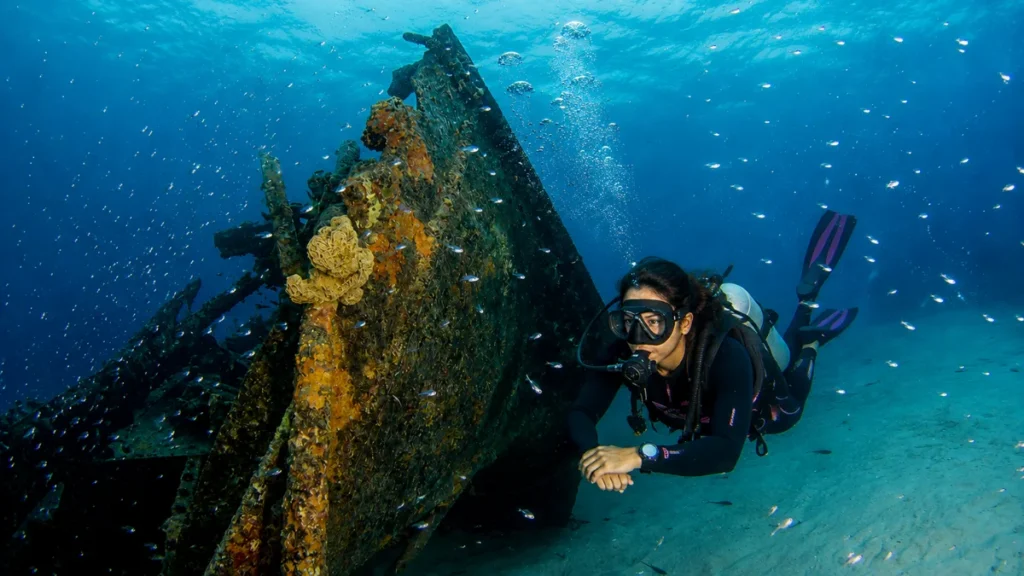
On Espiritu Santo, adventure takes a different form. Blue holes provide freshwater swimming in intensely clear surroundings, while the SS President Coolidge attracts experienced divers and those interested in maritime history. Jungle, beaches, caves, and remote coastal areas allow the island to feel active without being built around one single attraction.
Efate is the easiest Vanuatu base for travelers who want adventure without complicated island hopping. Waterfalls, snorkeling, cultural tours, kayaking, buggy tours, lagoon experiences, and trips around the island can create a varied itinerary. However, Efate alone does not fully represent the wilder image that draws some travelers to Tanna or Santo.
Vanuatu’s Strongest Adventure Qualities
- Experiences that feel strongly connected to volcanic and island geography
- A greater sense of discovery outside the main tourism centre
- Blue holes, wreck diving, waterfalls, jungle, caves, and cultural journeys
- Lower crowd energy in many areas
- Trips where local transport and changing landscapes become part of the story
- A destination personality that often feels less polished and more immediate
Vanuatu works best when travelers choose a clear priority. Trying to collect every famous experience can weaken the trip. A focused Santo diving and nature holiday may feel more worthwhile than a rushed itinerary that touches Efate, Tanna, and Santo without enough time to settle into any of them.
Travelers interested in how Vanuatu compares with another culturally grounded destination may also appreciate Samoa vs Vanuatu for Authentic Island Experiences, which explores why Vanuatu often feels more adventurous and geographically dramatic while Samoa can feel more road-accessible and socially grounded.
What Adventure Feels Like in Fiji
Fiji’s advantage is the number of ways an adventure trip can be shaped. It can be gentle, highly active, family-friendly, marine-focused, land-based, resort-supported, or spread across multiple islands. Travelers do not need to commit to one demanding experience to make the trip feel adventurous.
On Viti Levu, white-water rafting through the Upper Navua River area can reveal a side of Fiji that is completely different from the familiar resort image. River journeys, waterfalls, ziplining, sand dunes, inland hiking, and cultural excursions make it possible to build an active trip without relying entirely on inter-island flights.
Fiji’s marine activities are especially strong. Diving regions such as Taveuni, Kadavu, Savusavu, and the Bligh Water area have distinct underwater appeal. Surfing around the Mamanucas can be world-class, while snorkeling, kayaking, paddleboarding, fishing, and boat excursions are widely available at different skill levels.
The destination also works well for groups whose members define adventure differently. One traveler can dive, another can hike, and another can stay near the resort without making the holiday difficult to coordinate. This flexibility is valuable for couples, families, or friends with uneven confidence and fitness levels.
Fiji’s Strongest Adventure Qualities
- A broad mix of land, river, reef, surf, and resort-based activities
- More established operators and easier booking in major tourism regions
- Strong options for beginners as well as experienced divers, hikers, and surfers
- Better support for families and groups with mixed interests
- An easier balance between active days and comfortable recovery time
- Several regions that can support a full trip without excessive island hopping
Fiji’s main risk is assuming that every region offers the same access. A resort chosen only for its room or beach may be inconvenient for the activity you care about most. Adventure travelers should select the region first, then choose accommodation within it.
For a broader explanation of why Fiji works so well for return visitors, read Why Do Travelers Keep Returning to Fiji?. One reason is that travelers can return for a completely different style of trip rather than repeating the same resort experience.
Volcanoes, Mountains, and Land Adventures
Vanuatu has the stronger single land-based adventure icon. The volcanic landscape of Tanna can create a sense of scale, power, and unpredictability that is difficult for Fiji to match. For travelers who have imagined visiting an active volcano, this may be the experience that decides the entire comparison.
However, the volcano should not be treated as a casual attraction with guaranteed conditions. Volcanic activity is monitored, access can change, and travelers need to follow local authorities and experienced guides. The journey also involves more cost and coordination than an ordinary day tour from a major resort district.
Vanuatu’s other land experiences include waterfall walks, jungle routes, cave exploration, village-based journeys, and hiking on islands where tourism infrastructure can be limited. This gives the adventure a stronger expedition feeling, but it may also mean fewer facilities, rougher roads, and less predictability.
Fiji provides greater variety across ability levels. Travelers can choose short coastal walks, national-park landscapes, waterfall routes, highland treks, mountain biking, ziplining, sand-dune walks, river tubing, or multi-day guided hiking. Fiji may lack Vanuatu’s headline volcano experience, but it can offer more land activities within a trip that remains comfortable and flexible.
| Land Adventure | Vanuatu Advantage | Fiji Advantage |
|---|---|---|
| Volcanic landscapes | One of the destination’s defining experiences | Not a central visitor experience |
| Hiking variety | Rugged and distinctive, but often more location-specific | Broader range from easy walks to demanding guided routes |
| River adventure | Some kayaking and freshwater experiences | Stronger rafting, tubing, and river-journey options |
| Facilities and access | Can feel more basic and exploratory | Generally easier through established regions and operators |
| Best emotional reward | A rare-feeling encounter with a powerful landscape | A varied active day that fits smoothly into a wider holiday |
Diving, Snorkeling, Surfing, and Water Adventures
Both destinations can justify a trip built around the water, but they suit different priorities.
Vanuatu is particularly compelling for wreck divers. The SS President Coolidge near Santo is one of the destination’s best-known underwater experiences, and its scale rewards qualified divers who have the skill and time to explore it properly. Reef diving, caverns, blue holes, and clear freshwater environments add variety, although the strongest experiences may require choosing Santo rather than staying only on Efate.
Fiji has the broader diving identity. Different regions provide soft-coral walls, channels, pinnacles, shark-related dives, reef systems, and access for a range of experience levels. The country’s established dive industry makes it easier to select a resort or operator around a specific underwater goal.
For snorkeling, both countries can be rewarding, but site quality varies. A beautiful resort beach does not guarantee the best house reef. Travelers should research reef access, boat requirements, currents, coral condition, and whether the site matches their swimming confidence.
Fiji is usually the stronger choice for surfing because of the quality and international reputation of breaks around areas such as the Mamanucas. Many famous breaks require boat access and may not suit beginners. Vanuatu has surfing opportunities, but it is not generally the main reason adventure travelers choose the destination.
Fiji also provides more choice in kayaking, paddleboarding, river experiences, sailing, fishing, and resort-organized water sports. Vanuatu may feel less busy and more exploratory, while Fiji makes it easier to build several different water activities into one holiday.
Culture and Local Interaction
Adventure should not reduce either destination to a natural playground. Fiji and Vanuatu are living Pacific societies, and some of the most meaningful experiences come from understanding how communities relate to the land, sea, tradition, and visitors.
Vanuatu’s cultural identity can feel especially visible outside Port Vila. Village visits, kastom practices, local guides, markets, food, language, and island-specific traditions can become part of the travel experience. Some cultural events are tied to particular places and seasons, so they cannot always be added casually to a short itinerary.
Fiji’s visitor culture is often more immediately woven into the resort experience. Welcoming songs, conversation, village visits, cultural demonstrations, kava-related experiences, and staff interaction can make the holiday feel warm and inclusive. Yet a resort presentation is still only one part of Fijian life. Towns, markets, villages, Indo-Fijian communities, churches, local transport, and food traditions provide a fuller picture.
Responsible travelers should avoid treating cultural experiences as performances created only for photography. Dress respectfully, follow local guidance, ask before taking close photographs, and remember that community schedules and customs matter more than a visitor’s desire to collect an experience.
Vanuatu may offer the stronger feeling of cultural discovery because tourism can feel less dominant. Fiji may make interaction easier and more frequent because its visitor systems are more established. The more meaningful choice depends on whether you prefer a trip that asks for more effort or one that provides more accessible points of connection.
Comfort, Resorts, and Recovery Time
Adventure travelers still need to sleep, eat, recover, dry equipment, and manage tiredness. Accommodation can therefore shape the entire trip, even when the room is not the main reason for traveling.
Fiji generally provides the wider range of resorts, meal plans, family facilities, spas, pools, restaurants, and activity desks. It is easier to plan a demanding excursion and return to a highly organized environment. This can be particularly valuable after diving, rafting, hiking, or long boat trips.
Vanuatu also has comfortable resorts, especially around Port Vila and selected areas of Santo. However, travelers who move toward the country’s more remote experiences may encounter simpler accommodation, fewer dining choices, less consistent internet, and greater dependence on what is available locally.
Some travelers find that simplicity strengthens the adventure. Others discover that poor sleep, limited food choices, or unreliable logistics reduce their enjoyment. Neither reaction is wrong. Being honest about your preferred comfort level is part of choosing well.
| Comfort Factor | Vanuatu | Fiji |
|---|---|---|
| Resort range | Good in key areas, but thinner on more remote islands | Broad, from simple stays to large resorts and private islands |
| Meal flexibility | Strongest near Port Vila; choices may narrow elsewhere | Good in major regions, though isolated resorts may rely on meal plans |
| Activity coordination | Can require separate operators and more direct planning | Often easier through resorts and established tourism networks |
| Recovery-day options | Quiet beaches, lagoons, resort time, and slower local exploration | Resort facilities, spas, pools, beaches, and light activities |
| Best fit | Travelers comfortable with some simplicity and uneven infrastructure | Travelers wanting adventure without giving up predictable comfort |
Transport and Island Logistics
Transport is where the two destinations may feel most different in practice.
Vanuatu’s most distinctive adventures are distributed across islands. International travelers commonly arrive on Efate, but Tanna and Santo require additional travel. Domestic flights create cost and can make the itinerary more vulnerable to schedule changes. Once on the island, tours may involve long drives, basic roads, local boats, or early starts.
This does not make Vanuatu unsuitable for a short trip. It means the trip should be focused. A traveler with six or seven nights may be better choosing Efate plus either Tanna or Santo rather than attempting all three. The strongest itinerary is often the one that protects time for the experience that matters most.
Fiji can also involve domestic flights, ferries, speedboats, seaplanes, and long road transfers. However, many travelers can create a varied active holiday on Viti Levu alone, particularly around the Coral Coast, Pacific Harbour, Nadi area, and inland regions. Those who add Taveuni, Kadavu, Vanua Levu, the Mamanucas, or the Yasawas should still account for transfer days.
Fiji is generally easier for travelers who want one central base. Vanuatu is often more rewarding for travelers willing to organize the trip around one major island-specific experience.
For help deciding whether a week is enough for the wider Pacific, Which Pacific Islands Are Best for a One-Week Trip? compares how travel time, island transfers, and destination scale affect short holidays.
Budget and Value Expectations
Neither destination should automatically be treated as cheap. International flights may be only the beginning. Domestic travel, guided excursions, diving, equipment hire, boat transfers, meal plans, insurance, and weather-related flexibility can all affect the final cost.
Vanuatu may appear simpler and less commercial, but a multi-island adventure can become expensive quickly. Domestic flights to Tanna or Santo, specialized diving, guided volcano trips, private transport, and remote accommodation can raise the total. The destination offers strong value when the traveler deeply values its unique experiences, not necessarily when judged by the number of activities completed per dollar.
Fiji offers more budget shapes. Travelers can stay on the mainland, choose mid-range accommodation, join organized day trips, use resort packages, or spend heavily on private islands and premium diving. Greater competition and tourism scale can make planning easier, but remote resorts may still charge high prices for transfers, meals, and activities.
| Budget Area | Vanuatu | Fiji |
|---|---|---|
| International trip structure | Can be affordable when based on Efate, but additional islands increase cost | Broad range of packages and accommodation, especially from Australia and New Zealand |
| Domestic movement | Often essential for headline experiences on Tanna or Santo | Optional for many Viti Levu itineraries, but important for outer-island trips |
| Guided adventure cost | May feel high when transport and remoteness are part of the excursion | Wide range, with more operators in major regions |
| Food and imports | Imported products can be expensive; choices narrow in remote areas | Resort food can be costly, while towns and mainland areas give more flexibility |
| Best value for | Travelers prioritizing rare, destination-specific experiences | Travelers wanting multiple activities and greater control over comfort |
A realistic budget should compare complete itineraries rather than room prices. Include the flight needed to reach the right island, transfers from the airport, activity costs, meals, rest days, insurance, and a small buffer for changes.
For a closer look at Fiji’s costs beyond headline resort prices, read How Expensive Is Fiji Really in 2026?. It is particularly helpful for understanding why a low room rate does not always produce a low total trip cost.
Which Adventure Traveler Fits Each Destination?
The second diagram should help readers identify themselves rather than repeat the first visual. It compares traveler types, confidence levels, and trip priorities.
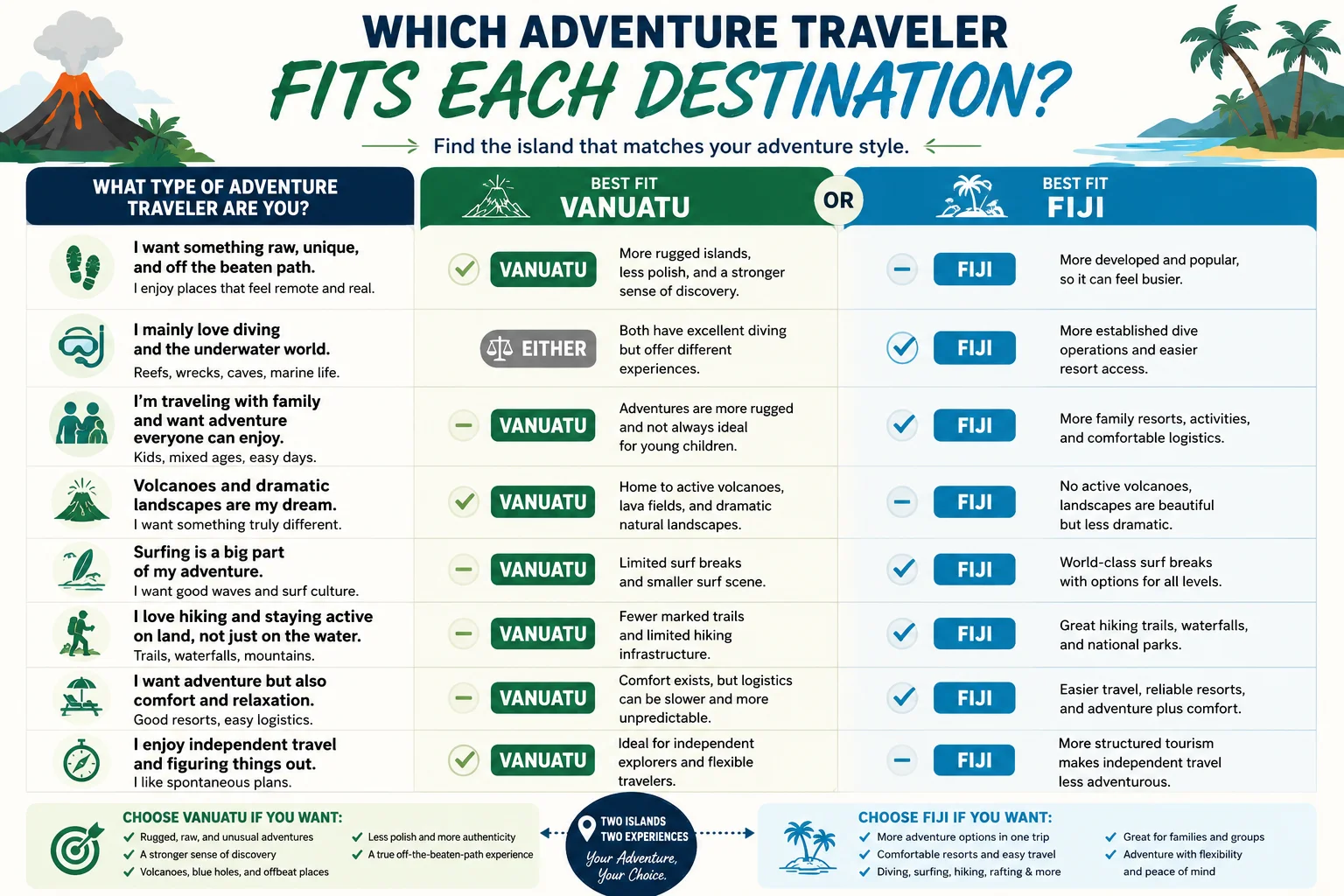
| Traveler Type | Likely Better Fit | Why |
|---|---|---|
| Volcano-focused traveler | Vanuatu | Tanna provides a destination-defining volcanic experience that Fiji does not directly match |
| First-time adventure traveler | Fiji | More activity choices, established operators, and easier ways to control intensity |
| Experienced wreck diver | Vanuatu | Santo’s SS President Coolidge creates a strong specialist reason to visit |
| Soft-coral and reef-focused diver | Fiji | Several established diving regions support different reef and current experiences |
| Family wanting active days | Fiji | More family resorts, flexible activities, kids’ facilities, and backup options |
| Independent explorer | Vanuatu | The destination often feels less packaged and more locally immediate |
| Surfer | Fiji | Stronger international surf identity and access to major reef breaks |
| Traveler wanting several activities in one week | Fiji | Easier to combine river, reef, hiking, resort, and cultural experiences |
| Traveler seeking a rare-feeling story | Vanuatu | Volcanoes, blue holes, wrecks, and remote-island journeys feel highly distinctive |
| Mixed-interest couple or group | Fiji | One person can pursue demanding activities while others use resort facilities |
| Slow traveler comfortable with simple logistics | Vanuatu | The less-polished environment can become part of the experience rather than a problem |
| Traveler wanting adventure plus dependable comfort | Fiji | Stronger tourism infrastructure makes recovery days and activity coordination easier |
The diagram adds value because it answers a personal question: not which destination has more adventure, but which one is more likely to satisfy a particular kind of traveler.
Best For and Not Ideal For
Adventure can become disappointing when travelers choose according to a famous photograph rather than the complete trip. These lists are designed to make the fit clearer.
Vanuatu Is Best For
- Travelers who want an active-volcano experience to define the trip
- Experienced divers interested in major wreck diving
- Visitors drawn to blue holes, jungle, caves, and less-polished island environments
- Independent travelers comfortable with flexible schedules and simpler facilities
- Travelers who value unusual experiences more than a long list of organized activities
- People who enjoy quieter destinations and lower crowd energy
Vanuatu Is Not Ideal For
- Travelers who want every major experience within a short drive of one resort
- Visitors who dislike domestic flights, rough roads, or possible schedule changes
- People who need a large choice of restaurants, entertainment, and polished facilities every evening
- Families wanting extensive kids’ clubs and a highly organized resort programme
- Travelers trying to fit Efate, Tanna, and Santo into a very short holiday
- Visitors who become frustrated when weather or local conditions alter the plan
Fiji Is Best For
- First-time Pacific adventure travelers who want reassurance and choice
- Divers, surfers, hikers, rafters, and travelers who want several activity types
- Families and groups with different confidence or fitness levels
- Active couples who also want resort comfort and slow afternoons
- Travelers who prefer established operators and easier booking
- Visitors who want to build an adventure trip around one practical region
Fiji Is Not Ideal For
- Travelers expecting every resort area to feel remote and untouched
- Visitors who book accommodation before checking where their preferred activities operate
- People who assume all diving, beaches, hiking, and snorkeling are equally good everywhere
- Travelers who want one single volcanic or geological experience to define the journey
- Strict-budget visitors who overlook meal plans, transfers, and activity charges
- Travelers who choose a busy family resort while actually wanting solitude
How Long Do You Need?
A week can work in either destination, but only when the itinerary is restrained.
In Vanuatu, seven nights are usually best used on one island or split between Efate and either Tanna or Santo. Choosing Tanna creates a volcano-centred trip. Choosing Santo creates a stronger diving, blue-hole, beach, and nature combination. Trying to include both may leave too little flexibility if a domestic connection changes.
In Fiji, seven nights can support one well-chosen base on Viti Levu or a split between the mainland and one island region. Travelers who want serious diving, hiking, or surfing should select the location around that activity rather than trying to see Fiji broadly.
Ten to fourteen nights create a better pace for both countries. Vanuatu travelers can combine two islands without making every transfer feel urgent. Fiji travelers can include an outer island or specialist region while preserving rest days.
The most satisfying adventure itinerary usually contains fewer headline activities than travelers first imagine. A major excursion followed by recovery and ordinary island time often creates a stronger memory than several rushed tours booked on consecutive days.
Practical Travel Insights
The best destination becomes clearer when you plan around your highest-priority experience rather than around a general idea of “adventure.”
- Choose Vanuatu when the volcano, wreck diving, blue holes, or raw island exploration is the main reason for traveling.
- Choose Fiji when you want a broader activity mix with easier resort support and more comfort choices.
- Research the exact island or region before booking accommodation. Neither country offers the same experience everywhere.
- Leave at least one flexible day around weather-sensitive diving, boat trips, surfing, or volcanic excursions.
- Compare total itinerary costs, including domestic flights, boat transfers, meals, equipment, and guided tours.
- Use qualified operators for diving, rafting, surfing, hiking, and volcanic areas, and follow current local safety guidance.
- Avoid placing demanding activities on every day. Heat, humidity, travel fatigue, and sea conditions can reduce energy.
- Pack for both sun and rain, and protect electronics and documents during boat or wet-weather travel.
Common Traveler Misunderstandings
One misunderstanding is that Vanuatu is automatically the more adventurous destination in every category. It has the stronger raw and unusual identity, but Fiji offers more variety in rafting, surfing, hiking, ziplining, diving, river travel, and organized outdoor experiences. The better destination depends on whether you value distinctiveness or range.
Another misconception is that Fiji is only for resort travelers. Large resorts are highly visible, but Fiji also has remote islands, inland highlands, powerful rivers, village-based trekking, specialist dive areas, reef breaks, and regions where tourism feels much quieter.
Travelers may also assume Vanuatu’s main attractions are all close to Port Vila. Efate has worthwhile adventures, but Tanna and Santo hold many experiences that define the country’s adventurous reputation. Domestic travel should be treated as a central planning decision, not a minor addition.
A further misunderstanding is that adventure must mean constant adrenaline. Swimming in a quiet blue hole, traveling through a volcanic landscape, walking with a local guide, or diving slowly through a historic wreck can feel more meaningful than a fast activity designed only for excitement.
Finally, neither destination guarantees empty landscapes. Popular tours may gather visitors at similar times, resorts can be busy during school holidays, and famous dive or surf sites may be shared. Low overall visitor numbers do not always mean complete solitude at the exact experience you came to see.
Seasonal and Weather Context
Weather should shape an adventure itinerary more strongly than it shapes a simple resort stay. Rain, wind, cloud, river levels, visibility, currents, and sea conditions can change what feels comfortable or possible.
Both Vanuatu and Fiji generally have warmer, wetter, more humid conditions from around November to April. This period also overlaps with the main tropical cyclone season in the region. It does not mean every trip will experience severe weather, but travelers should understand the greater possibility of disruption and maintain suitable insurance and flexibility.
The cooler and drier months are popular for outdoor travel because hiking and general movement may feel more comfortable. However, popular accommodation and activities can cost more or book earlier, particularly around Australian and New Zealand school holidays.
Diving conditions depend on the exact region, time of year, wind, visibility, currents, and diver experience. Surf conditions also vary by location and season. General monthly weather summaries are not enough for specialist trips; travelers should ask operators about the conditions relevant to the actual site.
Fiji’s larger islands can have meaningful rainfall differences between wetter and drier sides. Vanuatu’s conditions also vary by island and latitude. A forecast for the capital does not always describe the experience on another island.
Travelers considering lower-season prices in Fiji may find Is It Better to Visit Fiji During Wet Season? helpful. It explains why lower prices can be worthwhile for flexible travelers while still requiring realistic expectations about humidity, rain, and possible activity changes.
Pacific Worth Note: I think the most useful difference is that Vanuatu often asks you to build the trip around one defining adventure, while Fiji lets you build adventure around the trip. One approach feels rarer and more focused. The other feels easier to balance with comfort, variety, and the needs of different travelers.
Frequently Asked Questions
Vanuatu vs Fiji for adventure travelers: which is better?
Vanuatu is often better for travelers who want rawer, more unusual experiences such as an active-volcano journey, blue holes, wreck diving, and less-polished island exploration. Fiji is generally better for travelers who want a wider selection of organized adventures, easier logistics, stronger resort support, and a mix of diving, surfing, rafting, hiking, and ziplining.
Is Vanuatu more adventurous than Fiji?
Vanuatu can feel more adventurous because its signature experiences are unusual, remote, and closely tied to volcanic landscapes and island-specific travel. Fiji may offer more total activity variety, but many experiences are easier to organize and can feel more structured.
Which destination is better for diving?
Vanuatu is especially appealing to wreck divers because of the SS President Coolidge and other distinctive underwater sites. Fiji is often the stronger all-round diving destination because it has several established regions known for reefs, soft coral, channels, walls, marine life, and options across different experience levels.
Is Fiji or Vanuatu better for families who want adventure?
Fiji is usually easier for families because it has more family-oriented resorts, organized activities, kids’ facilities, restaurant choices, and alternatives when weather changes. Vanuatu can work well for adventurous families, particularly on Efate or Santo, but planning may require more care.
Can you visit Vanuatu or Fiji for one week?
Yes, but a focused itinerary is important. In Vanuatu, choose one island or combine Efate with either Tanna or Santo. In Fiji, choose one strong base or combine Viti Levu with one nearby island region. Too many transfers can reduce the time available for the experiences that motivated the trip.
Final Thoughts
So, when comparing Vanuatu vs Fiji for Adventure Travelers, Vanuatu is generally the better choice for people who want adventure to feel raw, unusual, geographically dramatic, and closely tied to one or two defining experiences. Fiji is usually the better choice for people who want a wider variety of activities, easier planning, established operators, and the ability to combine active days with comfortable resort time.
Choose Vanuatu for the volcano, blue holes, wreck diving, quieter exploration, and the feeling that reaching the experience is part of the adventure. It rewards travelers who accept slower logistics, simpler infrastructure, and a more focused itinerary.
Choose Fiji for rafting, surfing, hiking, reef adventures, ziplining, family activities, and greater choice across regions and comfort levels. It is particularly strong for groups and couples who want adventure without making every part of the holiday demanding.
Neither country is universally better. Vanuatu may produce the more unusual memory. Fiji may produce the more balanced trip. Weather, transport, location, and traveler confidence can change the experience more than destination popularity.
The journey becomes truly worthwhile when the style of adventure matches the way you naturally travel. Some people want to return home with one powerful story. Others want a week filled with different experiences that still felt easy to enjoy.
For Pacific Worth, that is the real decision: not which destination looks more adventurous online, but which Pacific experience will still feel meaningful after the excitement has passed.
Leave a Reply