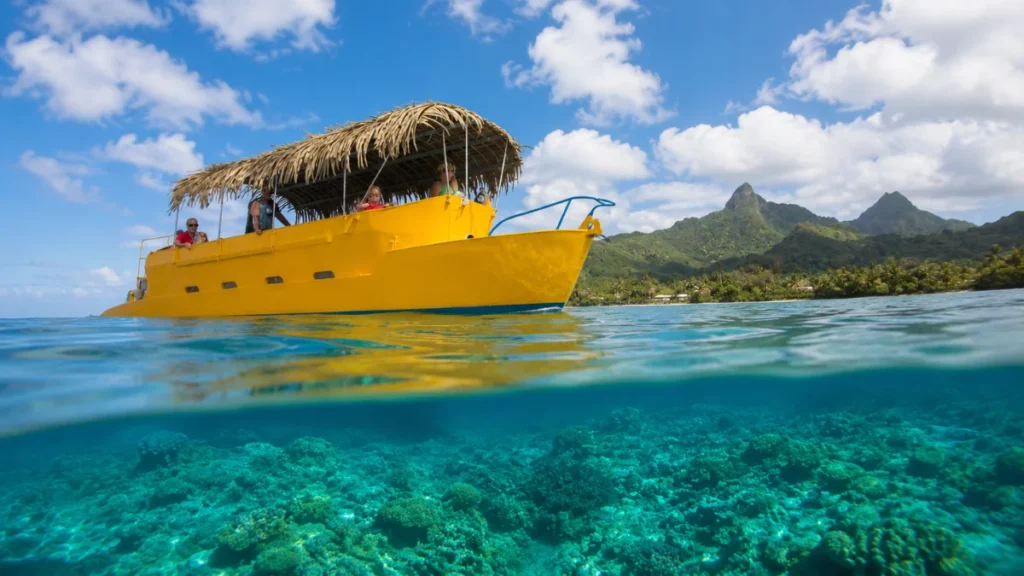
Pacific island holidays are often presented through swimming, snorkeling, diving, and bright lagoon water. That can make non-swimmers wonder whether they will spend an expensive trip watching everyone else enjoy the experiences they travelled so far to see.
The strongest Pacific choices for non-swimmers are Fiji, Rarotonga in the Cook Islands, Samoa, and Vanuatu because they offer meaningful cultural, scenic, food, resort, boating, and land-based experiences that do not depend entirely on swimming. The right island also depends on whether you want a comfortable resort holiday, an independent road trip, local interaction, or a quieter nature-focused escape.
The answer is not as simple as choosing the island with the calmest-looking lagoon. Shallow water can still contain currents, uneven coral, sudden drop-offs, slippery rocks, or changing tides. At the same time, a destination that appears highly water-focused may offer glass-bottom boats, scenic cruises, village visits, markets, mountain drives, spa days, cultural evenings, and beaches that remain enjoyable from shore.
This article compares which Pacific islands are best for non-swimmers, what each destination genuinely feels like, how much of the experience happens away from the water, which tradeoffs matter, and how to avoid choosing an island where the main appeal does not match the way you prefer to travel.
Quick Comparison: Best Pacific Islands for Non-Swimmers
The strongest choice depends less on which island has the most beautiful lagoon and more on what you want to do when swimming is removed from the schedule.
| If You Want… | Strongest Choice | Why It Fits |
|---|---|---|
| The best overall mix of comfort, activities, and flexibility | Fiji | Broad resort choices, cultural activities, scenic trips, food, gardens, markets, river experiences, and options for mixed groups |
| An easy island to explore independently | Rarotonga | A compact coastal road, cafés, markets, cultural evenings, scenic drives, and lagoon cruises where entering the water may be optional |
| Culture, villages, landscapes, and road trips | Samoa | A strong sense of local life with waterfalls, plantations, churches, volcanic scenery, coastal viewpoints, and slower travel |
| To see reefs and marine life while remaining dry | Vanuatu | Glass-bottom and semi-submersible boat options around Port Vila, alongside cultural and land-based excursions |
| Romantic scenery and a more polished atmosphere | Moorea | Dramatic mountain and lagoon views, island drives, resorts, food stops, viewpoints, and scenic boat journeys |
Fiji is the safest all-round recommendation, but it is not automatically right for everyone. Rarotonga may feel easier for independent travelers, Samoa may feel more meaningful for culture-focused visitors, and Vanuatu may offer the strongest dry alternative to snorkeling.
Which Pacific Islands Are Best for Non-Swimmers?
Fiji is often the best all-round Pacific destination for non-swimmers because it offers a wide range of resorts, cultural activities, boat trips, village experiences, gardens, markets, spas, river journeys, and family-friendly facilities. It is easier to build a satisfying holiday around more than one type of activity.
Rarotonga is another strong choice, particularly for travelers who want to explore independently. Its compact size makes it practical to combine scenic drives, cafés, markets, cultural shows, inland tours, beach walks, and lagoon cruises without making every day revolve around swimming.
Samoa is especially rewarding for travelers interested in landscapes, village life, waterfalls, coastal viewpoints, cultural traditions, and road trips. Some of its most photographed places are swimming locations, but the wider destination offers much more than entering the water.
Vanuatu works well for non-swimmers who still want to see marine life. Port Vila has boat-based reef experiences, including glass-bottom and semi-submersible viewing, while Efate also offers cultural tours, scenic drives, markets, gardens, and accessible day trips.
Tahiti and Moorea can also be worthwhile, but their value depends more heavily on scenery, lagoon excursions, and expensive water-oriented experiences. They suit non-swimmers who enjoy being near the water and are comfortable taking boat trips, even if they do not plan to enter it.
The best destination is therefore not necessarily the island with the clearest water. It is the one where enough of the holiday remains meaningful when swimming is removed from the itinerary.
What Does a Good Non-Swimmer Island Holiday Actually Mean?
“Non-swimmer” can describe several different travelers. Some cannot swim at all. Others can manage shallow water but feel anxious when they cannot touch the bottom. Some avoid snorkeling, currents, boats, or deep water but still enjoy pools and calm beaches. Others prefer to remain completely dry.
These differences matter because a destination advertised as suitable for beginners may still assume that guests are comfortable floating, wearing a life jacket, climbing from a boat, or entering water above waist height. A guided snorkeling tour may provide equipment and assistance, but it is not automatically suitable for someone who becomes distressed in open water.
A genuinely good island for non-swimmers should provide several layers of enjoyment:
- Beautiful surroundings that can be appreciated from land
- Cultural, food, nature, and sightseeing experiences
- Boat activities where entering the water is optional
- Accommodation that is comfortable even without daily excursions
- Easy ways to move around without relying on small boats
- Enough variety to prevent the holiday from feeling repetitive
The atmosphere also matters. A non-swimmer may enjoy a lagoon-centred resort when the setting is peaceful, the food is good, and there are shaded places to relax. The same traveler may feel isolated at a remote property where snorkeling is the main daily activity and everything else requires an expensive transfer.
The Real Pacific Travel Reality Check
Water is central to life and tourism across the Pacific. Beaches, reefs, lagoons, fishing, boating, surfing, snorkeling, and diving are not simply optional decorations added to the destinations. They shape how islands look, how communities travel, and how many visitor experiences are organized.
This does not mean non-swimmers should avoid the Pacific. It means destination and accommodation choices need more care. A large resort on Fiji’s main island may provide restaurants, entertainment, gardens, pools, cultural activities, and road access. A tiny outer-island property may offer extraordinary scenery but assume that guests will spend much of the day snorkeling, kayaking, or swimming.
Transport can also create discomfort. Some island transfers use small boats, beach landings, floating pontoons, or steps that move with the water. Travelers who are comfortable remaining on a stable sightseeing vessel may feel differently about boarding a small open boat in waves.
Weather affects the experience as well. Wind, rain, swell, tides, and cloud can change boat schedules or make a normally calm lagoon feel less inviting. When a holiday depends on one particular cruise or excursion, it helps to leave enough flexibility for the activity to move to another day.
Remote logistics influence value. Imported meals, transfers, tours, and accommodation can be expensive. A non-swimmer may receive better value from a well-connected island with several land-based choices than from a famous but isolated lagoon where the most promoted activities do not suit them.
Pacific travel also moves at a slower pace. Tours may begin later than expected, road journeys may take longer, and weather can reshape a day. This often becomes part of the atmosphere rather than a serious problem, but highly structured travelers may need to leave more room between plans.
What Many Travel Articles Miss
Many articles judge island destinations by beach quality, reef access, and snorkeling. Those factors matter, but they do not reveal whether a traveler can enjoy seven days without entering the sea.
The better question is what the destination feels like between the famous water activities. Can you walk to restaurants? Is there an island worth exploring by road? Are cultural experiences thoughtful or mainly short resort performances? Does the accommodation provide enough atmosphere on a quiet day? Can you see the lagoon from a boat without being pressured to snorkel?
Travel advertising also tends to treat confidence in water as universal. Photos show guests jumping from boats, floating above coral, or walking casually through lagoons. They rarely show how deep the water is, whether there is a current, how guests board the vessel, or whether staying onboard is welcomed.
A destination can be excellent for confident swimmers and disappointing for non-swimmers without being a poor destination. Traveler fit matters more than reputation. The goal is not to find the “best” island in general, but to find the place where your version of a Pacific holiday still feels complete.
Pacific Islands for Non-Swimmers Compared
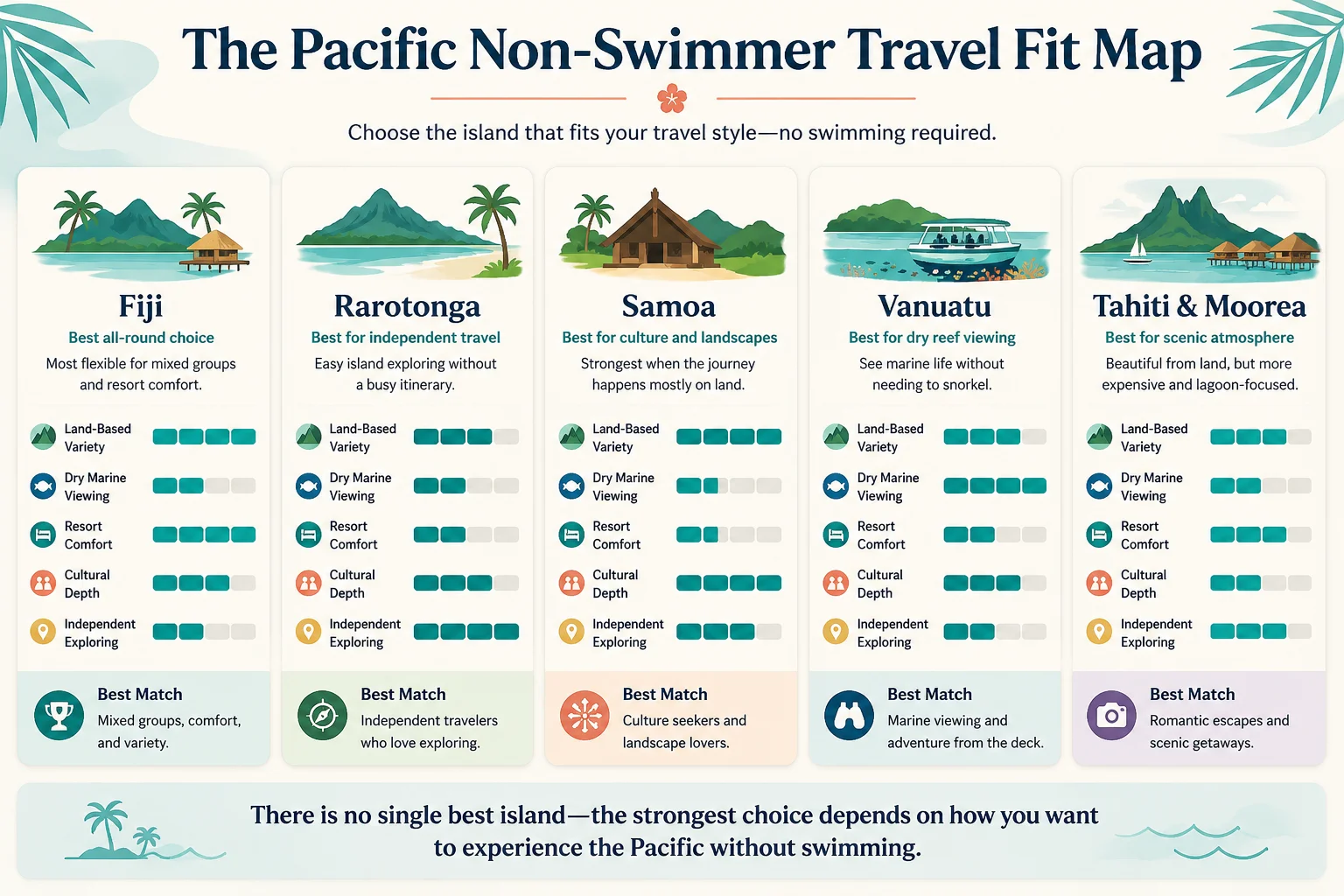
The following comparison looks beyond beach appearance and considers land-based variety, boating options, atmosphere, ease of movement, and how much of the destination’s appeal remains accessible without swimming.
| Destination | Why It Works for Non-Swimmers | Main Tradeoff | Overall Fit |
|---|---|---|---|
| Fiji | Broad resort choice, cultural activities, markets, gardens, river trips, village visits, road access, and boat excursions | Many outer-island experiences remain heavily centered on snorkeling and swimming | Best overall choice for variety and flexibility |
| Rarotonga, Cook Islands | Compact road network, easy independent exploring, markets, cafés, cultural evenings, inland tours, and lagoon cruises | The lagoon remains a major part of the destination, and some cruises emphasize snorkeling | Best for an easy, slower independent holiday |
| Samoa | Strong culture, scenic drives, waterfalls, villages, coastal landscapes, walking, and a more locally lived-in atmosphere | Less polished tourism infrastructure and fewer dry marine-viewing experiences | Best for culture, landscapes, and road trips |
| Vanuatu | Semi-submersible and glass-bottom viewing, cultural tours, markets, island drives, gardens, and accessible Efate excursions | Some of the most famous outer-island adventures involve water or more complicated transport | Best for seeing reefs without swimming |
| Tahiti and Moorea | Dramatic scenery, island drives, markets, food, viewpoints, cultural sites, resorts, and scenic boat journeys | High costs and a large share of the destination’s famous value is tied to lagoons and water activities | Best for scenic travelers with a comfortable budget |
No destination completely removes the ocean from the experience. The difference is how easily the holiday can be rebuilt around scenery, culture, food, relaxation, and exploration when swimming is not included.
Fiji: Best Overall for Choice and Resort Comfort
Fiji is often the easiest Pacific destination for non-swimmers to shape around their own comfort level. Its tourism industry includes large mainland resorts, private-island properties, family hotels, boutique stays, river excursions, village visits, markets, gardens, cultural programs, spas, golf, food experiences, and sightseeing.
The atmosphere depends heavily on where you stay. Denarau feels polished, convenient, and resort-focused. The Coral Coast offers a more spread-out mix of resorts, villages, scenery, cultural sites, and road access. Pacific Harbour feels more adventure-oriented, while outer islands can feel quieter, more remote, and much more dependent on boats and marine activities.
This range is Fiji’s greatest advantage. A traveler who does not swim can choose a comfortable mainland base and still enjoy an unmistakably Pacific setting without feeling trapped at the resort. Boat trips, river journeys, cultural experiences, local markets, scenic drives, spa treatments, resort activities, and village visits can create a varied week.
Fiji also suits mixed groups. One person can snorkel or dive while another enjoys the beach, a boat ride, a spa treatment, a cultural demonstration, or time at the resort. Families and couples do not always need to separate for the entire day.
What Fiji Feels Like for a Non-Swimmer
At its best, Fiji feels welcoming, social, and flexible. Resort staff often create a warm atmosphere, and larger properties provide enough daily activity that entering the ocean does not need to become the measure of whether the day was successful.
The experience can feel more contained at a large resort, particularly around Denarau. This is comfortable and practical, but it may not provide the deeply remote island feeling some travelers imagine. The Coral Coast or a carefully chosen island day trip may add more scenery and local context.
Outer-island Fiji requires more caution during planning. A beautiful small resort may have limited roads, few alternative activities, and a daily schedule built around snorkeling, kayaking, diving, or swimming. The surroundings may still be enjoyable, but non-swimmers should check what actually happens during a typical day.
Best For
- First-time Pacific travelers
- Couples or families with mixed swimming abilities
- Travelers wanting a comfortable resort base
- Visitors who want cultural and scenic activities alongside relaxation
- People who prefer several accommodation and budget levels
Not Ideal For
- Travelers choosing a tiny outer island without checking non-water activities
- Visitors expecting every resort area to feel culturally immersive
- People who dislike organized resort environments
- Travelers who want a highly independent island road trip
For a broader look at the destination’s atmosphere and repeat appeal, see Why Do Travelers Keep Returning to Fiji?. Travelers comparing costs may also find How Expensive Is Fiji Really in 2026? useful.
Rarotonga: Best for an Easy Independent Island Holiday
Rarotonga works well for non-swimmers because the island is compact enough to understand quickly but varied enough to explore over several days. Its circular coastal road connects beaches, villages, cafés, accommodation, markets, churches, restaurants, cultural venues, and scenic viewpoints.
The island atmosphere is slower and less polished than a large Fiji resort district. Travelers often move around independently by car, scooter, bicycle, or bus, although a car is usually the more comfortable choice for visitors who are not confident on scooters.
Lagoon cruises are a major attraction. Many include snorkeling stops, but the boat journey, views, entertainment, food, and motu visit may still be enjoyable for passengers who remain onboard or stay in shallow areas. This should be confirmed directly with the operator because boarding arrangements, water depth, and the structure of each excursion differ.
Rarotonga also offers island nights, cultural performances, markets, cafés, restaurants, garden visits, guided inland experiences, scenic drives, church services, and gentle beach time. A non-swimmer can build a complete itinerary without booking an excursion every day.
What Rarotonga Feels Like for a Non-Swimmer
Rarotonga often feels relaxed, approachable, and personal. It does not have the same broad resort infrastructure as Fiji, but its smaller scale can make the holiday feel easier. Travelers can return to familiar cafés, recognize parts of the road, and gradually settle into the island’s rhythm.
The lagoon is always visually present. This is an advantage for travelers who love water scenery but do not need to enter it. It may be less satisfying for someone who actively dislikes boats, beaches, or spending time near water because many of the island’s most memorable views and excursions still relate to the lagoon.
Social media often presents Rarotonga as empty and effortless. In reality, popular parts of Muri can feel active during the day, weather can change quickly, and traffic may feel noticeable by small-island standards. Even so, the island usually retains an unhurried mood.
Best For
- Independent travelers who want easy road-based exploring
- Couples seeking a slower island escape
- Non-swimmers who enjoy lagoon scenery and boat trips
- Travelers who prefer local cafés and smaller accommodation
- Visitors wanting a manageable one-week destination
Not Ideal For
- Travelers wanting large-resort entertainment every day
- Visitors who dislike any lagoon-focused activity
- People seeking extensive shopping or nightlife
- Travelers expecting a long list of major sightseeing landmarks
Our article Is Rarotonga Worth Visiting for a Short Island Escape? looks more closely at the island’s pacing, convenience, and short-trip value.
Samoa: Best for Culture, Scenery, and Road Trips
Samoa is one of the strongest choices for non-swimmers who want the trip to feel connected to landscapes and local life rather than built around a self-contained resort. Upolu and Savai‘i offer scenic roads, villages, churches, waterfalls, lava fields, coastal viewpoints, markets, plantations, cultural sites, and forested interiors.
Some of Samoa’s most famous attractions are swimming places, including ocean trenches, cave pools, waterfalls, and beaches. Non-swimmers can still appreciate some of these locations visually, but not every site offers the same value from the viewing area. It is important not to build the whole itinerary around places where entering the water is the main experience.
The better approach is to combine selected natural sites with cultural experiences, scenic drives, village stays, markets, museums, food, coastal walks, and time observing everyday island rhythms.
Samoa generally feels less polished and more locally lived-in than major Fiji resort areas. This can make the journey feel more meaningful, but it also brings tradeoffs. Road conditions, signage, opening hours, accommodation standards, and service pacing may be less consistent than travelers expect from highly developed tourism destinations.
What Samoa Feels Like for a Non-Swimmer
Samoa often feels green, spacious, traditional, and quietly dramatic. Villages line the roads, churches remain visually important, families gather around open homes, and the landscape shifts between rainforest, plantations, waterfalls, volcanic coast, and beaches.
The experience is usually strongest for travelers who enjoy observing, driving, stopping, talking, eating, and allowing the island to unfold slowly. It is not a destination where every hour needs to be filled by an organized attraction.
Weather can deepen the mood. Rain makes the greenery richer and waterfalls stronger, although it can also interrupt plans and make paths slippery. Bright days bring stronger coastal colour but also heat and humidity.
Best For
- Cultural travelers
- Visitors who enjoy scenic drives and natural landscapes
- Travelers comfortable with a less polished destination
- People who value local atmosphere over resort entertainment
- Non-swimmers who want a Pacific trip that is not defined by a lagoon
Not Ideal For
- Travelers wanting highly polished transport and tourism systems
- Visitors who prefer all-inclusive resort convenience
- People who need a large selection of indoor attractions
- Travelers expecting every famous natural site to be equally rewarding without swimming
First-time visitors deciding whether Samoa suits them can read Is Samoa Worth Visiting for First-Time Pacific Travelers?. Our comparison of Why Does Samoa Feel Different from Fiji? also explains the contrast between Samoa’s locally lived-in atmosphere and Fiji’s broader resort variety.
Vanuatu: Best for Accessible Adventure and Dry Reef Viewing
Vanuatu deserves consideration because non-swimmers can experience parts of its marine environment without entering the water. Port Vila offers glass-bottom and semi-submersible boat experiences where passengers can view coral and fish through underwater windows.
This does not make every Vanuatu excursion suitable for every non-swimmer. Travelers should still ask about boat stability, boarding steps, seasickness, accessibility, trip duration, and whether remaining dry is possible for the entire experience.
Efate also offers cultural experiences, markets, scenic drives, gardens, coastal viewpoints, village visits, food, and day tours. This makes Port Vila a practical base for travelers who want a mix of comfort and adventure without depending entirely on snorkeling.
The destination tends to feel less polished than large Fiji resort areas. Port Vila has recognizable visitor infrastructure, but roads, schedules, and service standards can vary. Beyond the capital area, Vanuatu can feel rawer, quieter, and more logistically demanding.
What Vanuatu Feels Like for a Non-Swimmer
Vanuatu can feel adventurous without requiring constant physical activity. Even a road journey may pass dense greenery, village communities, coastline, gardens, and locally run attractions. Cultural interaction can feel central rather than added to the edge of a resort program.
Port Vila itself feels practical and compact rather than conventionally beautiful in every direction. Its value comes from using it as a base for experiences, not expecting the town alone to provide the complete island holiday.
Espiritu Santo is visually compelling, but many of its famous blue holes and water experiences are more rewarding for swimmers. Non-swimmers can still enjoy beaches, drives, cultural sites, food, and scenery, although the cost and logistics of reaching Santo may be harder to justify if water experiences are excluded.
Best For
- Travelers who want to view reefs without snorkeling
- Visitors interested in culture and locally operated tours
- People who enjoy active sightseeing but not necessarily swimming
- Australians seeking a relatively accessible Pacific escape
- Travelers comfortable with a destination that feels less polished
Not Ideal For
- Travelers who want seamless luxury infrastructure
- Visitors uncomfortable on any type of boat
- People expecting every outer-island highlight to be land-based
- Travelers who dislike changing schedules or variable road conditions
Tahiti and Moorea: Beautiful but More Water-Centred
Tahiti and Moorea can be deeply memorable for non-swimmers, but they require more selective planning. The scenery is strong enough to appreciate from land: steep mountains, tropical valleys, coastal roads, viewpoints, markets, black-sand beaches, waterfalls, gardens, and changing lagoon colour.
Tahiti offers the greatest amount of practical, cultural, and road-based variety. Papeete has markets, restaurants, shops, museums, and a more locally lived-in atmosphere. An island drive adds waterfalls, coastline, gardens, surf viewpoints, and mountain scenery.
Moorea feels slower and more scenic. Its bays, mountain ridges, viewpoints, plantations, beaches, roadside food stops, and lagoon views create a satisfying road-based holiday. Boat excursions remain central, but non-swimmers may still enjoy the scenery if an operator welcomes passengers who prefer to remain onboard.
The tradeoff is cost. French Polynesia can be expensive to reach and expensive on the ground. When snorkeling, swimming, diving, and lagoon activities are removed, some travelers may question whether the remaining experience justifies the price compared with Fiji, Samoa, or Rarotonga.
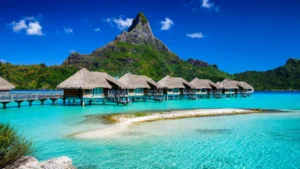
Bora Bora is a more difficult recommendation. Its visual drama is undeniable, but much of its value is tied to the lagoon, overwater accommodation, boat trips, and resort seclusion. A non-swimmer who loves water views, luxury, privacy, and scenic cruises may still find it worthwhile. A traveler seeking broad land-based variety may not.
Best For
- Scenery-focused couples
- Travelers who enjoy boat journeys but do not swim
- Visitors comfortable paying for atmosphere and remoteness
- People who value mountain and lagoon views
- Travelers combining markets, food, drives, and resort relaxation
Not Ideal For
- Budget-conscious travelers seeking many free land attractions
- Visitors who dislike boats as well as swimming
- People wanting constant activity and entertainment
- Travelers choosing Bora Bora mainly because social media says it is essential
Why Tonga, Niue, and Bora Bora Are Not the Main Recommendations
Tonga, Niue, and Bora Bora can all be rewarding for certain non-swimmers. They are not poor choices, but each has a stronger dependence on a particular type of water-based experience, a narrower tourism offering, or more complicated value considerations than Fiji, Rarotonga, Samoa, and Vanuatu.
| Destination | Why It May Still Appeal | Why It Is Not a Main Recommendation |
|---|---|---|
| Tonga | Strong Polynesian culture, quieter islands, scenic coastlines, churches, local markets, and a less commercial atmosphere | Many of its most promoted visitor experiences are connected to whales, boats, reefs, and seasonal marine activities, while land-based tourism choices can feel more limited |
| Niue | Dramatic limestone coast, caves, chasms, forest walks, viewpoints, and a highly distinctive landscape | Swimming, snorkeling, diving, and water access feature heavily in the destination’s appeal, while steep coastal access points may not suit every non-swimmer |
| Bora Bora | Extraordinary lagoon scenery, romantic resorts, privacy, overwater accommodation, and a strong sense of occasion | High prices and a large dependence on lagoon, boat, and resort experiences can reduce value for travelers seeking varied land-based days |
Tonga
Tonga can suit non-swimmers who value culture, quiet islands, churches, markets, scenic drives, and a destination that feels less commercially developed. The atmosphere can feel personal and understated.
However, whale encounters, boat trips, reefs, and marine experiences are central to much of Tonga’s international appeal. A visitor who avoids both swimming and boats may find the remaining activity range narrower than in Fiji or Samoa.
Niue
Niue is visually different from many lagoon destinations. Its raised limestone coastline, caves, chasms, forest tracks, dramatic sea views, and natural formations can appeal to travelers who enjoy walking and unusual landscapes.
The difficulty is access. Many coastal sites involve steps, rocks, ladders, uneven paths, or water entry points. Niue may work well for an active non-swimmer who enjoys coastal exploration, but it is less straightforward for someone who wants easy sightseeing, large resorts, or broad activity variety.
Bora Bora
Bora Bora can be worthwhile when the lagoon scenery and resort atmosphere are themselves the main experience. A traveler does not need to swim to appreciate mountain views, sunsets, privacy, boat journeys, resort meals, or an overwater setting.
It is not one of the strongest general recommendations because the cost is high and the range of independent land activities is limited compared with Tahiti or Moorea. A non-swimmer may pay heavily for access to a lagoon-centred experience without using many of the activities built around it.
Travelers interested in the difference may find Bora Bora vs Moorea: Which Is More Worth It? helpful.
Pacific Islands for Non-Swimmers: Expectation vs Reality
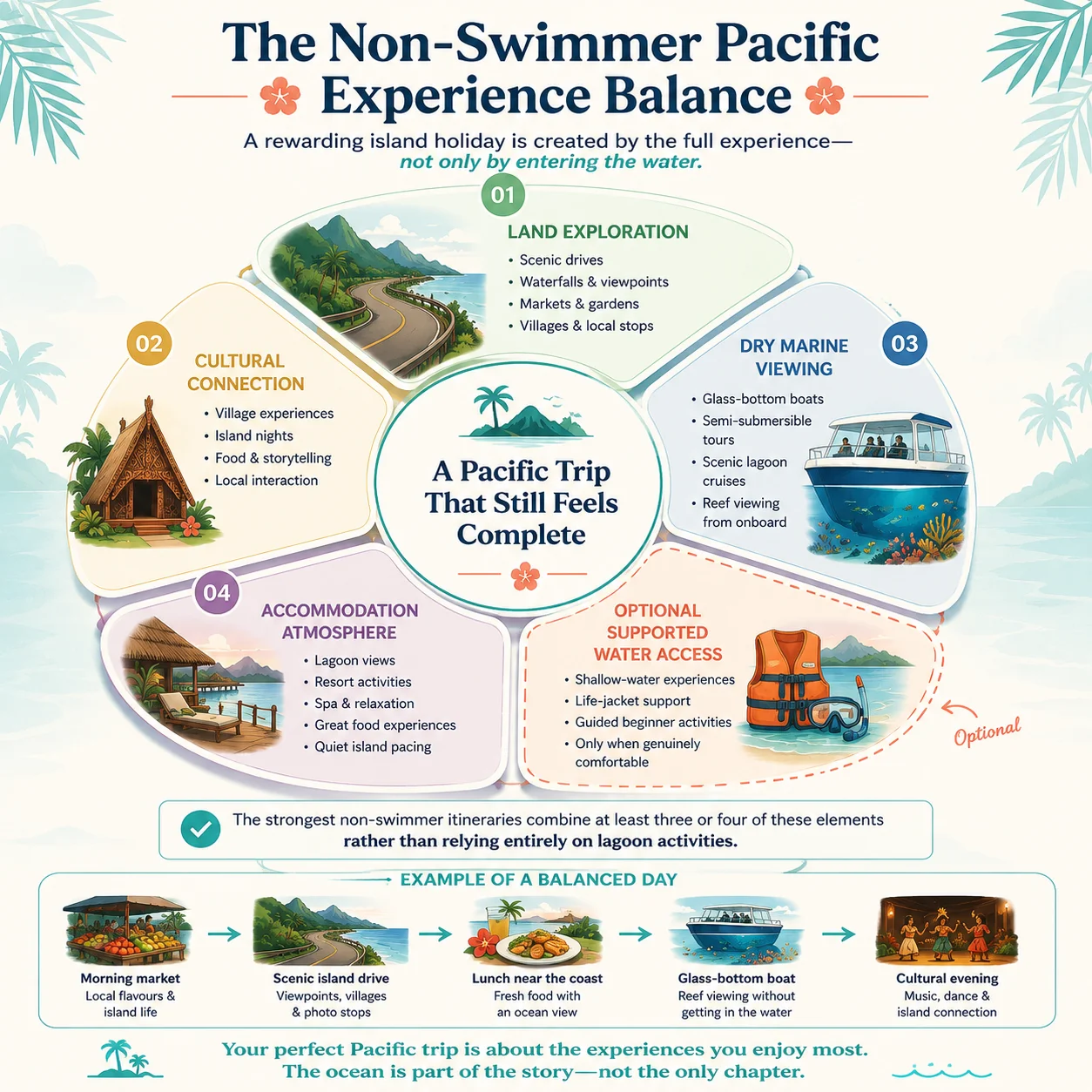
Non-swimmers sometimes arrive with one of two expectations. They may believe they will miss almost everything, or they may assume every advertised water excursion will be easy because life jackets are provided. Neither expectation is completely accurate.
| What Travelers May Expect | What the Experience Often Feels Like |
|---|---|
| There will be nothing meaningful to do without snorkeling | Well-chosen islands offer culture, food, markets, scenic drives, cruises, gardens, villages, walking, and resort experiences |
| Every lagoon is calm and shallow | Depth, coral, tides, currents, waves, and entry conditions vary significantly |
| A life jacket makes every water tour comfortable | Equipment supports flotation but does not remove anxiety, current, boat access, or open-water discomfort |
| Remaining on the boat will always be allowed | Some operators welcome dry passengers, while other tours are designed mainly around entering the water |
| A famous lagoon resort is automatically the best choice | A mainland or road-accessible island may provide more variety and better overall value |
| Learning to swim just before the trip solves the problem | Basic pool confidence does not automatically create comfort in deep, moving, or open water |
Social media usually shows the moment a traveler is floating over coral, not the boat briefing, ladder, current, depth, nervousness, or decision to remain onboard. It also underrepresents land-based moments that may become equally memorable: a village welcome, a slow coastal drive, a market breakfast, a mountain viewpoint, or an evening cultural performance.
Which Island Suits Your Holiday Style?
Non-swimmers should choose according to the type of holiday they want, not only according to water conditions. Two travelers who both avoid swimming may need completely different islands.
| Your Preferred Travel Style | Strongest Choice | Why It Fits |
|---|---|---|
| Comfortable resort holiday with varied activities | Fiji | Broad accommodation range, cultural programming, restaurants, tours, spas, and mixed-group flexibility |
| Independent island drive with cafés and slow days | Rarotonga | Compact road network, manageable scale, local food, cultural evenings, and easy sightseeing |
| Culture, villages, waterfalls, and raw scenery | Samoa | Strong sense of place, scenic roads, natural landscapes, and less resort-dominated travel |
| Seeing marine life while remaining dry | Vanuatu | Glass-bottom and semi-submersible reef-viewing possibilities around Port Vila |
| Romantic scenery with a comfortable budget | Moorea | Mountain and lagoon views, island drives, resorts, food stops, and scenic excursions |
| Local food, markets, and practical sightseeing | Tahiti | More urban and road-based experiences than smaller lagoon-centred islands |
A traveler who wants a restful resort week may find Fiji easier than Samoa. Someone who wants a road trip with stronger local atmosphere may prefer Samoa even though the tourism infrastructure is less polished. A couple seeking dramatic scenery may accept French Polynesia’s higher cost, while a traveler wanting easy daily variety may receive better value from Rarotonga.
How to Choose the Right Resort or Accommodation
Accommodation choice may affect a non-swimmer more than destination choice. Two resorts on the same island can create completely different holidays.
A remote island resort can look extraordinary, but it may have one restaurant, no public road access, limited evening activity, and a daily program centered on snorkeling, diving, kayaking, and paddleboarding. A mainland resort may look less exclusive but offer easier access to markets, tours, restaurants, villages, and scenic drives.
Before booking, check what a normal day looks like rather than reading only the headline activity list.
| Accommodation Question | Why It Matters for Non-Swimmers |
|---|---|
| Can the property be reached by road? | Road access usually provides more independence and avoids mandatory small-boat transfers |
| Are restaurants or shops nearby? | Nearby choices reduce the feeling of being confined to one resort |
| Which activities do not involve entering water? | A long generic activity list may contain very few genuinely suitable options |
| Can non-swimmers join boat trips and remain onboard? | Policies and boat layouts vary between operators |
| Is the beach entered over sand, rock, coral, or steps? | Even shallow water can be difficult when the entry is uneven or slippery |
| Does the resort provide evening programs? | Cultural evenings, music, food events, and demonstrations add variety after quiet days |
| Are land tours easy to arrange? | Accessible land excursions prevent the stay from becoming entirely lagoon-focused |
Location should be considered part of the experience rather than a small booking detail. A modest property near restaurants and road transport may create a more enjoyable non-swimmer holiday than an expensive remote bungalow surrounded by activities you do not plan to use.
Pacific Activities That Do Not Require Swimming
A non-swimmer itinerary should not feel like a list of substitutes. The Pacific offers experiences that are worthwhile in their own right and often reveal more about a destination than spending every day at the same beach.
Glass-Bottom and Semi-Submersible Boats
These experiences allow travelers to observe coral and marine life through viewing windows. Vanuatu is particularly useful for this type of activity, while glass-bottom excursions may also be available in parts of Fiji and other developed visitor areas.
Visibility depends on weather, water clarity, reef condition, and vessel design. Travelers should treat these trips as nature experiences rather than expecting the perfect underwater scene shown in promotional material.
Lagoon and Scenic Cruises
A cruise can still be enjoyable without snorkeling when the journey includes scenery, commentary, food, entertainment, cultural activities, or a comfortable island stop. Confirm that staying onboard is acceptable and ask how passengers reach any motu or beach included in the itinerary.
Village and Cultural Experiences
Village visits, cultural centers, demonstrations, storytelling, dance, food preparation, craft, music, and local history can become some of the most meaningful parts of a Pacific trip. The strongest experiences feel connected to real communities rather than performed only as a quick resort attraction.
Markets and Local Food
Markets reveal what daily island life looks, smells, and sounds like. Travelers may encounter tropical produce, cooked food, flowers, fish, crafts, clothing, and conversation. Opening times can be early, and the atmosphere often changes once the morning activity slows.
Scenic Drives
Rarotonga, Samoa, Tahiti, Moorea, Efate, and Fiji’s larger islands all offer varying forms of road-based exploration. Drives make it possible to combine coastline, villages, viewpoints, waterfalls, restaurants, gardens, and local stops at your own pace.
Gardens, Waterfalls, and Viewpoints
Not every waterfall needs to be entered. Some are most impressive from viewing areas or surrounding trails. Botanical gardens, plantations, mountain lookouts, volcanic landscapes, blowholes, and coastal paths add visual variety without requiring swimming.
Resort Experiences
Cooking demonstrations, spa treatments, crafts, music, cultural evenings, yoga, gardens, photography, food events, and quiet shaded spaces can matter more than expected. These are especially valuable during rain or when a traveling companion spends part of the day on the water.
Best For and Not Ideal For
A Pacific island holiday can be genuinely rewarding for non-swimmers, but the experience is strongest when the traveler still enjoys coastal scenery, boats, island pacing, and outdoor environments.
Best For
- Travelers who love ocean scenery without needing to enter the water
- Couples and families with different swimming abilities
- Visitors interested in culture, markets, food, villages, and local interaction
- Travelers who enjoy scenic drives and slower exploration
- People comfortable joining cruises while remaining onboard
- Visitors seeking resort relaxation, spas, and quiet days
- Travelers willing to ask detailed questions before booking excursions
Not Ideal For
- Travelers who strongly dislike boats, beaches, humidity, and coastal environments
- Visitors choosing remote marine resorts only because they look impressive online
- People expecting large-city entertainment and all-weather indoor attractions
- Travelers who feel pressured to join activities outside their comfort level
- Visitors who book snorkeling-focused itineraries without checking alternatives
- Travelers unwilling to accept weather changes and slower island logistics
Choose an Island Based on What Makes You Nervous
Two non-swimmers may have very different concerns. One may be comfortable on a large boat but afraid of deep water. Another may dislike boats entirely but enjoy beaches and road trips. Matching the destination to the specific concern is more useful than treating every non-swimmer as the same type of traveler.
| If You Are Most Concerned About… | Consider… | Why |
|---|---|---|
| Deep water or being unable to touch the bottom | Fiji’s mainland resort areas | You can build a varied holiday around resorts, road trips, cultural activities, food, markets, and gardens without relying on open-water excursions |
| Small boats and rough transfers | Rarotonga or Tahiti | Both offer road-based exploring and accommodation choices that do not necessarily require an outer-island boat transfer |
| Being trapped at an isolated resort | Rarotonga, Tahiti, or Fiji’s Coral Coast | Road access, restaurants, markets, villages, and independent sightseeing provide more control over each day |
| Missing all marine life | Vanuatu | Glass-bottom and semi-submersible trips may provide reef viewing without requiring snorkeling |
| Feeling pressured to participate in snorkeling | Samoa | The destination can be shaped more naturally around culture, villages, scenery, road trips, and land-based exploration |
| Not having enough activities | Fiji | Its broad tourism range makes it easier to combine resort time, culture, food, sightseeing, nature, and optional cruises |
| Paying for a lagoon experience you may not use | Samoa or Rarotonga | Both can provide strong atmosphere and exploration without requiring a high-priced luxury lagoon resort |
| Uneven paths, ladders, or difficult coastal access | Fiji’s larger resorts or Tahiti | More developed visitor infrastructure may provide easier access than remote caves, reef platforms, or rugged coastal sites |
This table is a starting point rather than a guarantee. Conditions vary between resorts, tours, beaches, and operators, so the final decision should be based on the exact accommodation and activities you plan to book.
Practical Planning for Non-Swimmers
The most useful planning happens before choosing the resort, cruise, or island transfer. Clear questions can prevent a beautiful-looking booking from becoming an uncomfortable experience.
- Explain your swimming ability honestly rather than describing yourself only as a beginner.
- Ask whether you can remain onboard for the entire boat excursion.
- Check whether reaching a beach or motu requires stepping into water.
- Ask about currents, depth, ladders, pontoons, boat movement, and boarding arrangements.
- Do not assume that “shallow lagoon” means flat, calm, or easy to walk through.
- Choose road-accessible accommodation when independence is important.
- Plan several meaningful land-based days before adding optional water activities.
- Leave weather flexibility around any important cruise or sightseeing flight.
Life jackets are valuable safety equipment, but they should not be treated as a complete answer to fear or discomfort. A traveler who panics in deep water may not enjoy floating away from shore even while wearing one.
It is also worth discussing expectations with traveling companions. A mixed group can plan some shared days, some separate activities, and one or two experiences where everyone can participate comfortably. This is usually better than expecting the non-swimmer to wait at the resort during every marine excursion.
Travel insurance should be read carefully, particularly when an itinerary includes boating, adventure activities, weather disruption, or remote island transfers. Operators should also be told about mobility limitations, severe anxiety around water, or difficulty using ladders before the booking is confirmed.
Common Traveler Misunderstandings
One misunderstanding is that non-swimmers cannot enjoy Pacific beaches. A beach can still provide scenery, shade, walking, photography, food, sunsets, and a strong sense of place. Enjoying the coast does not require spending hours in deep water.
Another is that all calm-looking lagoons are safe for inexperienced visitors. Conditions vary according to tide, wind, reef passages, depth, coral, boat traffic, and location. Visual calmness is not enough information.
Travelers also assume that every boat excursion welcomes passengers who remain onboard. Some do, while others are designed primarily as transport to a snorkeling location. The value may feel limited when most of the group spends a long period in the water and there is little to see from the vessel.
A further misconception is that Fiji, Samoa, Vanuatu, the Cook Islands, and French Polynesia offer similar holidays because they share tropical scenery. Fiji tends to offer the broadest resort variety. Samoa often feels more cultural and road-trip oriented. Rarotonga feels compact and independently manageable. Vanuatu can feel adventurous and locally connected. French Polynesia often feels more scenic, remote, polished, and expensive.
Finally, non-swimmers sometimes feel they must force themselves into a famous activity because they travelled so far. A holiday does not become more worthwhile because you spent it anxious. Choosing experiences that suit you personally is not missing the destination; it is experiencing the destination honestly.
Seasonal and Local Context
Pacific weather is tropical and variable. Drier periods may bring more comfortable temperatures and lower humidity, but they do not guarantee cloudless days or calm seas. Wetter periods may feel greener and quieter, although heavy showers, humidity, cyclones, rough water, and transport disruption become more relevant in some destinations.
Season matters even when you do not swim. Wind can affect cruises, scenic flights, beach comfort, ferry crossings, and visibility through glass-bottom boats. Rain can make trails slippery, reduce views, or change road conditions, while also strengthening waterfalls and deepening the green atmosphere.
School holidays and major travel periods can increase resort prices, tour demand, and crowd levels. The Cook Islands, Fiji, and French Polynesia may feel noticeably busier around popular holiday dates, even if they rarely resemble the crowd levels of major global beach destinations.
Cruise ship days can temporarily change the feel of markets, waterfront areas, and popular attractions. Travelers seeking a quieter atmosphere may want to ask accommodation hosts which days are usually busiest.
Island transfers also deserve extra time. Weather, mechanical issues, and schedule changes can affect small aircraft, ferries, and boats. A simple itinerary with one main base is often more comfortable than trying to move through several islands quickly.
Pacific Worth Note: I think non-swimmers often worry too much about whether they will experience the Pacific “properly.” The more useful question is whether the island still offers enough atmosphere, culture, scenery, and meaningful time when swimming is removed. A trip that feels comfortable and personally rewarding is worth more than completing an activity simply because every brochure includes it.
Frequently Asked Questions
Which Pacific Islands Are Best for Non-Swimmers?
Fiji, Rarotonga in the Cook Islands, Samoa, and Vanuatu are among the strongest choices. Fiji offers the broadest resort and activity variety, Rarotonga is easy to explore independently, Samoa provides culture and land-based scenery, and Vanuatu offers opportunities to view reefs while remaining dry.
Can I enjoy Fiji if I cannot swim?
Yes. Fiji offers resorts, cultural activities, village visits, markets, gardens, river trips, scenic drives, spas, food experiences, and boat excursions. A mainland or road-accessible resort usually provides more non-swimming variety than a very small outer-island property.
Are lagoon cruises suitable for non-swimmers?
Some lagoon cruises welcome non-swimmers who prefer to remain onboard, but this should be confirmed directly. Ask whether snorkeling is optional, how passengers board, whether any island stop requires walking through water, and what can be seen from the boat.
Is Samoa worth visiting if I do not swim?
Yes, especially if you enjoy culture, villages, scenic drives, waterfalls, markets, volcanic landscapes, coastal viewpoints, and slower road trips. Some famous attractions are swimming-focused, so the itinerary should include a wider range of cultural and land-based experiences.
Is Bora Bora suitable for non-swimmers?
Bora Bora can suit non-swimmers who value lagoon views, luxury resorts, privacy, scenery, and boat journeys. It may offer weaker value for travelers seeking varied land activities because much of its appeal and cost are connected to the lagoon and resort experience.
Which Pacific island is best if I dislike small boats?
Rarotonga, Tahiti, and road-accessible parts of Fiji may be better starting points because travelers can build much of the holiday around driving, restaurants, markets, cultural attractions, and land-based sightseeing. Always check whether the chosen accommodation requires a boat transfer.
Can non-swimmers see coral reefs in the Pacific?
Yes, in some destinations. Glass-bottom and semi-submersible boat experiences can allow travelers to view coral and fish without entering the water. Vanuatu is one of the stronger choices for this type of dry marine-viewing experience.
Final Thoughts
So, which Pacific islands are best for non-swimmers? Fiji is the strongest overall choice for travelers who want resort comfort, variety, and flexibility. Rarotonga suits independent visitors who enjoy a compact island, slow drives, cafés, culture, and lagoon scenery. Samoa works best for travelers drawn to local atmosphere, landscapes, and road trips. Vanuatu stands out for visitors who want to see reef life without necessarily entering the water.
Tahiti and Moorea can also feel worthwhile when scenery, food, island drives, and resort atmosphere matter more than completing every lagoon activity. Bora Bora is more selective: memorable for travelers who value privacy and visual drama, but potentially expensive when many water experiences are removed.
Tonga and Niue may appeal to travelers seeking quieter, less conventional destinations, but both require more careful matching. Tonga’s visitor appeal is strongly connected to marine experiences, while Niue’s dramatic coastal sites can involve rugged paths, steps, rocks, or difficult access.
The most important decision is not whether a destination has calm water. It is whether the holiday remains complete without relying on that water. Look at accommodation location, road access, cultural depth, food options, dry boat experiences, sightseeing variety, and how a normal unplanned day would feel.
A carefully chosen Pacific island can offer non-swimmers much more than a view from the beach. It can provide warm local interactions, slow mornings, dramatic landscapes, market visits, scenic journeys, cultural evenings, memorable food, and the rare feeling of having enough time to notice where you are.
The trip is less likely to feel worthwhile when it is built around pressure to swim, a remote resort with few alternatives, or an itinerary copied from travelers with completely different interests. It is more likely to feel worth the journey when the island suits your real comfort level, personality, budget, and preferred pace of travel.
The best Pacific island for a non-swimmer is not simply the one with the bluest lagoon. It is the one where your favourite memories can happen long before you ever need to think about entering the water.
Leave a Reply