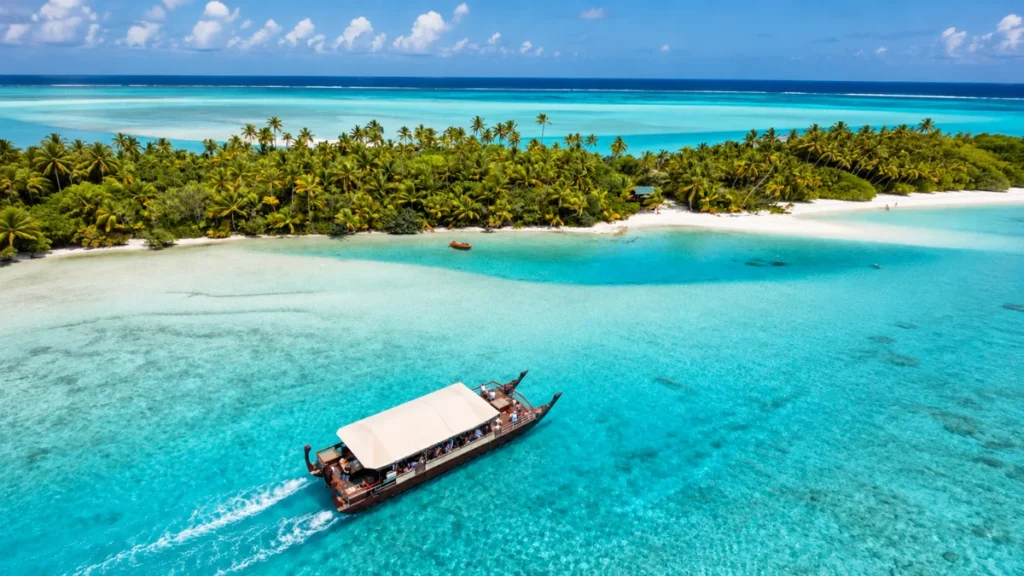
Choosing a Pacific island for its lagoon can be surprisingly difficult. Bora Bora, Aitutaki, Moorea, Fiji, and other destinations can all look extraordinary in photographs, yet the experience around those lagoons can feel very different once you arrive.
For the strongest overall combination of vivid lagoon colour, dramatic scenery, and the feeling of being surrounded by water, Bora Bora is difficult to beat. Aitutaki is a very close alternative and may suit travelers better if they want a quieter, more lagoon-focused experience with less emphasis on polished resort luxury.
The difference matters because a beautiful lagoon is not only about how blue the water looks. Some lagoons feel dramatic and cinematic. Others feel peaceful, open, local, adventurous, or easy to explore. Budget, accommodation, weather, transport, and your preferred pace of travel can influence the experience just as much as the scenery.
This comparison looks at which Pacific island has the most beautiful lagoon experience through scenery, atmosphere, accessibility, swimming and snorkeling, cost, traveler fit, and what spending time around the water genuinely feels like.
The Short Answer: Bora Bora and Aitutaki Stand Apart
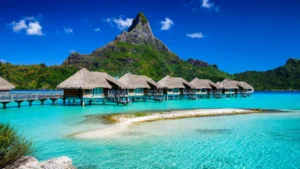
If I had to choose one island for the most complete visual lagoon experience, I would choose Bora Bora. The lagoon wraps around a dramatic volcanic landscape, with Mount Otemanu rising in the middle and small motu scattered around the surrounding reef.
That combination gives Bora Bora something unusual. You are not simply looking across beautiful blue water. The lagoon, mountain, reef, boats, and small islands all become part of the same landscape.
Aitutaki, however, makes the decision much closer than its smaller international profile might suggest.
Aitutaki feels less like a famous island surrounded by a lagoon and more like a huge lagoon with small pieces of land scattered through it. Long stretches of shallow blue water, sandbars, reef areas, and tiny motu make the lagoon itself the main event.
The simplest difference is this:
Bora Bora offers the more dramatic overall setting. Aitutaki can offer the more lagoon-focused day-to-day experience.
| Destination | Lagoon Character | Overall Feel | Best For | Main Tradeoff |
|---|---|---|---|---|
| Bora Bora | Bright lagoon surrounding a dramatic mountainous island | Scenic, polished, romantic, remote | Iconic Pacific scenery and special trips | High accommodation and activity costs |
| Aitutaki | Huge shallow lagoon dotted with small motu | Open, quiet, slow, relaxed | Travelers who want the lagoon itself to dominate the trip | More remote with fewer tourism options |
| Moorea | Clear lagoon areas beneath steep green mountains | Relaxed, varied, lived-in | Lagoon time combined with exploring on land | Less continuously lagoon-focused than Bora Bora |
| Fiji | Highly varied depending on island and reef location | Warm, social, diverse | Reefs, families, resorts, culture, and island variety | You need to choose the specific island carefully |
How This Lagoon Comparison Is Judged
There is no objective measurement that can declare one Pacific lagoon the most beautiful for every traveler. A comparison like this becomes more useful when the destinations are judged consistently rather than simply ranked by photographs.
Here, the lagoon experience is considered through several practical factors: the visual setting, how strongly the lagoon shapes the destination, access to swimming and snorkeling, opportunities to experience the water by boat, surrounding island atmosphere, crowd and resort feel, ease of exploration, travel logistics, and the cost required to experience what makes the destination special.
Conditions also vary within individual islands. Water clarity, wind, tides, weather, reef access, and the exact location of your accommodation can all influence what you experience. The comparisons below are therefore best understood as traveler-fit guidance rather than guarantees about a particular day or beach.
What Makes a Lagoon Experience Truly Beautiful?
There is an important difference between an island having beautiful water and having a beautiful lagoon experience.
A beach can have perfectly clear turquoise water without creating the broad lagoon landscape many travelers imagine when they think of the South Pacific. In the same way, an island can have an extraordinary lagoon that you barely experience if most of your trip is spent beside a resort pool or moving between activities on land.
The strongest lagoon experiences combine water colour, clarity, scale, surrounding scenery, swimming access, snorkeling, boat experiences, reef life, quietness, and how much the lagoon shapes the ordinary rhythm of your day.
That final point matters more than it may seem.
The most memorable lagoon is not always the one that looks best in a single photograph. It may be the lagoon you cross in the morning, swim in during the afternoon, eat beside at sunset, and watch change from pale turquoise to deeper blue as the light and weather move across the island.
The Real Pacific Travel Reality Check
Pacific lagoon travel often looks effortless online. Reaching some of the most beautiful lagoons can require more patience.
International travelers may need to connect through a larger Pacific gateway before continuing by domestic flight, ferry, small aircraft, or resort boat. Aitutaki generally involves another flight after reaching Rarotonga. Bora Bora is normally reached after arriving in Tahiti. Some of Fiji’s smaller islands require additional boat or air transfers.
Those extra steps matter when your holiday is short. A spectacular remote lagoon may be worth the journey when you have plenty of time, while a traveler with only four or five nights may reasonably prefer somewhere easier to reach.
If flight time is important to your decision, our guide to which Pacific islands are easiest to reach from Australia can help put the travel logistics into perspective.
Weather adds another layer. Tropical rain can appear during otherwise beautiful weeks, while wind can affect snorkeling visibility, lagoon cruises, and boat comfort. Remote transport may also run less frequently than travelers are accustomed to in larger tourism destinations.
Remoteness can increase everyday costs too. Fuel, food, building materials, and many other supplies travel long distances before reaching smaller islands, so even relatively simple accommodation or meals can sometimes cost more than expected.
None of this makes remote Pacific travel less worthwhile. It simply means the journey, cost, and flexibility required should be considered alongside the photograph that first made you want to go.
What Many Lagoon Comparisons Miss
Many lagoon comparisons focus almost entirely on water colour. The problem is that beautiful water is only part of what you remember when the trip is over.
Bora Bora feels dramatic partly because Mount Otemanu continually influences the view. Aitutaki feels peaceful because so much of its lagoon appears open and lightly developed. Moorea feels more varied because the water sits alongside roads, valleys, mountains, bays, small businesses, and ordinary island life.
Fiji can feel more social and active. A lagoon day might sit alongside resort activities, diving, family time, cultural experiences, or another island journey. The water matters, but it does not always dominate the entire holiday.
Those differences determine whether a destination feels romantic, adventurous, local, polished, quiet, social, or remote.
This is similar to the broader choice explored in our comparison of Fiji vs French Polynesia. The destination that creates the strongest memory is not necessarily the one with the most famous photograph.
What Makes Each Pacific Lagoon Feel Different?
Looking at lagoon destinations through experience rather than appearance makes their differences much clearer.
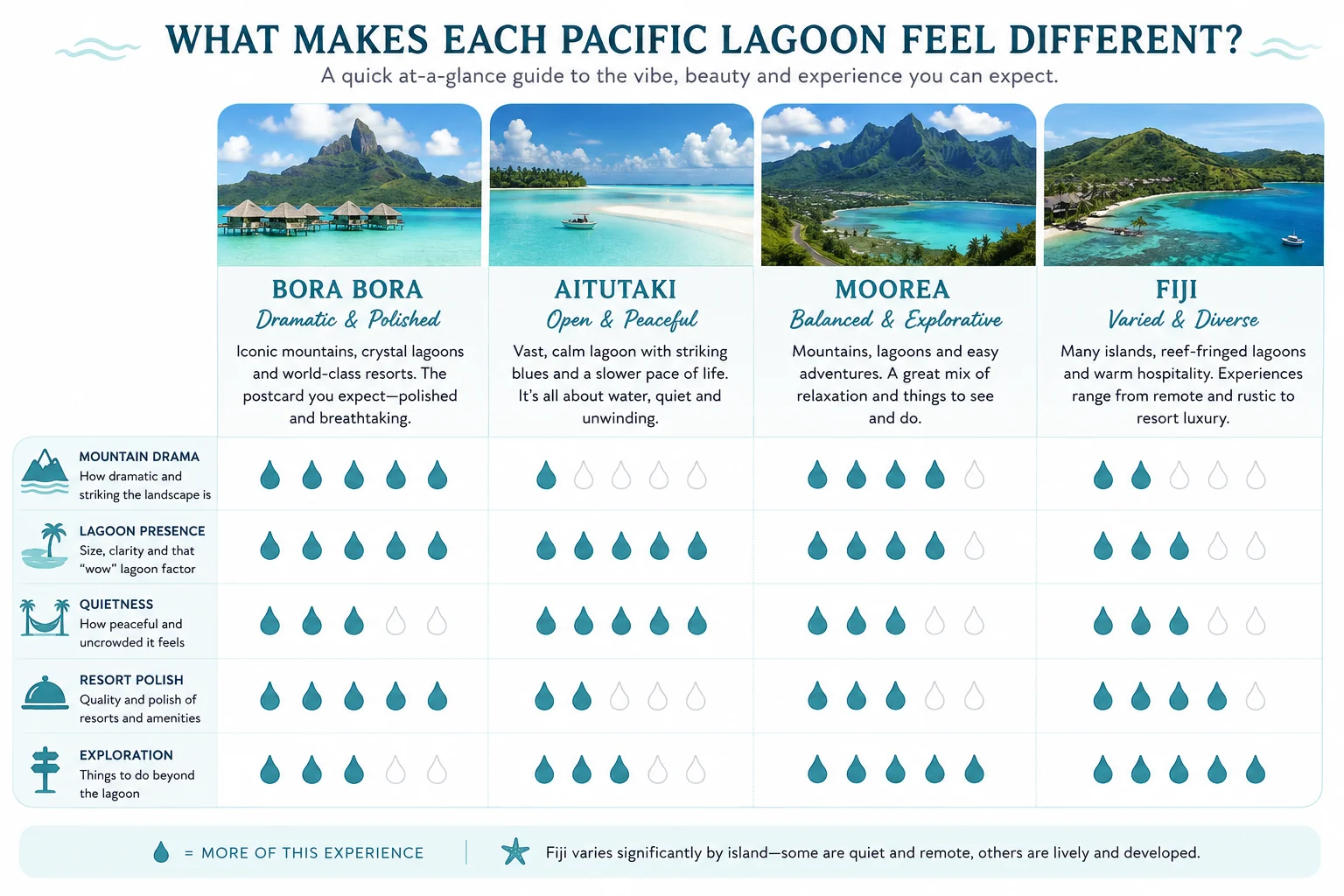
| Experience Factor | Bora Bora | Aitutaki | Moorea | Fiji |
|---|---|---|---|---|
| Mountain drama | Very high | Low | Very high | Varies by island |
| Lagoon presence | Very high | Very high | High | Varies considerably |
| Quietness | Moderate to high | Very high | Moderate to high | Varies considerably |
| Resort polish | Very high | Moderate | Moderate to high | Low to very high |
| Independent exploration | Moderate | Moderate | Very high | High depending on location |
This is why asking which Pacific island has the most beautiful lagoon experience does not produce one perfect answer. Bora Bora can be visually stronger while Aitutaki feels calmer. Moorea can provide more balanced days, while Fiji offers considerably more variation from one island to another.
Bora Bora: The Most Dramatic Overall Lagoon Setting
Bora Bora has one major advantage over almost every other destination in this comparison: the island and lagoon strengthen each other visually.
Mount Otemanu rises steeply from the centre while the surrounding reef creates a broad protected lagoon. Shallow sections can appear pale aqua, deeper channels become stronger blue, and small motu interrupt the water around the outer reef.
From a boat, these colour changes become particularly noticeable as you move repeatedly between different depths.
The result is a destination where the lagoon rarely feels like a separate attraction. It becomes the setting for almost everything.
What Bora Bora Actually Feels Like
Bora Bora often feels calm, scenic, polished, and deliberately slow. Tourism is well established, and many of the most famous lagoon locations are associated with resorts, private motu, and overwater accommodation.
A resort stay can create a strong sense of separation from ordinary life. Days may revolve around breakfast beside the water, snorkeling, a lagoon excursion, swimming, reading, eating slowly, and watching Mount Otemanu change as clouds move across the island.
That polished version of Bora Bora is real, but it is not the entire destination. The main island also contains homes, shops, roads, local businesses, schools, and everyday island routines.
You also do not need an overwater bungalow to appreciate the lagoon. Boat trips can provide some of the most memorable water experiences regardless of where you sleep.
Cost, however, is a genuine tradeoff. Our separate guide to how much a Bora Bora trip actually costs explains why accommodation style can change the overall budget significantly.
Best For
- Travelers wanting the classic dramatic South Pacific lagoon landscape
- Couples and special-occasion trips
- Travelers who value scenery and atmosphere as much as activities
- People who enjoy slow days built around water
- Travelers comfortable with higher costs for location and remoteness
Not Ideal For
- Very tight travel budgets
- Nightlife-focused trips
- Travelers who want constant sightseeing
- People who dislike resort-focused destinations
Aitutaki: Perhaps the Purest Lagoon Experience
Aitutaki is the destination that comes closest to challenging Bora Bora, but it does so for different reasons.
Instead of one dramatic volcanic mountain dominating the view, Aitutaki creates a stronger feeling of openness. Its large lagoon spreads between the main island, reef, small motu, sandbars, and shallow water that can appear almost luminous in strong sunlight.
The scale is difficult to appreciate properly from shore. It becomes much clearer once you move across the lagoon by boat.
That is where Aitutaki has a strong argument for offering the better pure lagoon experience.
The lagoon is not simply scenery surrounding your accommodation. Exploring it can become the central activity of the visit. A slow lagoon cruise, swimming near a sandbar, snorkeling beside reef areas, or stopping on a small motu can fill much of a day without making the itinerary feel busy.
What Aitutaki Actually Feels Like
Aitutaki generally feels quieter, smaller, and less tourism-dominated than Bora Bora. There are polished places to stay, but the destination is less strongly defined by high-end resort imagery.
The pace is genuinely slow. That can be wonderful for travelers wanting uncomplicated days around the water, but it may feel too quiet for people who need extensive nightlife, shopping, restaurant choice, or a different major attraction every day.
Aitutaki’s relative lack of distractions is therefore both a tradeoff and one of the reasons its lagoon feels so central to the experience.
It is commonly combined with Rarotonga, and travelers considering that type of itinerary may also find our guide to whether Rarotonga is worth visiting for a short island escape useful.
Best For
- Slow travelers
- Couples wanting quiet without requiring extreme luxury
- Travelers who genuinely enjoy being on the water
- People looking for a less developed lagoon atmosphere
Not Ideal For
- Travelers wanting nightlife and extensive shopping
- People who dislike additional island transfers
- Visitors who want a packed sightseeing itinerary
- Travelers who become restless in very quiet destinations
Moorea: Lagoon Beauty With More Island Variety
Moorea is different again.
Its lagoon can be extremely beautiful, particularly where clear water sits beneath steep green mountains, but the island rarely feels as completely dominated by the lagoon as Bora Bora or Aitutaki.
For some travelers, that is an advantage.
Moorea offers more opportunities to move between water and land. Roads circle the island, dramatic bays break up the coastline, mountains remain visually important, and independent exploration can become a larger part of the trip.
What Moorea Actually Feels Like
Moorea generally feels more lived-in and less separated from everyday island life than the most resort-focused parts of Bora Bora.
You might spend the morning snorkeling, drive around the island later, stop somewhere for lunch, visit a viewpoint, and still return to the lagoon in the afternoon.
This makes Moorea particularly suitable for travelers who worry that several consecutive days in a lagoon resort might eventually feel repetitive.
Bora Bora often encourages you to stop and admire where you are. Moorea tends to encourage you to explore.
We compare that choice more closely in Bora Bora vs Moorea: Which Is More Worth It?.
Best For
- Travelers wanting lagoon scenery without making it the entire holiday
- Independent explorers
- Couples who enjoy a mixture of relaxation and activity
- Travelers interested in mountain scenery as well as water
Not Ideal For
- Travelers whose only priority is the most iconic lagoon view
- Visitors wanting complete resort seclusion
- People expecting every coastline to resemble Bora Bora
Fiji: The Most Varied Lagoon Experience
Fiji is harder to place in a simple lagoon ranking because there is no single Fiji lagoon experience.
Viti Levu, the Mamanuca Islands, Yasawa Islands, and smaller offshore resort islands can feel remarkably different from one another.
Some locations have shallow turquoise water and easy reef access. Others are better known for beaches, surf, diving, deep-water access, resort facilities, or cultural experiences rather than a classic enclosed lagoon.
That variation is both Fiji’s weakness and its strength in this comparison.
You cannot simply book any Fiji resort and assume the surrounding water will resemble Bora Bora. The specific island, coastline, reef, and accommodation location matter.
However, Fiji gives travelers far more ways to combine beautiful water with family travel, diving, resort activities, cultural experiences, different budgets, and different levels of remoteness.
What Fiji Actually Feels Like
Fiji can feel more social and varied from day to day than a highly lagoon-focused destination.
Depending on where you stay, days can move between snorkeling, village or cultural experiences, boat trips, family activities, diving, swimming, resort time, and simply relaxing beside the water.
For many travelers, this can make Fiji the better overall holiday, even when Bora Bora or Aitutaki provides the stronger pure lagoon setting.
Our article explaining why travelers keep returning to Fiji looks more closely at why its appeal often extends beyond scenery.
Pacific Lagoon Expectation vs Reality
Lagoon destinations are particularly vulnerable to unrealistic expectations because photographs capture one moment under one set of conditions.
| What Travelers May Expect | What Pacific Lagoons Often Feel Like |
|---|---|
| The lagoon looks bright turquoise every hour of every day | Water colour changes with sunlight, depth, clouds, wind, tide, and weather |
| Every coastline on a famous island looks equally beautiful | Lagoon conditions and swimming access can vary significantly around the same island |
| Beautiful lagoons automatically mean empty beaches | Popular resorts, boat stops, and famous locations can still feel busy |
| An overwater bungalow is essential | Boat trips, snorkeling, swimming, and lagoon cruises can provide more meaningful water time |
| Island hopping is quick and simple | Flights, ferries, small boats, weather, and transfer schedules require realistic planning |
| The most expensive destination must have the best lagoon | Quieter and less famous islands can provide equally rewarding experiences for the right traveler |
Social media can also hide ordinary tropical weather. A lagoon photographed under strong midday sun can look almost fluorescent. The same stretch of water beneath heavier cloud may become a much softer blue.
Wind changes the mood too. A still morning can produce smooth, reflective water, while stronger afternoon breezes may make the same lagoon look rougher and less transparent.
Neither version is false. They are simply different conditions within the same destination.
Which Lagoon Feels Most Beautiful From the Water?
This is where the difference between Bora Bora and Aitutaki becomes particularly interesting.
In Bora Bora, Mount Otemanu provides a dramatic reference point while you move around the lagoon. Even as you travel away from the main island, you repeatedly look back toward the mountain.
This gives the lagoon a strong sense of place. Its scenery is unmistakably connected to Bora Bora itself.
Aitutaki feels different once you move farther across its lagoon. The experience becomes more about open water, shallow sand, reef edges, small islands, and distance.
Instead of feeling monumental, it can feel spacious.
If your idea of lagoon beauty is a dramatic mountain rising from vivid blue water, Bora Bora is stronger. If it involves spending hours crossing a huge quiet lagoon between motu and sandbars, Aitutaki may be more rewarding.
Which Is Better for Swimming and Snorkeling?
A beautiful lagoon does not automatically mean perfect swimming everywhere.
Depth, tides, coral, currents, boat channels, sea life, and access can vary even within the same destination. Some beautiful stretches are ideal for swimming directly from shore. Others are shallow, rocky, coral-heavy, or better experienced by kayak or boat.
This is why lagoon excursions often add more value than travelers initially expect. Boat trips can reach reef areas, deeper snorkeling sites, motu, and swimming locations that may be difficult to access from your accommodation.
Fiji becomes particularly competitive when underwater variety matters more than the appearance of one continuous lagoon. Its different island groups provide very different reef and snorkeling environments.
Travelers who are not confident swimmers should not assume lagoon destinations have little to offer them either. Scenic boat trips, shallow-water areas, beaches, sandbars, and shoreline experiences can still be worthwhile. Our guide to which Pacific islands are best for non-swimmers looks at that decision separately.
How the Lagoon Atmosphere Changes Between Islands
The atmosphere around the water may ultimately matter more than small differences in lagoon colour.
| Destination | Morning Feel | Daytime Rhythm | Evening Mood |
|---|---|---|---|
| Bora Bora | Quiet, polished, scenic | Lagoon activities mixed with slow resort time | Calm, romantic, often very quiet |
| Aitutaki | Slow, open, peaceful | Boat trips, swimming, island exploring, simple meals | Very quiet and lightly developed |
| Moorea | Relaxed and more active | Lagoon time mixed with driving, viewpoints, food stops, and exploration | Relaxed with more variety than smaller lagoon islands |
| Fiji | Highly dependent on island | Can be social, family-focused, adventurous, resort-based, or very quiet | Ranges from remote calm to a livelier resort atmosphere |
A traveler who values extremely quiet evenings may find Aitutaki ideal. Someone wanting occasional restaurants, driving, and independent exploration may feel more comfortable on Moorea. Families or travelers wanting more organised choices may prefer particular parts of Fiji.
Lagoon Beauty vs Budget
Price changes the value equation considerably.
Bora Bora may provide the strongest overall lagoon scenery, but experiencing the polished version shown in tourism campaigns can become expensive quickly. Premium accommodation, overwater villas, meals, transfers, and lagoon activities can turn a relatively short visit into a substantial travel expense.
Aitutaki is not necessarily a budget destination either. Its remote location affects flights, accommodation, food, and supplies. However, travelers may feel less pressure to stay in an ultra-premium resort because exploring the lagoon itself can provide much of the destination’s appeal.
Moorea can provide more flexibility through a broader mix of accommodation and greater opportunities for independent exploration. Fiji has the widest cost range because staying on Viti Levu feels financially very different from staying at a remote private-island resort.
| Destination | Budget Pressure | What Drives the Cost | When the Cost Makes Most Sense |
|---|---|---|---|
| Bora Bora | High | Remote location, resort positioning, food, transfers, and premium accommodation | When the lagoon and scenery are major reasons for the journey |
| Aitutaki | Moderate to high | Domestic flight, small tourism market, remote supplies, and limited accommodation | When quiet lagoon days matter more than extensive entertainment |
| Moorea | Moderate to high | French Polynesian pricing, accommodation, food, and activities | When you want lagoon scenery with more independent exploration |
| Fiji | Low to very high | Island choice, resort level, boat transfers, meals, and activity packages | When you carefully match the island to your budget and travel style |
The key lesson is that the most expensive lagoon is not automatically the most worthwhile one. Value depends on how much you personally care about what the additional money buys.
Choose the Lagoon That Fits Your Travel Style
Instead of choosing only from photographs, start with the kind of experience you want your days to have.
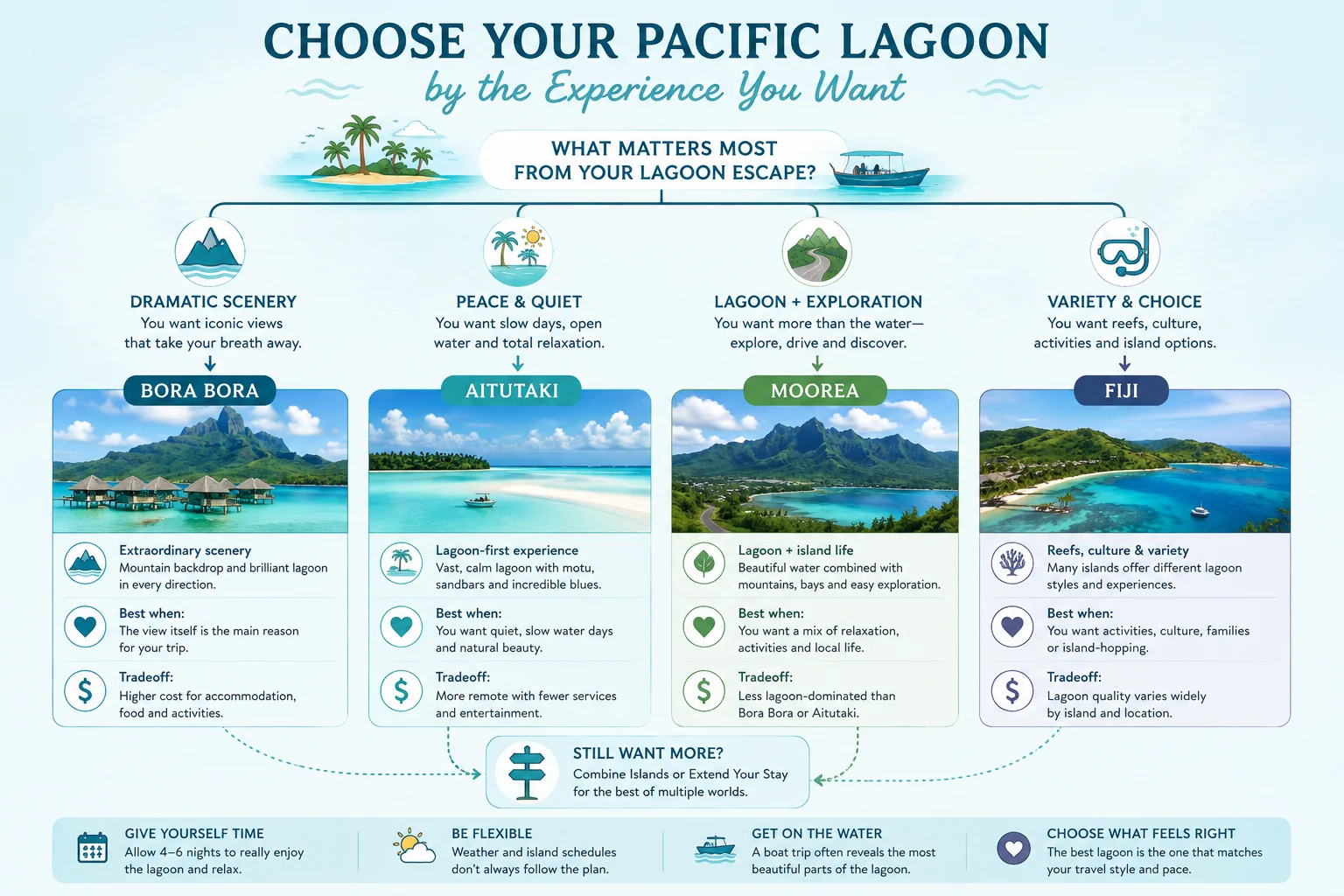
| If You Want… | Strongest Fit | Why | Main Tradeoff |
|---|---|---|---|
| The most dramatic iconic lagoon scenery | Bora Bora | The mountain and lagoon create an unusually complete landscape | Higher overall cost |
| A quiet lagoon-focused escape | Aitutaki | The lagoon dominates the experience with fewer distractions | Fewer services and entertainment options |
| Lagoon beauty plus land exploration | Moorea | More varied days and easier independent movement | Less lagoon-dominated than Bora Bora |
| Reefs, resorts, culture, and island variety | Fiji | Many island styles and accommodation choices | Lagoon character varies greatly by location |
| A polished romantic escape | Bora Bora | Strong resort infrastructure combined with dramatic scenery | Higher prices and a stronger tourism focus |
| Very slow and simple island days | Aitutaki | Quiet atmosphere and a strong focus on water | May feel too quiet for highly active travelers |
This is ultimately more useful than asking which water is technically the bluest. The strongest destination is the one whose scenery and everyday rhythm match the holiday you actually want.
Seasonal and Weather Context
There is no month that guarantees perfect lagoon conditions across the Pacific.
Many South Pacific destinations broadly experience a cooler and somewhat drier period around May to October, followed by warmer, wetter, and more humid conditions around November to April. Exact patterns vary by destination and year.
For lagoon trips, wind can matter almost as much as rain.
Calmer conditions may provide smoother boat rides and clearer-looking water. Windier days can make the surface choppier and reduce the glassy appearance travelers often associate with resort photographs.
Cloud cover can change the mood quickly too. A lagoon that appears bright turquoise under strong sun may look deeper and softer when clouds move overhead.
This is one reason a very short lagoon trip can feel risky if everything depends on one specific excursion day. Leaving some flexibility gives you more room to work around changing conditions.
Practical Lagoon Travel Insights
A few thoughtful choices can make a lagoon-focused Pacific trip considerably more rewarding.
- Research the exact accommodation location. Water conditions can change around the same island.
- Budget for at least one good lagoon excursion. Many islands reveal themselves better from the water than from shore.
- Look at photographs taken under different conditions. Do not judge a destination from one perfectly sunny image.
- Allow realistic transfer time. Domestic flights, ferries, and resort boats can take a meaningful part of the day.
- Keep some water time flexible. Wind or rain may change the best day for snorkeling or cruising.
- Think about evenings before booking. A wonderfully quiet island during the day may become extremely quiet after sunset.
- Choose the destination before choosing the resort. A beautiful room cannot compensate for an island that does not suit your travel style.
Popular properties can also book well ahead during stronger travel periods. Our guide explaining how early you should book Pacific island resorts can help with accommodation planning.
Common Traveler Misunderstandings
Not every Pacific island has a Bora Bora-style lagoon. Pacific islands have very different coastlines and reef structures. Some have broad protected lagoons, while others have narrower reef areas, volcanic coastlines, surf breaks, or beaches facing more open ocean.
The most expensive resort does not automatically have the best water. Price can reflect room design, privacy, service, food, exclusivity, and resort facilities rather than noticeably better lagoon conditions.
An overwater bungalow is not required for a meaningful lagoon experience. For some travelers, spending less on the room and more on boat trips, snorkeling excursions, or additional nights may result in more actual time enjoying the water.
Lagoon destinations are not only for honeymooners. Romantic tourism is prominent in places such as Bora Bora, but these destinations can also suit families, solo travelers, snorkelers, divers, photographers, and people who simply enjoy slower island travel.
Most importantly, beautiful lagoon destinations are still real tropical places. Weather changes, transport can require patience, imported food may cost more than expected, and remote island routines may move differently from those in major tourism cities.
Pacific Worth Note: I think the most useful way to judge a lagoon is by how much it adds to the experience of being there, not just how impressive it looks in one photograph. A slow boat ride, an unhurried swim, or watching the water change with the weather can matter more than finding the exact viewpoint you first saw online.
Frequently Asked Questions
Which Pacific island has the most beautiful lagoon experience?
Bora Bora is the strongest overall choice for travelers wanting dramatic lagoon scenery combined with a mountainous island backdrop. Aitutaki is a very close alternative and may suit travelers better if they want a quieter, more lagoon-focused experience.
Is Aitutaki’s lagoon better than Bora Bora?
Aitutaki can be better if your priority is spending long, quiet days exploring the lagoon itself. Bora Bora generally provides the more dramatic overall setting because its mountain scenery rises directly above the surrounding lagoon.
Which Pacific island has the best lagoon without requiring a luxury resort?
Aitutaki and Moorea are particularly appealing because memorable lagoon experiences do not depend entirely on ultra-premium overwater accommodation. Boat trips, snorkeling, swimming, and exploring the island can provide much of the experience.
Is Fiji better than Bora Bora for lagoon travel?
Fiji can be better for travelers who want more variety, family activities, reef experiences, cultural interaction, and different accommodation choices. Bora Bora is generally stronger if your priority is one dramatic and visually distinctive lagoon setting.
How many days should you spend on a Pacific lagoon island?
For many travelers, around four to six nights gives enough time to enjoy lagoon activities while leaving some flexibility for weather and transfers. Remote destinations may deserve longer because reaching them takes more time. Travelers choosing Bora Bora can also read our guide to how many days you really need in Bora Bora.
Final Thoughts
So, which Pacific island has the most beautiful lagoon experience? Bora Bora is my overall choice for the strongest complete lagoon setting. The combination of Mount Otemanu, reef, motu, and changing shades of blue creates a landscape that is difficult to reproduce elsewhere.
That does not make Bora Bora automatically better for every traveler.
Aitutaki may offer the more rewarding lagoon-focused experience if you want quiet water, small motu, slow boat days, and fewer distractions. Its simplicity can be exactly what makes the lagoon feel so important to the trip.
Moorea is likely to suit travelers who want beautiful water while still having plenty to explore on land. Fiji becomes stronger when resort variety, culture, reefs, families, activities, and different travel budgets matter alongside lagoon scenery.
The most beautiful Pacific lagoon is therefore not simply the one with the brightest turquoise water.
It is the lagoon whose atmosphere, pace, cost, accessibility, and surrounding island experience best match the kind of Pacific journey you genuinely want to have.
Leave a Reply