Booking a Pacific island resort can feel surprisingly difficult. You may find a beautiful place months before your trip and wonder whether you should reserve it immediately or wait in case a better rate appears. The decision becomes even less obvious when flights, school holidays, island transfers, weather seasons, and limited room choices all affect the same journey.
For many Pacific island holidays, booking your resort 4 to 8 months ahead gives you a useful balance of choice and flexibility. For Christmas, school holidays, honeymoons, highly sought-after resorts, or destinations with limited accommodation, 8 to 12 months ahead can be sensible. Flexible travelers visiting during quieter periods may still find suitable options 2 to 4 months before travel.
The right timing depends on more than the destination name. A large resort area in Fiji works differently from a small property on a remote island. Bora Bora has different pressures again, especially when travelers want a particular overwater bungalow, view, meal plan, or transfer arrangement.
This article explains how early you should book Pacific island resorts, when booking far ahead genuinely helps, when waiting can still work, and how to judge the right booking window for your own dates, budget, travel style, and expectations.
A Realistic Pacific Resort Booking Timeline
There is no single booking deadline that suits every Pacific trip. It is more useful to think in planning ranges based on how fixed, popular, remote, or important the holiday is.
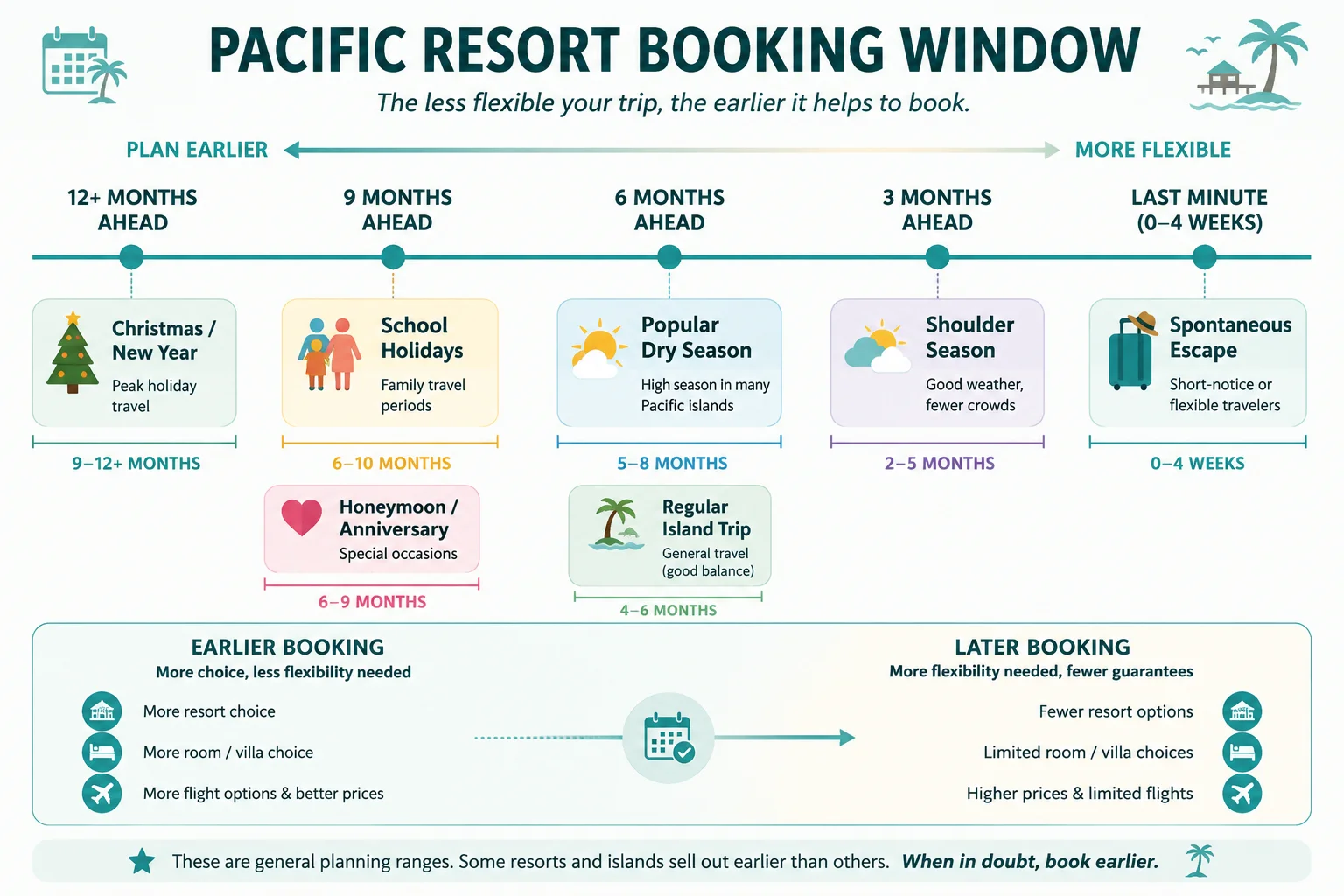
| Travel Situation | Useful Booking Window | Why It May Help |
|---|---|---|
| Christmas and New Year | 9 to 12+ months ahead | Popular dates, family rooms, convenient flights, and well-known resorts can become limited. |
| Australian or New Zealand school holidays | 6 to 10 months ahead | Family-friendly resorts and larger room configurations may face stronger demand. |
| Honeymoon or anniversary trip | 6 to 10 months ahead | You may want a particular resort, room category, view, atmosphere, or experience. |
| Popular dry-season holiday | 5 to 8 months ahead | More travelers may be choosing the same comfortable weather period. |
| Regular trip with some flexibility | 4 to 6 months ahead | This often provides a reasonable choice of flights, rooms, and locations. |
| Shoulder-season holiday | 2 to 5 months ahead | Quieter demand and flexible dates can make later planning more practical. |
| Very flexible last-minute escape | Under 2 months | Possible when you can accept the resorts, room types, and flight times still available. |
These are general planning ranges, not guarantees of price or availability. A particular resort can fill much earlier than the destination around it, while another property on the same island may still have plenty of space. Always check the current cancellation terms, transfer requirements, and availability for the exact property you are considering.
Why Pacific Resort Booking Is Different
On a city holiday, losing your first-choice hotel may not change the trip very much. There may be dozens of similar properties within a short taxi or train ride.
Pacific island travel does not always work that way. A resort may be part of the experience itself. Its beach, lagoon access, house reef, food options, atmosphere, distance from town, transfer arrangements, and pace can shape the entire holiday.
Some islands also have naturally limited accommodation. If the small number of properties matching your budget and travel style are unavailable, choosing another hotel may mean staying in a different part of the island or accepting a completely different resort feel.
Transport adds another layer. Reaching a resort may involve an international flight followed by a domestic flight, ferry, boat, or long road transfer. Pacific schedules can be less frequent than travelers expect, particularly once they leave the main tourism centres.
This does not make Pacific travel unmanageable. It simply means resort availability should be considered alongside the whole journey rather than as a separate booking.
What Generic Booking Advice Often Misses
Many booking guides reduce the decision to one simple rule: reserve as early as possible for the best choice, or wait for a deal to save money. Both ideas can be useful, but neither tells the whole story.
Travelers do not all need the same level of certainty. Someone planning a honeymoon around one specific lagoon resort faces a different decision from a flexible couple who would happily stay at any of five properties.
Generic advice also overlooks how different Pacific destinations feel. Fiji may offer a wide range of resort styles, while a smaller island may have only a few properties that fit a particular budget. French Polynesia may require several island connections, while a direct resort stay elsewhere may be much simpler.
The best booking time therefore depends on what would actually change the trip if it disappeared: the dates, the destination, the room, the resort, the flight, or the transfer.
Pacific Resort Booking: Expectation vs Reality
Travel photos often make Pacific resort planning look effortless. The room appears ready, the lagoon is calm, and the boat seems to arrive exactly when needed. Real travel is usually more layered.
| What Travelers May Expect | What Pacific Resort Booking Often Feels Like |
|---|---|
| Hotels are easy to replace | Changing resorts can also change the beach, atmosphere, transfer time, and overall holiday style. |
| Waiting always creates a cheaper deal | A lower rate may appear, but the preferred room, dates, or flight combination may disappear. |
| If a room is available, the trip works | Flights, ferries, boats, and check-in timing still need to connect realistically. |
| All beachfront resorts feel similar | Beach conditions, crowd levels, service style, isolation, and access to local areas can differ greatly. |
| Remote always means more relaxing | Remoteness can feel peaceful to one traveler and restrictive to another. |
| A more expensive resort guarantees a better trip | Traveler fit often matters more than luxury level. |
This is one of the quieter realities social media rarely shows. Two resorts can look equally beautiful online and create completely different experiences once you arrive.
When Should You Book a Pacific Island Resort?
Book 9 to 12 Months Ahead When the Trip Has Very Little Flexibility
Booking close to a year ahead can make sense when the holiday depends on exact dates. This is especially true around Christmas and New Year, major school holiday periods, weddings, milestone anniversaries, or trips where several people need to coordinate leave.
The advantage is not necessarily getting the cheapest room. It is getting the right combination of dates, flights, room type, and resort.
Families can benefit particularly from this approach. A property may still have rooms available later, but the family suite, connecting rooms, accessible room, or bedding arrangement you need may have disappeared.
Book 6 to 8 Months Ahead for Popular Resorts and High-Demand Seasons
This is a comfortable planning window for many Pacific holidays. At six to eight months out, travelers often have more freedom to compare resorts based on atmosphere, location, room style, and overall value rather than simply choosing from what remains.
It is especially useful when you are visiting a well-known destination but still want control over the experience. In Fiji, for example, a convenient mainland resort and a smaller outer-island stay can create very different holidays.
If Fiji is part of your planning, our guide to how expensive Fiji really is can help you judge the resort cost within the wider trip budget.
Book 3 to 5 Months Ahead for a Flexible Pacific Holiday
Three to five months can still be a sensible booking window when your dates are flexible and you are not attached to one particular resort.
This suits travelers who are comfortable comparing several properties, shifting the trip by a few days, or accepting a different room category. It also works well when the destination matters more than having a particular resort name.
However, check flights before assuming that room availability means the whole trip will be easy to arrange. A good accommodation rate is less useful if practical flights have become expensive or the arrival time misses the final island transfer.
Booking Under 2 Months Ahead Can Work, but Flexibility Matters
Last-minute Pacific travel is not automatically a bad idea. Resorts can still have rooms outside peak periods, and an appealing offer may appear.
The tradeoff is choice. You may need to compromise on the property, room category, flight time, length of stay, or exact dates.
This can work well for a spontaneous escape. It is much less comfortable for a milestone trip that has been imagined around one particular resort experience.
How Booking Timing Changes by Destination
Pacific islands vary too much for one universal rule. Accommodation supply, flight access, resort style, season, and transport all affect how early you should book.
Fiji: More Choice, but Popular Resort Types Still Fill
Fiji generally gives travelers a wide range of stays, from larger properties in established tourism areas to smaller island resorts that feel much more removed from everyday life.
That variety provides some flexibility. If one resort is unavailable, another may still suit you. However, the atmosphere can change considerably depending on what you choose. A polished family resort, a quiet adults-focused property, and a remote island stay may all look tropical online but feel completely different.
Season also matters. Travelers deciding whether to book outside the driest period may find our guide on whether it is better to visit Fiji during wet season useful. If price is shaping the decision, see the cheapest month to visit Fiji.
Bora Bora: Book Earlier When the Resort Is the Dream
Bora Bora is a destination where accommodation can be central to the reason for traveling. If you simply want to experience the island and are flexible about where you stay, you have more room to wait.
If your picture of the trip includes a particular resort, overwater bungalow, Mount Otemanu view, meal plan, or milestone celebration, earlier booking becomes more valuable.
Social media can make Bora Bora look like an interchangeable collection of overwater villas. In reality, resort location, boat transfers, restaurant choices, privacy, views, and how much time you plan to spend at the property all affect the experience.
Before committing a large part of your budget, it may help to look at what a Bora Bora trip actually costs and how many days you really need in Bora Bora.
Samoa: Fewer Matching Resorts Can Make Earlier Planning Useful
Samoa often appeals to travelers looking for a slower and more grounded island experience rather than a holiday built entirely around polished resort infrastructure.
That can mean fewer properties matching a very specific combination of location, comfort, budget, and atmosphere. Demand may feel quieter than in a famous luxury destination, yet the limited number of suitable rooms can still make earlier planning useful.
If weather is shaping your dates, our guide to the best time to visit Samoa for good weather can help place the booking window in context.
French Polynesia: Plan the Whole Island Combination
French Polynesia becomes more complicated when a trip includes several islands. The resort is only one part of the plan. Domestic flights, ferries, international arrival times, and the number of nights on each island all need to fit together.
A room may be available on your preferred dates, but that does not mean the overall itinerary flows well. A poorly timed connection can remove much of an arrival or departure day.
Travelers working with limited time may also find our article on whether French Polynesia is worth visiting on a short trip helpful.
Book Flights, Resorts, and Transfers Together
One common mistake is finding the perfect resort, booking it, and only then checking how practical it is to reach.
For Pacific travel, it is safer to look at accommodation and transport together. An island resort may require a boat that leaves at set times. A domestic flight may not line up with your international arrival. Reaching a remote property after dark may not be possible.
Sometimes the trip needs an overnight stay on the main island before continuing the next day. This is not necessarily a problem, but it changes the budget and the rhythm of the journey.
Travelers starting in Australia can get a broader overview from our guide to which Pacific islands are easiest to reach from Australia.
In some cases, paying slightly more for a resort and flight combination that removes an awkward connection provides better value than choosing the cheapest individual pieces.
When Booking Early Is Worth It
Early booking has the greatest value when losing your first choice would meaningfully change the holiday.
- Your dates cannot move: especially school holidays, weddings, anniversaries, and limited annual leave.
- You need a particular room type: such as family accommodation, connecting rooms, an accessible room, or a specific villa category.
- The resort is a major reason for the trip: particularly honeymoons and resort-focused stays.
- You are visiting several islands: accommodation and transport need to fit together.
- You are traveling as a group: several suitable rooms are harder to find than one.
- You are visiting during a high-demand period: good weather and holiday calendars can concentrate demand.
In these situations, the main value of booking early is choice and coordination rather than a guaranteed low price.
When Waiting Can Make Sense
There is no need to turn every Pacific holiday into a year-long planning project. Waiting can be reasonable when you are flexible about dates, destination, resort, and room type.
Shoulder-season travelers may have more freedom to compare options closer to departure. This approach works particularly well when several resorts would suit you and losing one would not create genuine disappointment.
For shorter holidays, destination choice can matter more than booking extremely early. Our guide to which Pacific islands are best for a one-week trip may help narrow down places that fit limited time.
Should You Wait for Resort Deals?
Waiting because you expect the price to fall is more uncertain. Resort rates can change according to season, occupancy, room type, packages, exchange rates, and promotions.
A cheaper rate may appear later, but there is no guarantee it will apply to the exact room or dates you wanted. There is also a difference between getting the lowest nightly price and getting the best overall trip value.
A lower-priced resort that requires an inconvenient transfer, costly meals, or extra transport may not leave you better off. Pacific islands often rely on imported goods, so food and everyday resort costs can be higher than first-time visitors expect.
Instead of asking only whether the room might become cheaper, compare the full cost and conditions of the stay. Cancellation rules, meal inclusions, airport or boat transfers, taxes, and room type can matter as much as the headline nightly rate. Consider what you are risking by waiting and whether the possible saving would meaningfully change the full holiday budget.
Seasonal and Regional Context
Weather in the Pacific is more nuanced than a simple good season and bad season. Different island groups have different patterns, and even wetter months can include many enjoyable travel days.
However, travelers naturally concentrate around periods associated with drier or more settled conditions. When those dates overlap with school holidays, resort availability and prices may tighten earlier.
Shoulder periods can offer a different balance. The atmosphere may feel quieter, prices can sometimes be more comfortable, and accommodation choice may remain available closer to departure. The tradeoff is greater weather uncertainty.
Cyclone risk, surf seasons, whale seasons, and regional events can also affect demand. This does not mean travelers should become anxious about every possibility. It simply makes flexible booking terms, suitable travel insurance, and realistic transfer planning more valuable. Before departure, check current weather information and confirm important flight, ferry, boat, or resort-transfer schedules with the relevant provider.
Different Travelers Should Book Differently
The right booking window is partly about personality. Some travelers enjoy securing everything early. Others value flexibility and are comfortable choosing from what remains.
| Traveler Type | Useful Approach | Why |
|---|---|---|
| Honeymoon travelers | Book earlier | The resort, room, privacy, and atmosphere may be central to the celebration. |
| Families | Book moderately early to early | School dates, room layouts, child-friendly facilities, and transfer convenience reduce flexibility. |
| Solo travelers | Can often book later | One room and flexible dates usually create more options. |
| Groups | Book early | Finding several suitable rooms at one property becomes harder closer to travel. |
| Luxury resort travelers | Book earlier | The exact room category and resort experience often matter more. |
| Slow and flexible travelers | Can wait longer | Several locations or smaller locally oriented stays may suit them. |
This is why the same destination can require very different planning for different people. The right answer depends on how much uncertainty you can comfortably accept.
Best For and Not Ideal For
Booking 6 to 12 Months Ahead Is Best For
- Honeymoon and anniversary trips
- Families traveling during school holidays
- Christmas and New Year travel
- Groups needing several rooms
- Travelers wanting a specific resort or room category
- Multi-island trips with limited transfer choices
Very Early Booking May Not Be Ideal For
- Travelers whose work or personal dates may change
- People comparing several similar resorts
- Flexible shoulder-season travelers
- Visitors who care more about the destination than a particular property
- Spontaneous travelers comfortable with fewer choices
The goal is not to book as early as humanly possible. It is to book early enough that the trip you genuinely want is still realistic.
Practical Booking Insights
A useful way to decide when to reserve is to measure how many parts of the trip are non-negotiable.
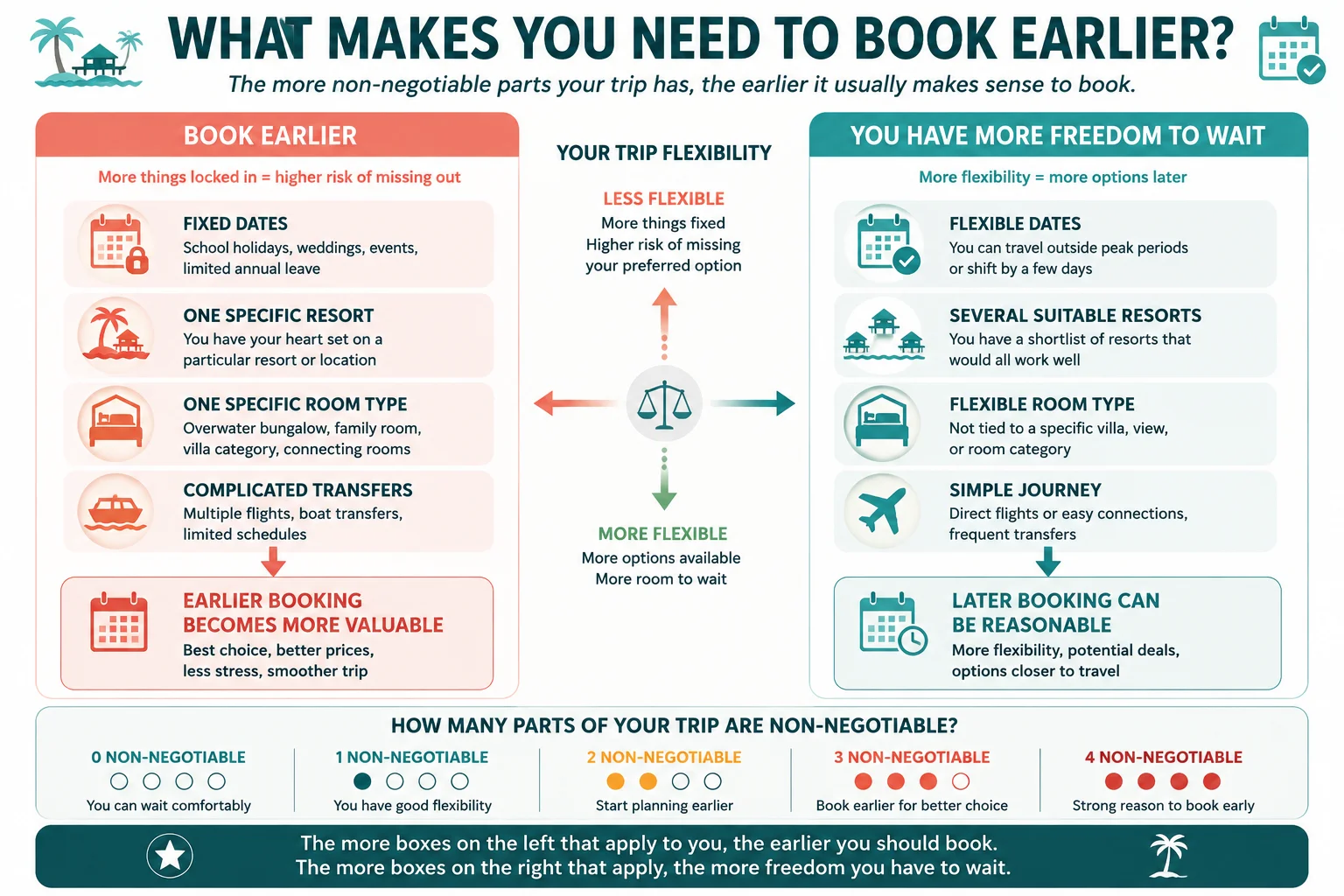
| Your Level of Flexibility | Practical Booking Approach |
|---|---|
| Fixed dates + specific resort + specific room | Book early |
| Fixed dates + several acceptable resorts | Book moderately early |
| Flexible dates + specific resort | Compare several date combinations |
| Flexible dates + flexible resort | You can consider booking later |
| Flexible destination + dates + resort | Well suited to short-notice or opportunistic travel |
- Check flights before confirming a non-refundable resort booking.
- Read the resort transfer details, not only the room description.
- Compare the total stay cost, including meals, transfers, and local transport.
- Prioritize family rooms, accessible rooms, and special room categories early.
- Use flexible cancellation terms when booking far ahead.
- Leave breathing room around remote-island transfers and weather-sensitive travel.
- Avoid forcing too many islands into a short itinerary simply because rooms are available.
Common Pacific Resort Booking Mistakes
Booking the resort before checking flights. A strong accommodation price can lose its appeal when practical flights are expensive or poorly timed.
Choosing entirely from photographs. A property can photograph beautifully while being too isolated, too busy, too polished, or too quiet for your travel style.
Ignoring transfers. A short boat ride may sound simple until you discover that the final departure leaves before your international flight arrives.
Assuming remote means better. A remote island can feel wonderfully peaceful, but it can also mean fewer restaurants, fewer independent activities, slower transport, and less flexibility.
Waiting for a perfect deal on an important trip. Saving money matters, but not if you eventually spend almost as much on accommodation you like considerably less.
Trying to visit too many islands. Pacific distances and transfer schedules can make island hopping slower than a map suggests. More islands do not automatically create a more meaningful trip.
Pacific Worth Note: I think the most useful question is not simply how many months ahead you should book. It is what would genuinely disappoint you if it disappeared. If several resorts would suit you, there may be little reason to rush. If one particular place, room, or island experience is what made you want to take the journey, booking earlier can be worth more than waiting for a possible discount.
Frequently Asked Questions
How early should you book Pacific island resorts?
For many trips, booking 4 to 8 months ahead offers a good balance of choice and flexibility. Consider 8 to 12 months for Christmas, school holidays, honeymoons, groups, popular resorts, or specific room categories.
How far in advance should I book a resort in Fiji?
Around 4 to 8 months ahead is a useful range for many Fiji holidays. Book earlier for school holidays, Christmas, family rooms, groups, or a particular island resort. Flexible shoulder-season travelers may be comfortable booking later.
How far ahead should I book Bora Bora?
Six to ten months ahead can be sensible if you want a particular resort or overwater bungalow. A highly specific honeymoon or peak-season trip may justify booking even earlier.
Should I book a Pacific resort before flights?
It is better to check both before committing to either. This is especially important when the resort requires another flight, ferry, boat, or scheduled transfer after your international arrival.
Is it cheaper to book Pacific island resorts early?
Not necessarily. Early booking mainly protects choice and availability. Prices can rise or fall later, and promotions may appear, but waiting does not guarantee a cheaper stay.
Can I book a Pacific holiday at the last minute?
Yes, especially when your dates, resort, room type, and destination are flexible. Last-minute planning is harder during school holidays, major holiday periods, and when remote transfers or special room requirements are involved.
Should I book earlier for the Pacific dry season?
Often, yes. Periods associated with more settled weather can attract stronger demand, although seasons vary across the Pacific. Your exact island and travel dates matter more than one broad regional rule.
Is a refundable resort rate worth paying for?
A flexible rate can be useful when booking far ahead because flights, personal plans, weather considerations, or island logistics may change. Compare the cancellation deadline, refund conditions, included extras, and price difference carefully before choosing.
Final Thoughts
So, how early should you book Pacific island resorts? For many travelers, 4 to 8 months ahead is the most practical middle ground. Move closer to 8 to 12 months when your dates are fixed, demand is likely to be high, or the resort itself is an important part of the experience.
Flexible travelers visiting during quieter periods can often plan closer to departure. The right timing depends on how many parts of the trip can change without reducing the experience.
A Pacific holiday is shaped by how the pieces fit together: flights, island transfers, accommodation, weather, budget, pace, and atmosphere. A resort that looks perfect online may not suit someone who wants local movement and independence, while a less famous property may create exactly the quiet, slower experience another traveler hoped to find.
Booking early is worthwhile when it protects something important. Waiting is reasonable when you genuinely have flexibility. The best decision is the one that leaves you with realistic logistics, manageable costs, and a Pacific experience that feels truly worth the journey.



Leave a Reply