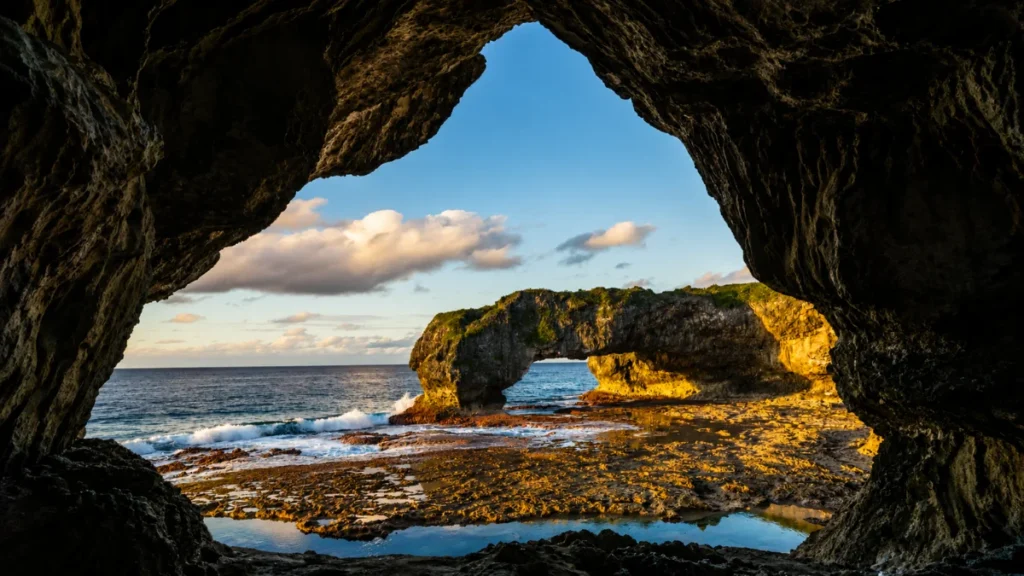
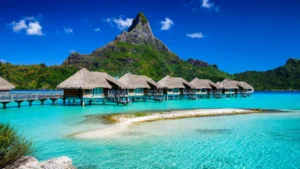
Niue can be difficult to judge from travel photos alone. It does not have the same resort reputation as Fiji, the famous lagoon imagery of Bora Bora, or the long sandy beaches many travelers automatically associate with a South Pacific holiday. For nature lovers considering the cost and effort of reaching a small, remote island, the bigger question is whether Niue offers enough meaningful natural experiences to justify the journey.
For travelers who enjoy rugged coastlines, limestone caves, natural swimming pools, snorkeling, forest tracks, marine life, and quiet outdoor exploration, Niue can be one of the Pacific’s more rewarding nature-focused destinations. Its appeal is less about conventional beach-resort beauty and more about experiencing an unusual island landscape at a slow, independent pace.
This distinction matters because Niue rewards a different type of traveler. Someone expecting long beaches, large resorts, effortless swimming everywhere, and a packed menu of organized activities may find parts of the island surprisingly simple. Someone who enjoys following a forest track toward a hidden chasm, snorkeling beneath limestone walls, exploring caves, watching the ocean from a rugged coast, and spending time somewhere that rarely feels crowded may see Niue very differently.
This article looks at whether Niue is worth visiting for nature lovers by explaining what the island genuinely feels like, why its landscape is unusual, what the best nature experiences involve, how weather and tides affect your days, what the travel costs and logistics feel like, and which travelers are most likely to appreciate what Niue does differently.
The Real Pacific Travel Reality Check
Niue’s quiet atmosphere does not happen by accident. It is a small and remote Pacific destination with limited international air access, a modest tourism industry, and fewer transport and accommodation choices than travelers may be used to in destinations such as Fiji or Hawaii.
International flights connect Niue with Auckland, and flight frequency is limited. This means a Niue holiday usually needs to be planned around the available flights rather than simply choosing any arrival and departure dates that suit your itinerary.
There is also no public transport network around the island. For most visitors who want to explore independently, hiring a vehicle is the most practical option. Niue’s main road circles the island, while many natural attractions are reached by smaller roads, sea tracks, or walking trails.
These realities matter because the same remoteness that helps Niue feel peaceful also makes the journey less flexible. Imported food and goods can cost more, accommodation choices are relatively limited, and changing plans at the last minute may not be as easy as it would be in a large tourism destination.
This does not necessarily make Niue difficult to visit. It simply means the island works better when travelers arrive expecting remote Pacific travel rather than big-destination convenience.
If ease of access is an important part of your decision, our guide to Which Pacific Islands Are Easiest to Reach from Australia? provides useful context for comparing Niue with more connected destinations.
What Many Travel Articles Miss About Niue
Many travel guides naturally focus on Niue’s caves, swimming holes, snorkeling locations, whales, and coastal scenery. Those are important reasons to visit, but a list of attractions does not fully explain why some nature lovers become deeply attached to the island.
The difference is often the space between the attractions.
You may drive along a quiet road, notice a small sea-track sign, park nearby, and walk beneath thick vegetation before the landscape suddenly opens toward cliffs, reef, caves, or clear water. There may be no large visitor centre, no major commercial development, and very little sense that every scenic place has been turned into a packaged tourism product.
That can make exploration feel more personal.
Niue is not untouched, and visitors should not treat local places as undiscovered wilderness. These landscapes belong to communities, have local names and histories, and many tracks are maintained specifically so people can visit them safely. What feels different is the relatively small scale of tourism around them.
This is why whether Niue feels worthwhile depends strongly on personality. If you need constant entertainment, the island may feel quiet. If you enjoy noticing landscapes slowly and allowing one memorable natural place to occupy an entire morning, the same quietness can become one of the best parts of the trip.
This slower style of Pacific travel is also explored in our comparison of the Cook Islands vs Hawaii for a slower island experience.
Why Niue’s Nature Experience Feels Different
Niue is a raised coral atoll, and that geology shapes almost everything travelers experience outdoors.
Instead of a low island where wide sandy beaches gradually meet a shallow lagoon, much of Niue rises above the surrounding ocean. Limestone cliffs, reef platforms, caves, rock pools, arches, chasms, and rugged coastal formations define large sections of the shoreline.
This changes the nature experience completely.
In many tropical destinations, the beach is the main natural space and everything else is built around it. In Niue, the journey from inland forest to the ocean can be part of the attraction itself.
You might begin beneath tropical vegetation, walk through limestone terrain, descend toward a chasm, reach a reef platform, and finally arrive beside remarkably clear ocean water.
Places such as Talava Arches, Togo Chasm, Matapa Chasm, and Limu Pools illustrate different parts of this landscape. They do not all provide the same type of experience. One may be memorable for the walk, another for geology, another for swimming, and another for the feeling of arriving somewhere enclosed by limestone.
This variety is one reason Niue deserves consideration alongside the destinations in our guide to Which Pacific Islands Still Feel Underrated in 2026?.
The Niue Nature Experience: From Forest to Deep Ocean
One useful way to understand Niue is not as a collection of separate attractions, but as a natural transition from the island’s interior toward deep Pacific water. Each zone creates a slightly different experience, and together they explain why such a small destination can feel surprisingly varied to nature-focused travelers.
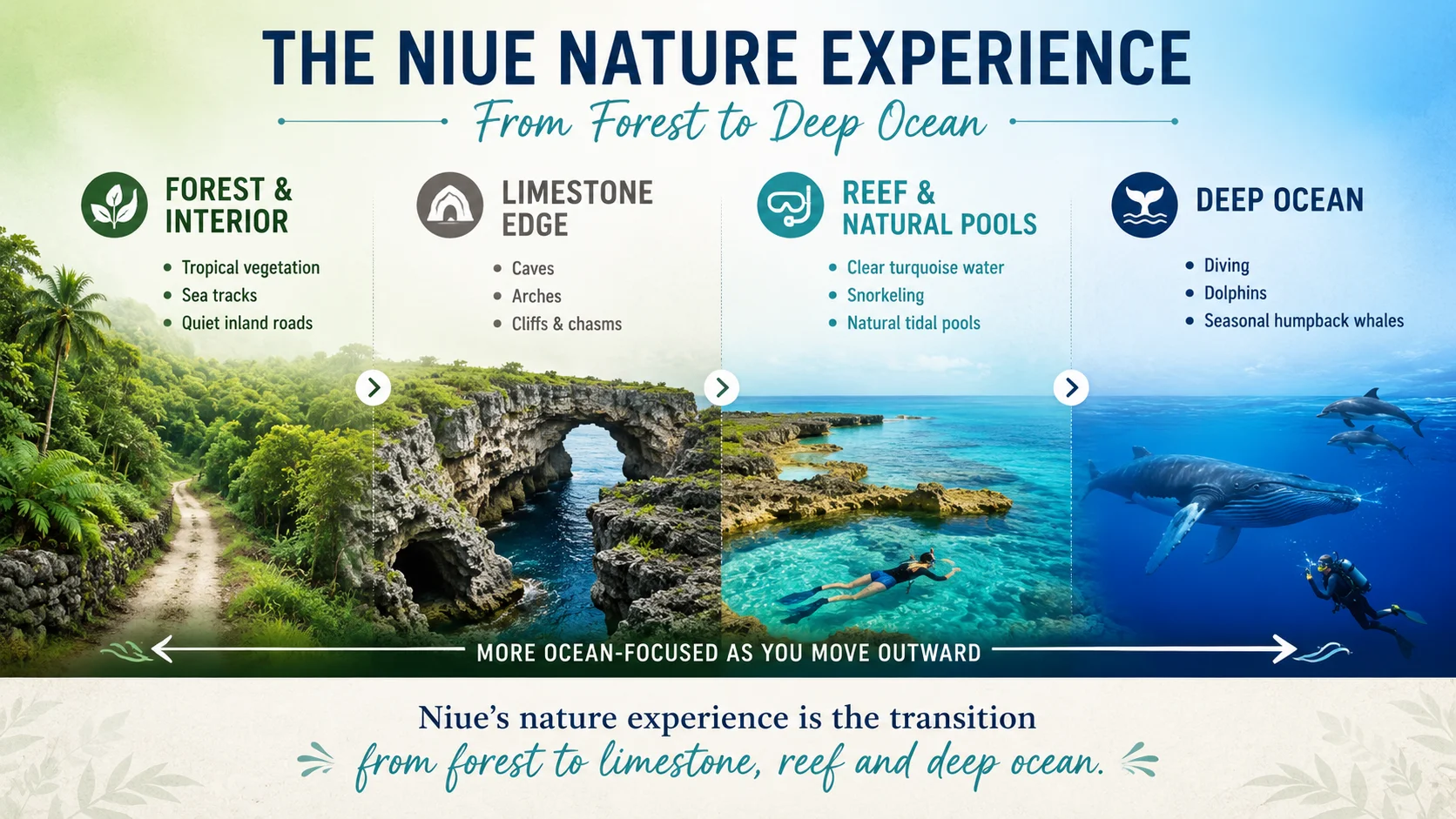
The inland environment provides forest, vegetation, quiet roads, and the starting points for many sea tracks. Moving toward the coast introduces limestone formations, caves, arches, and chasms. Closer to the water, reef platforms and natural pools create opportunities for swimming and snorkeling. Beyond that lies the deep ocean environment associated with diving, dolphins, and seasonal humpback whales.
| Natural Zone | What You Experience | What It Often Feels Like |
|---|---|---|
| Forest and Interior | Vegetation, bush areas, road journeys, and sea-track entrances | Quiet, green, local, and removed from conventional tourism |
| Limestone Edge | Caves, arches, cliffs, chasms, and rugged coral formations | Adventurous and noticeably different from a typical beach island |
| Reef and Natural Pools | Clear swimming areas, reef platforms, snorkeling, and tidal pools | Intimate and nature-focused, with conditions influenced by tides |
| Deep Ocean | Diving, dolphins, marine life, and seasonal humpback whales | Wild, open, and closely connected to Niue’s marine environment |
The important point is that Niue’s nature experience is not simply one famous cave or one beautiful swimming hole. It is the repeated transition between forest, limestone, reef, and ocean that gives the island much of its personality.
Why the Coastline Is One of Niue’s Greatest Attractions
For many nature lovers, Niue’s coastline becomes the part of the trip they remember most.
It is rugged rather than conventionally tropical. Instead of seeing the same broad beach landscape repeatedly, travelers encounter cliffs, narrow openings, reef shelves, caves, arches, small coves, and protected pools.
Talava Arches is one of the better-known examples. The experience involves walking through forest and limestone terrain before reaching large natural coastal arches. The walk and the final coastal view are part of the same experience.
Togo Chasm feels different. The track moves through vegetation and dramatic coral formations before reaching a chasm with sand and coconut palms below. It is the kind of landscape that helps explain why Niue should not be judged purely by whether it has long beaches.
Matapa Chasm provides another atmosphere again. Tall limestone walls shelter a narrow body of clear water, creating a swimming and snorkeling environment that feels much more enclosed than an open beach.
For travelers interested in adventure rather than resort-based relaxation alone, our comparison of Vanuatu vs Fiji for Adventure Travelers provides another useful way to think about how rugged Pacific destinations differ from more developed tourism islands.
Nature in Niue Rewards Travelers Who Like Exploring
There is an important difference between enjoying beautiful scenery and enjoying the process of getting to that scenery.
Niue is particularly rewarding for the second type of traveler.
Many coastal attractions are connected to the road by sea tracks or walking routes. Some are straightforward and relatively short. Others involve uneven limestone, steps, roots, forest surfaces, or more demanding terrain.
This means the island’s nature is often something you participate in rather than simply observe through a vehicle window.
You may spend part of the morning walking beneath trees, carefully crossing rough limestone, descending toward the coast, and then sitting beside the water once you arrive. That process can make relatively short distances feel like real exploration.
Good footwear therefore matters more than some first-time visitors may expect. Beach sandals can be useful around accommodation or easy swimming areas, but shoes with reasonable grip are much more practical for many tracks.
The tradeoff is accessibility. Travelers with limited mobility should research individual tracks carefully rather than assuming every famous natural site will be easy to reach.
Niue’s appeal is not that every experience is difficult. It is that the island gives independent travelers many opportunities to choose how active they want each day to be.
What Snorkeling in Niue Really Feels Like
Niue is particularly interesting for travelers who enjoy being in the water as much as looking at it.
Because the island is formed from porous limestone and has no rivers producing the kind of sediment runoff found in many other destinations, the surrounding water can be exceptionally clear. This clarity is one of Niue’s defining marine qualities.
Places such as Limu Pools, Matapa Chasm, Avaiki Cave, and other coastal areas give visitors opportunities to snorkel in settings that feel very different from a broad sandy lagoon.
You may be swimming beside limestone walls, looking across reef formations, entering a protected natural pool, or watching the colour of the water change where freshwater and seawater interact.
For nature lovers, this can make snorkeling feel connected to the geology of the island rather than simply being another holiday activity.
However, the beautiful underwater photographs only tell part of the story.
Tides, swell, and local sea conditions matter. A location that looks calm at one time can feel quite different later. Some snorkeling areas are more suitable during particular tide windows, so travelers should check current conditions and follow local advice rather than treating every swimming place as permanently accessible.
This is an important part of Niue’s personality: nature often sets the schedule.
If snorkeling and water scenery are your main priorities, you may also enjoy our broader comparison of Which Pacific Island Has the Most Beautiful Lagoon Experience?. Niue offers something quite different from the classic lagoon destinations discussed there.
Marine Life and Whale Season
The surrounding ocean adds another layer to a nature-focused Niue trip.
Reef fish, turtles, dolphins, and other marine life can be encountered around the island, while migrating humpback whales create one of Niue’s most distinctive seasonal experiences.
Humpback whales are commonly associated with Niue from around July through October as they move through tropical Pacific waters. Because deep water lies unusually close to the island’s coastline, whales can sometimes be seen from shore as well as during licensed boat experiences.
This gives Niue an unusual connection between land-based exploration and marine wildlife. You may spend the morning walking a limestone track and later find yourself watching the same coastline from the ocean.
Travelers considering Niue mainly for whales should still keep expectations realistic. Wildlife encounters are never guaranteed, ocean conditions influence tours, and responsible operators may change plans when circumstances are unsuitable.
The better approach is to see whale season as something that can add another memorable dimension to an already nature-focused island rather than the only reason the trip can succeed.
Travelers interested in how much seasonal wildlife should influence a Pacific trip may also find Is Tonga Worth Visiting Beyond Whale Season? helpful.
Niue Expectation vs Reality
Niue becomes much easier to appreciate when travelers stop comparing it with the standard image of a tropical island holiday. Some of the most common disappointments come from expecting Niue to provide an experience it was never likely to provide.
| What Travelers May Expect | What Niue Often Feels Like |
|---|---|
| Long white-sand beaches | Rugged limestone coast, small coves, cliffs, reef platforms, caves, and natural pools |
| Nature viewed from a resort | Nature reached by driving, walking, exploring tracks, and watching local conditions |
| Easy swimming anywhere | Excellent swimming and snorkeling in selected places where tides and sea conditions matter |
| Large organized attractions | Small-scale, often self-guided outdoor experiences |
| A packed sightseeing schedule | A few meaningful nature experiences spread through a slower day |
| Highly polished tropical tourism | A quieter, more natural, less commercial destination atmosphere |
| Nature as attractive background scenery | Nature as the main reason for traveling there |
This difference explains why travelers can return from Niue with very different opinions.
Someone may miss broad beaches, nightlife, extensive restaurant choices, large resorts, and easy transport. Another traveler may remember having a quiet coastal track almost to themselves, swimming between limestone walls, or spending an afternoon without feeling any pressure to rush toward the next attraction.
Neither traveler is necessarily wrong. They simply value different things.
The Atmosphere and Pace of Niue
Niue tends to feel quiet, independent, local, and noticeably slower than heavily developed tourism destinations.
There are accommodation choices and visitor services, but the island is not dominated by large resort complexes. When you leave your accommodation, you quickly return to normal island roads, villages, vegetation, sea tracks, and coastline.
This creates a more raw destination feel than travelers may experience in highly polished resort areas elsewhere in the Pacific.
The soundscape can also feel different. Around natural areas, you are more likely to notice waves hitting reef and limestone, wind moving through vegetation, birds, or long quiet periods than music from beach clubs or large groups moving between attractions.
Local interactions can feel naturally woven into the journey rather than being a separate cultural activity. Stopping at a small business, asking about conditions, picking up food, or receiving directions may become part of an ordinary day.
The pace generally suits travelers who are comfortable allowing plans to remain slightly loose. There is little benefit in trying to turn Niue into a tightly scheduled sightseeing destination.
If quiet Pacific atmosphere matters as much to you as natural scenery, our comparison of Tonga vs Samoa for Quiet Tropical Travel looks at the same travel preference through two other island destinations.
What About Niue’s Beaches?
This is one of the most important expectations to understand before booking.
Niue does have sandy areas, small beaches, and secluded coves, but long stretches of soft sand are not the defining feature of the island.
If your ideal nature holiday involves walking for hours along a tropical beach, swimming directly in front of your accommodation, and spending most days moving between large sandy bays, another Pacific destination may suit you better.
Niue offers a different trade.
You give up some of the easy beach experience in exchange for limestone caves, chasms, natural swimming pools, arches, cliffs, reef environments, and an unusually dramatic relationship between land and ocean.
For some nature lovers, that is a much more interesting landscape. For others, beaches are too important to compromise on.
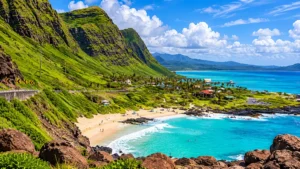
This is why choosing a Pacific destination by photographs of blue water alone can be misleading. Islands that look similar from a distance may feel completely different once you arrive.
Would Niue Feel Worth It to You?
The most useful way to answer whether Niue is worth the journey is to compare its strongest qualities with the experiences you personally want from a Pacific holiday.
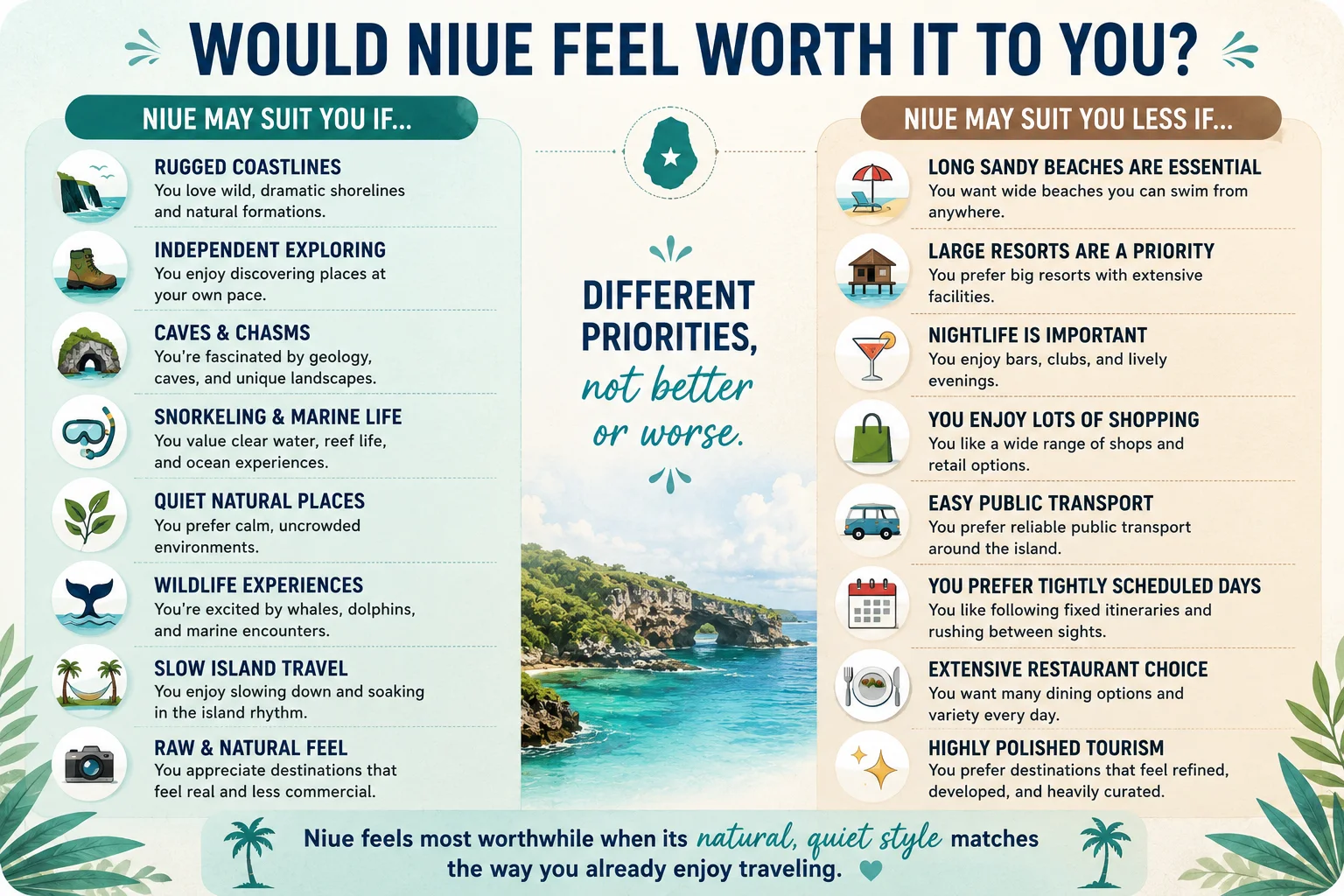
The diagram should not be read as one travel style being better than another. It simply shows how closely Niue’s strongest qualities match different traveler priorities.
| If You Value… | How Well Niue Fits | Why |
|---|---|---|
| Quiet natural places | Very strong fit | Small-scale tourism can make outdoor experiences feel calm and spacious |
| Independent exploration | Very strong fit | A rental vehicle and network of sea tracks make self-guided days rewarding |
| Geology, caves, and rugged coastlines | Very strong fit | Limestone formations are central to the island’s landscape |
| Snorkeling and marine life | Very strong fit | Clear water, reef environments, natural pools, and marine encounters are major attractions |
| Long sandy beaches | Weaker fit | The coastline is predominantly rugged rather than beach-focused |
| Large resort facilities | Weaker fit | Niue is much smaller-scale and less resort-dominated |
| Nightlife and shopping | Weak fit | These are not central parts of the destination experience |
| Slow, uncrowded travel | Very strong fit | Niue rewards travelers who are comfortable doing less and experiencing places more slowly |
This is the most important part of deciding whether Niue is worth visiting for nature lovers. The answer depends less on how many attractions the island has and more on whether its style of nature travel matches yours.
Best For and Not Ideal For
Niue works particularly well for travelers who see nature as the main experience rather than something added around a resort holiday.
Best For
- Nature lovers interested in unusual landscapes and coastal geology
- Snorkelers and divers who value clear water and distinctive underwater environments
- Wildlife travelers interested in marine life and seasonal whale experiences
- Couples looking for quiet exploration rather than nightlife
- Independent travelers comfortable hiring a vehicle and planning their own days
- Photographers interested in forests, caves, cliffs, coastlines, and marine scenery
- Slow travelers who enjoy spending meaningful time in one small destination
- Repeat Pacific travelers looking for something different from a conventional resort island
Not Ideal For
- Travelers wanting long sandy beaches every day
- Visitors primarily looking for large luxury resort complexes
- Nightlife-focused travelers
- People who want extensive shopping and restaurant choice
- Travelers trying to fit the island into a very rushed itinerary
- Visitors uncomfortable with limited flight schedules
- People who dislike walking on uneven natural terrain
- Travelers expecting large-city transport and convenience
Niue becomes much more rewarding when visitors choose it because these characteristics suit them rather than because they simply want to visit another tropical island.
The Real Budget Tradeoff
Niue should not automatically be treated as a cheap Pacific holiday simply because it is small and relatively undeveloped.
Remote islands often have a different cost structure. Flights are limited, many goods need to be imported, visitor accommodation has finite capacity, and independent travelers will usually need to budget for vehicle hire as part of the trip.
The advantage for nature lovers is that enjoying Niue does not necessarily require purchasing an expensive organized activity every day.
Walking coastal tracks, exploring appropriate swimming locations, visiting viewpoints, driving between villages, and spending time at natural areas can create very satisfying days without repeatedly paying large attraction fees.
| Budget Area | What to Expect | Where the Value Comes From |
|---|---|---|
| Flights | Potentially significant because access is limited and usually involves Auckland | The cost becomes easier to justify if you stay long enough to experience the island properly |
| Accommodation | More limited choice than major Pacific destinations | You do not need a large luxury resort to experience Niue’s main natural attractions |
| Transport | Vehicle hire should usually be included in the budget | A car gives freedom to explore nature independently and respond to conditions |
| Food | Imported products can cost more than travelers expect | Realistic planning prevents everyday prices from becoming a surprise |
| Nature Experiences | Many land-based experiences are inexpensive or self-guided | A full day does not need to involve multiple paid attractions |
| Marine Tours | Diving, guided snorkeling, and whale experiences add to the budget | Choosing one or two meaningful paid experiences can be more rewarding than overbooking |
This makes Niue’s value quite different from simply asking whether the destination is cheap or expensive.
A better question is whether you personally value the kind of quiet, independent nature experience you receive in exchange for the cost of getting there.
How Long Should Nature Lovers Stay in Niue?
For many nature-focused travelers, around a week is a comfortable way to experience Niue.
This provides enough time to explore different sections of coastline, walk several sea tracks, snorkel in different environments, have a slower day, consider a marine activity, and leave some flexibility for weather and sea conditions.
A week also allows Niue’s pace to become part of the experience rather than something you are constantly fighting.
A very short visit may technically allow you to see several famous places, but rushing between them can remove some of what makes the island enjoyable. One of Niue’s strengths is being able to stay somewhere because the conditions feel good rather than immediately moving to the next item on a checklist.
| Trip Length | Best For | What It May Feel Like |
|---|---|---|
| 3 to 4 days | Travelers with very limited time | Enough for a taste of Niue, but vulnerable to weather and potentially rushed |
| 5 to 6 days | Active nature travelers | Good balance of coastal exploration, snorkeling, and downtime |
| About 1 week | Most first-time nature lovers | Slow enough to experience the island properly while keeping days varied |
| 8+ days | Divers, whale-focused visitors, and very slow travelers | More flexibility for marine conditions and repeating favorite experiences |
Available flights will also influence practical trip length, so it is better to build the itinerary around real transport schedules rather than choosing an arbitrary number of days first.
If you are comparing Niue with other destinations for limited annual leave, our guide to Which Pacific Islands Are Best for a One-Week Trip? provides useful context.
Practical Travel Insights for Nature Lovers
Niue becomes easier to enjoy when you allow the landscape and local conditions to influence your itinerary. A few practical decisions can make the experience significantly calmer.
- Plan around flights first. Limited international services mean transport dates should be confirmed before building the rest of the itinerary.
- Consider hiring a vehicle. There is no public transport, and natural attractions are spread around the island.
- Bring suitable footwear. Limestone, forest tracks, roots, and wet surfaces can make proper walking shoes more useful than beach sandals.
- Check tides before snorkeling. The best conditions at natural pools and reef areas can change throughout the day.
- Keep water activities flexible. Swell, wind, rain, and sea conditions may make one location better than another on a particular day.
- Do not overbook every day. Niue’s strongest experiences often come from having enough time to explore without rushing.
- Budget for island prices. Imported goods, transport, and limited availability can make costs feel different from larger destinations.
- Listen to local advice. Current information about tracks, weather, tides, access, and sea conditions is more useful than forcing a fixed itinerary created months earlier.
Because accommodation is more limited than in larger island destinations, travelers with fixed dates may also find our guide to How Early Should You Book Pacific Island Resorts? useful. The same principle of booking important accommodation early can be valuable even when you are choosing a smaller property rather than a resort.
Common Traveler Misunderstandings About Niue
One common misunderstanding is assuming that a small island will not have enough to keep nature lovers interested. That depends entirely on what you consider an activity. Travelers who need numerous commercial attractions may find the choices limited, while people who enjoy walking, swimming, snorkeling, geology, wildlife, photography, and quiet exploration can fill their days very differently.
Another misunderstanding is thinking of Niue as a conventional beach destination. The island does have sandy areas, but its strongest visual identity comes from limestone, reef, caves, cliffs, natural pools, and rugged coastline.
Travelers may also assume that every natural swimming location can be visited at any time. In reality, tides and sea conditions are part of planning a safe and enjoyable nature trip. A flexible traveler will usually experience Niue more successfully than someone determined to follow an exact hour-by-hour itinerary.
Another misconception is that a quiet destination has nothing happening. Niue has communities, businesses, local life, restaurants, visitor activities, and events. What it lacks is the constant tourism intensity associated with much larger destinations.
Finally, travelers sometimes assume remote automatically means inexpensive. In the Pacific, remoteness can increase the cost of flights, transport, supplies, and imported goods. The real value comes from deciding whether the experience itself is worth those costs to you.
Seasonal and Local Context
Niue can provide nature experiences throughout the year, but the season influences temperature, rainfall, humidity, sea conditions, wildlife, and the overall mood of the trip.
The cooler and generally drier part of the year is often attractive for travelers planning walking, snorkeling, diving, and outdoor exploration. This period also overlaps with the seasonal presence of humpback whales, particularly from around July through October.
The warmer part of the year can feel more humid and may bring greater rainfall and tropical weather variability. That does not automatically make it a bad time to visit. It simply increases the value of flexible planning.
For a nature traveler, sea conditions can sometimes matter more than whether there is a short rain shower. Rain may pass while still leaving much of the day usable, while stronger swell can affect whether a particular coastal swimming or snorkeling location is suitable.
This is why it helps to think in terms of several possible activities rather than deciding in advance that Tuesday must be a snorkeling day and Wednesday must be a cave day.
Pacific weather is rarely as simple as choosing a perfect or imperfect season. Our guide to What Is the Rainiest Time to Visit Fiji? explores this broader Pacific travel reality in more detail.
Pacific Worth Note: I think Niue becomes much easier to understand when you stop asking whether it can compete with larger Pacific destinations and instead ask whether you value what it does differently. A quiet track ending at a limestone chasm may not look as glamorous in a holiday brochure as a famous resort beach, but for the right traveler that smaller encounter with nature may become the part of the journey that stays with them.
Frequently Asked Questions
Is Niue worth visiting for nature lovers?
Yes, Niue can be very worthwhile for nature lovers who enjoy rugged coastlines, limestone caves, chasms, clear-water snorkeling, marine life, forest tracks, and quiet independent exploration. It is less suited to travelers whose idea of nature travel depends mainly on long sandy beaches or large resort environments.
What is special about nature in Niue?
Niue’s raised coral geology creates an unusual combination of forest, limestone caves, arches, cliffs, chasms, reef platforms, natural swimming pools, and deep ocean close to shore. This allows a relatively small island to offer several noticeably different natural environments.
How many days should nature lovers spend in Niue?
Around one week works well for many first-time visitors. This gives enough time for coastal walks, snorkeling, several major natural sites, a marine excursion if desired, slower days, and some flexibility for changing weather, tides, and ocean conditions.
Does Niue have good beaches?
Niue has small beaches and coves, but travelers should not expect long sandy beaches to dominate the island. Its coastline is better known for limestone cliffs, reef platforms, caves, chasms, natural pools, and rugged coastal scenery.
Is Niue worth visiting if you do not dive?
Yes. Diving can add another dimension to a Niue trip, but it is not necessary to enjoy the island. Walking tracks, caves, chasms, snorkeling areas, viewpoints, natural swimming locations, forest environments, and seasonal whale watching provide plenty of nature experiences without scuba diving.
Final Thoughts
So, is Niue worth visiting for nature lovers? For travelers who appreciate rugged landscapes, unusually clear water, limestone caves, chasms, snorkeling, marine wildlife, forest tracks, quiet roads, and independent exploration, the answer can be a strong yes.
The important part is understanding what kind of nature destination Niue actually is.
This is not primarily a holiday built around endless sandy beaches, enormous resorts, polished tourist districts, shopping, or constant organized entertainment. Nature sits much closer to the centre of the experience.
You may drive beneath tropical vegetation to reach a sea track, walk carefully across limestone, descend toward clear water, change your snorkeling plans because of the tide, stop longer than expected at a quiet coastline, or spend an afternoon without feeling that you need another attraction to justify the day.
The tradeoffs are real. Reaching Niue takes more planning than visiting many mainstream Pacific destinations. Flights are limited. A rental vehicle is important for most independent travelers. Imported goods can be expensive. Some natural places require walking over uneven terrain. Weather, swell, and tides sometimes decide what you can comfortably do.
Those realities will make another island a better choice for some travelers.
But they are also connected to what makes Niue feel different. Limited access helps keep visitor numbers modest. The lack of sprawling resort development keeps the wider island central to the holiday. The rugged coastline that prevents Niue from offering endless beaches creates its caves, cliffs, arches, chasms, and natural pools instead.
For nature lovers who prefer exploration over entertainment and meaningful outdoor experiences over a perfectly polished resort holiday, that can be a very worthwhile trade.
Niue does not need to be the right Pacific island for everyone. If its quietness, geology, marine environment, and slower style of exploration match the way you like to travel, it may be exactly the kind of place that feels worth going further to experience.
Leave a Reply