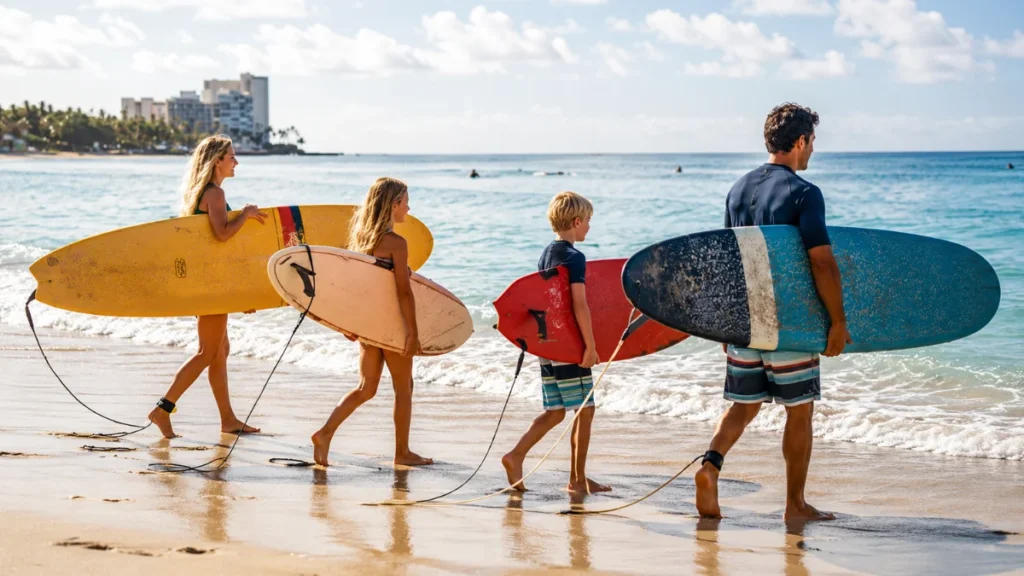
Choosing between Fiji and Hawaii for a family holiday from Australia can feel surprisingly difficult. Both sound familiar, both promise warm weather and beaches, and both are often shown online as easy tropical escapes. But for families, the real question is not only which place looks better. It is which one feels easier, more enjoyable, and more worth the money once flights, children, meals, transfers, and daily energy are included.
For most Australian families wanting a relaxed beach holiday with shorter flights, easier resort days, and a gentler island pace, Fiji is usually the simpler choice. Hawaii can be more rewarding for families who want beaches plus shopping, sightseeing, food variety, road trips, and bigger activity options, but it often costs more and feels busier.
The decision feels hard because Fiji and Hawaii are often compared as if they offer the same type of holiday. In real travel situations, they feel very different. Fiji often feels slower, warmer in hospitality, and more resort-focused. Hawaii feels more developed, more active, and more like a full destination with beaches, cities, landscapes, and attractions mixed together.
This article will help you compare Fiji vs Hawaii for Families from Australia in a realistic way, including flight effort, budget expectations, resort feel, activities, food, children’s needs, crowd levels, and which destination may suit your family best.
The Real Family Travel Reality Check
Family travel is different from couple travel or solo travel. A destination may look beautiful online, but parents usually need to think about sleep, transfers, food, boredom, safety, walking distance, laundry, weather, and whether the trip still feels enjoyable after a long flight.
This is where Fiji and Hawaii start to separate. Fiji is often easier for Australian families because the journey is shorter, the resort experience is simpler, and many holidays can be built around one base. You arrive, settle in, swim, eat, rest, and repeat. For families with younger children, that can be a major advantage.
Hawaii can offer more variety, but it usually asks more from the family. Flights are longer, the time difference can affect sleep, and many of the best experiences involve driving, planning, bookings, parking, walking, or moving between areas. This can be exciting for some families and tiring for others.
Neither destination is automatically better. The right choice depends on your children’s ages, your budget, your travel style, your tolerance for logistics, and whether your family wants rest or stimulation.
What Many Travel Articles Miss About Fiji and Hawaii
Many Fiji and Hawaii comparisons focus on beaches, resorts, and scenery. Those things matter, but they do not fully explain how a family holiday feels day by day.
For families, the best destination is often the one that reduces pressure. A beautiful place can still feel stressful if meals are expensive, children are overtired, transport takes too long, or every activity needs booking. A simpler destination can feel more valuable if everyone sleeps better, swims easily, and parents do not feel like they are managing a complicated itinerary every day.
This is why Fiji often wins for rest and ease, while Hawaii often wins for variety and activity. Fiji is usually more about staying, slowing down, and enjoying a resort rhythm. Hawaii is more about doing, exploring, eating out, shopping, beach-hopping, and mixing natural beauty with developed convenience.
Fiji vs Hawaii for Australian Families: Quick Comparison
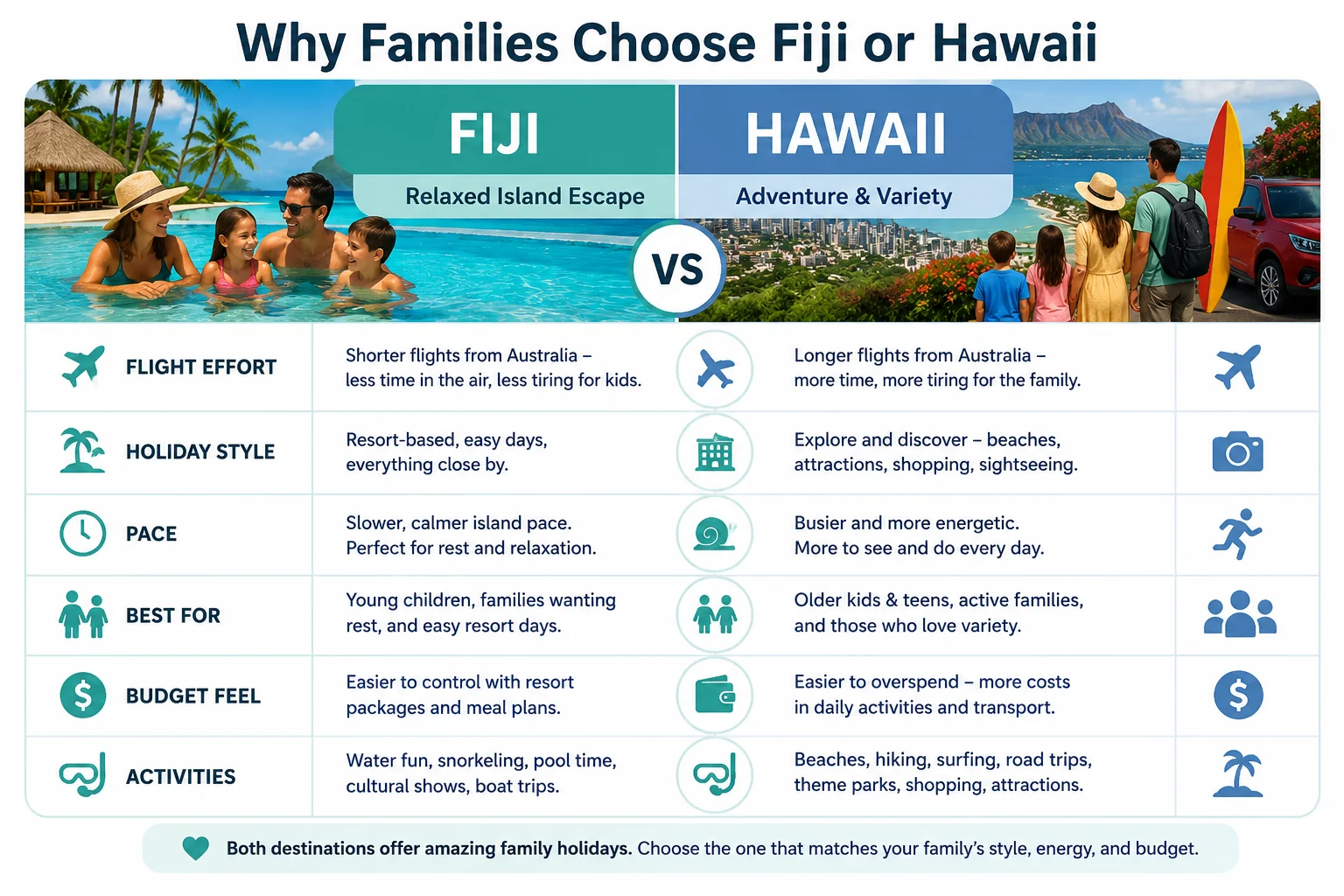
If your family is choosing between these two Pacific destinations, this table gives a simple starting point. It does not replace the details, but it shows the biggest differences clearly.
| Family Travel Factor | Fiji | Hawaii |
|---|---|---|
| Best overall fit | Relaxed resort holiday with younger children | Active family holiday with variety and sightseeing |
| Flight effort from Australia | Usually shorter and easier | Longer, especially with children |
| Holiday pace | Slow, gentle, resort-based | Busier, more flexible, more activity-driven |
| Family budget feel | Often easier to control with resort packages | Often higher due to flights, food, car hire, and activities |
| Best for young children | Very strong | Good, but more tiring |
| Best for teenagers | Good if they enjoy water and resort life | Very strong because there is more to do |
| Food convenience | Easy in resorts, less varied outside | More variety, but often expensive |
| Resort feel | Warm, relaxed, family-friendly | Polished, developed, often busier |
| Best emotional feeling | Restful and welcoming | Exciting and varied |
For a broader first-time comparison, you may also find Hawaii vs Fiji for First-Time Pacific Travelers helpful. This article, however, focuses more specifically on families travelling from Australia.
How Fiji and Hawaii Feel Different for Families
Fiji often feels softer and slower. Many family holidays are built around resorts, pools, beaches, kids clubs, cultural shows, boat trips, and relaxed meals. The atmosphere is usually warm and welcoming, and families often notice the friendliness of the people as much as the scenery.
For parents, Fiji can feel like permission to slow down. You do not need to fill every hour. Children can swim, rest, join activities, or simply move between the pool, beach, and room. The days can feel repetitive in a good way, especially when the goal is recovery rather than sightseeing.
Hawaii feels more developed and energetic. Oahu, especially around Waikiki, can feel lively, busy, and highly convenient. Families can combine beaches with shopping, restaurants, museums, lookouts, hikes, surf lessons, road trips, and cultural sites. It has more movement and more choice.
The tradeoff is that Hawaii may feel less like a slow island escape and more like a full international holiday. That can be wonderful for families who want variety. But if your children are young or your parents are already tired before the trip begins, Fiji may feel easier.
Flight Time and Travel Effort from Australia
For Australian families, travel effort is one of the biggest reasons Fiji often feels more practical. Direct flights to Nadi from major Australian cities are usually much shorter than flying to Honolulu. That difference matters when travelling with young children, prams, car seats, snacks, sleep routines, and tired parents.
Fiji can feel like a true overseas holiday without the same long-haul pressure. Families can often arrive with enough energy to settle in, have dinner, and begin relaxing fairly quickly. That first-day feeling matters more than many people realise.
Hawaii is still very reachable from Australia, especially from Sydney, but it feels more like a bigger trip. The longer flight, time difference, and arrival tiredness can affect the first few days. For families with older children or teenagers, this may not be a problem. For families with toddlers or younger children, it can be a real consideration.
There is also the paperwork difference. Australians generally do not need a tourist visa for Fiji for short visits, while travel to Hawaii means entering the United States and meeting US entry requirements. Families should always check current travel rules before booking, especially when travelling with children.
Family Budget Expectations
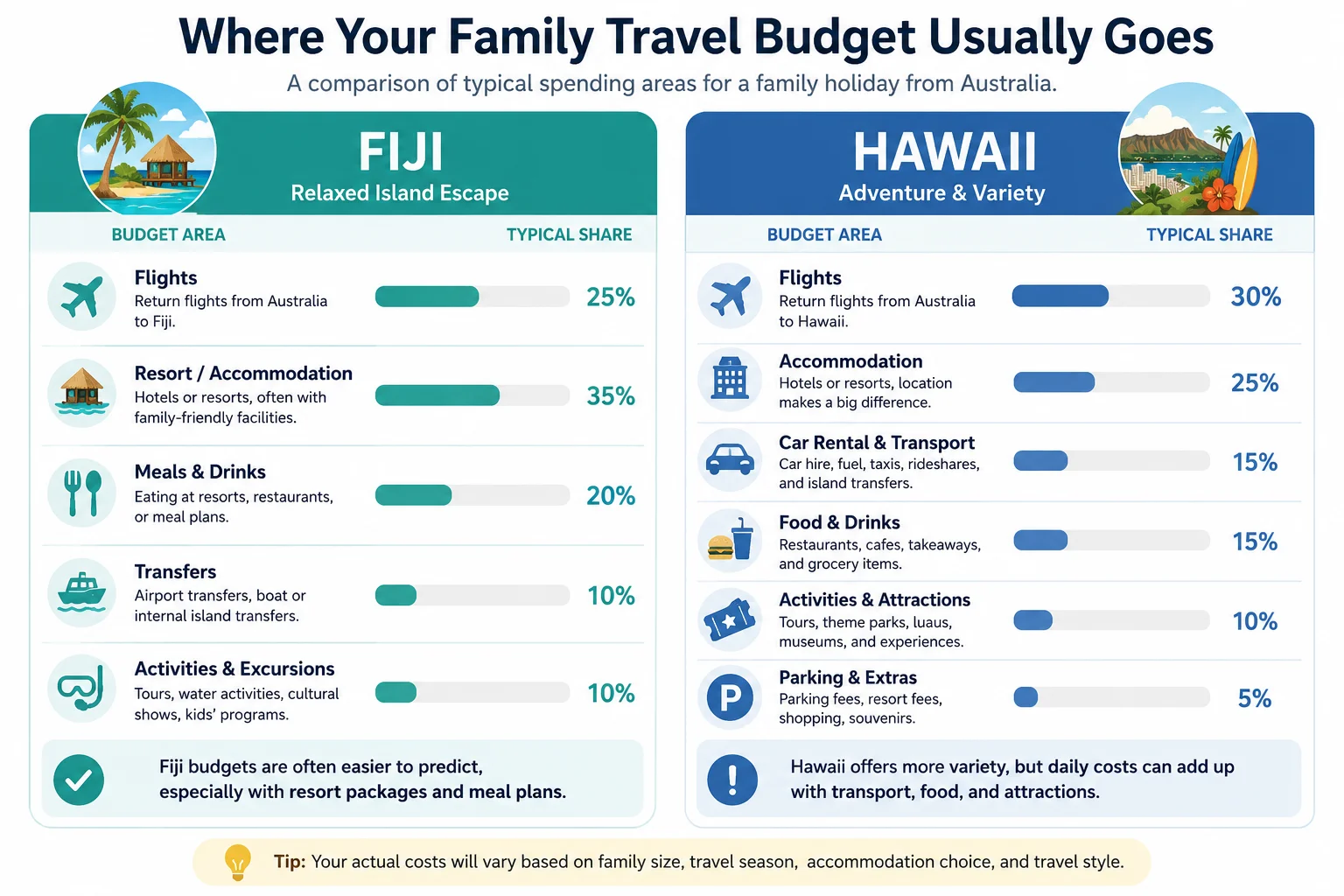
Budget is where the choice becomes more personal. Fiji is not always cheap, especially once school holiday pricing, island transfers, resort meals, and activities are included. However, many Australian families find Fiji easier to budget because resort packages, meal plans, and shorter flights can make the total cost feel more predictable.
If you are trying to understand Fiji costs more deeply, our article How Expensive Is Fiji Really in 2026? explains why Fiji can feel affordable in some areas and surprisingly expensive in others.
Hawaii can become expensive quickly for families because the holiday often includes longer flights, accommodation in high-demand areas, restaurant meals, transport, resort fees, car rental, parking, shopping, and paid attractions. Even when a flight deal looks good, the daily spend can be higher than expected.
This does not mean Hawaii is poor value. It simply means the value works differently. Hawaii gives more variety, but families usually pay for that variety. Fiji may offer less daily variety, but the simpler resort rhythm can make the holiday feel easier to control.
| Budget Area | Fiji Family Holiday | Hawaii Family Holiday |
|---|---|---|
| Flights | Often lower due to shorter distance from Australia | Often higher due to longer distance |
| Accommodation | Resort packages can help with planning | Wide choice, but popular areas can be costly |
| Food | Can be predictable with resort meal plans | More variety, but eating out often adds up |
| Transport | Often resort transfers and selected tours | May include car rental, parking, fuel, taxis, or rideshares |
| Activities | Water activities, cultural shows, boat trips, resort programs | Beaches, attractions, tours, shopping, hikes, road trips |
| Overall budget feeling | Simpler and easier to contain | More flexible but easier to overspend |
If cost is your biggest concern, you may also want to read Is Fiji Expensive Compared to Hawaii? because it compares the two destinations from a broader value perspective.
Resort Feel and Accommodation Style
Fiji has a strong reputation for family-friendly resorts, and for many Australian families this is the main reason it works so well. Resorts often understand that families want easy meals, children’s activities, swimming areas, simple transfers, and a relaxed daily rhythm.
The resort atmosphere in Fiji can feel warm and personal. Staff often interact kindly with children, and the pace is usually calm rather than polished in a big-city way. Families who want to stay mostly in one place may find this very comfortable.
Hawaii offers a different accommodation experience. Hotels and resorts can be polished, convenient, and close to restaurants, shops, beaches, and attractions. In Waikiki, families may appreciate being able to walk to many places. On other islands, accommodation may feel more scenic, spread out, and road-trip friendly.
The tradeoff is that Hawaii accommodation can feel busier and more commercial, especially in popular areas. Fiji is often better if your family wants a resort to become the centre of the holiday. Hawaii is often better if accommodation is only one part of a wider trip.
Activities for Children, Teens, and Parents
Fiji works especially well for families who want swimming, snorkeling, sand, boat trips, cultural performances, resort activities, and quiet downtime. Younger children often do well because the holiday can be simple and repetitive without feeling boring.
Parents may also appreciate that Fiji does not pressure them to do something new every day. A pool day, beach day, or slow lunch can still feel like a proper holiday. This can be valuable when adults are tired and children need routine.
Hawaii has a much wider range of activities. Families can visit beaches, volcanic landscapes, lookouts, historical sites, surf schools, markets, shopping centres, food spots, gardens, waterfalls, museums, and scenic drives. Teenagers may especially enjoy the variety.
The decision often comes down to age and energy. Younger children may enjoy Fiji more because it is simpler. Older children and teenagers may prefer Hawaii because there is more to see and do.
| Child Age or Family Type | Fiji May Suit Better If… | Hawaii May Suit Better If… |
|---|---|---|
| Toddlers and young children | You want short flights, easy resort days, and less movement | You are comfortable managing longer flights and busier days |
| Primary school children | You want swimming, kids club, beach time, and family rest | You want beaches plus sightseeing and varied activities |
| Teenagers | They enjoy water, resort life, snorkeling, and slower holidays | They want shopping, food, attractions, surfing, hiking, and movement |
| Multi-generational families | You want one base where grandparents, parents, and children can relax | You want a broader destination with choices for different interests |
Food, Meals, and Daily Convenience
Food can shape a family holiday more than expected. Children may be picky, parents may not want to search for restaurants every night, and meal costs can become a major part of the budget.
In Fiji, resort dining is often the easiest option. This can be convenient, especially with younger children, but it may also feel limited or expensive if your family prefers variety. Meal plans can help, but they should be checked carefully before booking.
Hawaii usually offers far more food variety. Families can find restaurants, food courts, supermarkets, casual meals, takeaway, cafés, and different cuisines. This is helpful for families with teenagers or children who like familiar choices.
The downside is that Hawaii food costs can build quickly, especially when eating out often. Families may need to balance restaurants with supermarket meals, simple breakfasts, and occasional self-catering where possible.
Beaches, Swimming, and Water Comfort
Both Fiji and Hawaii offer beautiful water experiences, but they are not the same. Fiji often feels more lagoon-like, resort-based, and gentle, especially around family-friendly resorts and island areas. This can be comforting for parents with younger children.
Hawaii has famous beaches, but ocean conditions can vary more by island, season, and beach. Some beaches are calm and family-friendly, while others have stronger surf, rocks, currents, or conditions better suited to experienced swimmers and surfers.
For families who mainly want easy swimming close to the resort, Fiji may feel more relaxing. For families who enjoy exploring different beaches and understanding local conditions, Hawaii can be more exciting.
Either way, families should never assume every beach is safe for children just because it looks beautiful. Local advice, signs, lifeguards, and daily conditions matter in both destinations.
Culture and Local Interactions
Fiji often leaves a strong impression because of its warmth. Many families remember the people, greetings, singing, resort staff, village visits, and slower rhythm as much as the water. Children may feel welcomed in a way that makes the trip emotionally memorable.
That said, families should remember that resort Fiji is not the whole of Fiji. A resort holiday can be lovely, but it is still only one part of the country. Families who want deeper understanding may include a village visit, local market, cultural activity, or guided experience that is respectful and well organised.
Hawaii also has deep culture, but it is sometimes harder for visitors to understand because tourism, American convenience, and local identity sit close together. Families may enjoy learning about Hawaiian history, language, music, hula, navigation, land, and respect for place, especially when they choose thoughtful cultural experiences rather than only commercial entertainment.
In both destinations, the best family experiences often come from slowing down enough to notice people, place, and rhythm rather than treating the trip only as a list of beaches.
Travel Pace and Family Energy
Fiji’s slower pace is one of its biggest family strengths. It can feel like the holiday is designed around rest. You may not feel the need to leave the resort every day. This can be exactly what many Australian families need after school terms, work pressure, sport schedules, and daily routines.
Hawaii’s pace depends on where you stay. Waikiki can feel lively and convenient, but also crowded and busy. Other islands can feel slower, but they often require more driving and planning. This gives families more freedom, but also more decisions.
If your family wants to recover, Fiji may be the better match. If your family gets bored sitting still, Hawaii may be more rewarding. This is one of the clearest differences between the two destinations.
Best For and Not Ideal For
Fiji and Hawaii both suit families, but they suit different family moods. A good decision starts with being honest about what kind of holiday your family actually needs.
Fiji Is Best For
- Families with babies, toddlers, or younger children
- Australian families wanting shorter flights
- Parents who want a simple resort-based holiday
- Families who want warm hospitality and slower days
- Travelers who value rest more than sightseeing
- Families wanting a first overseas island holiday
Fiji Is Not Ideal For
- Families who want theme-park-style variety
- Teenagers who need constant activities
- Travelers who dislike resort-based holidays
- Families expecting very cheap food and activities everywhere
- Visitors who want large-city convenience
Hawaii Is Best For
- Families with older children or teenagers
- Travelers who want beaches plus sightseeing
- Families who enjoy food variety, shopping, and day trips
- Parents who want a more active holiday
- Families comfortable with longer flights and higher daily spending
- Travelers who want both nature and developed convenience
Hawaii Is Not Ideal For
- Families wanting the easiest short-haul island escape
- Travelers on a tight budget during school holidays
- Parents who do not want to plan daily logistics
- Families expecting quiet resort life everywhere
- Young children who struggle with longer flights and time changes
If you are still drawn to Fiji but want to understand why travelers return, our article Why Do Travelers Keep Returning to Fiji? explains the emotional side of Fiji travel beyond just beaches and resorts.
Practical Travel Insights for Australian Families
Before choosing, it helps to think beyond the destination name. A family holiday is usually shaped by small practical details that do not always appear in glossy travel photos.
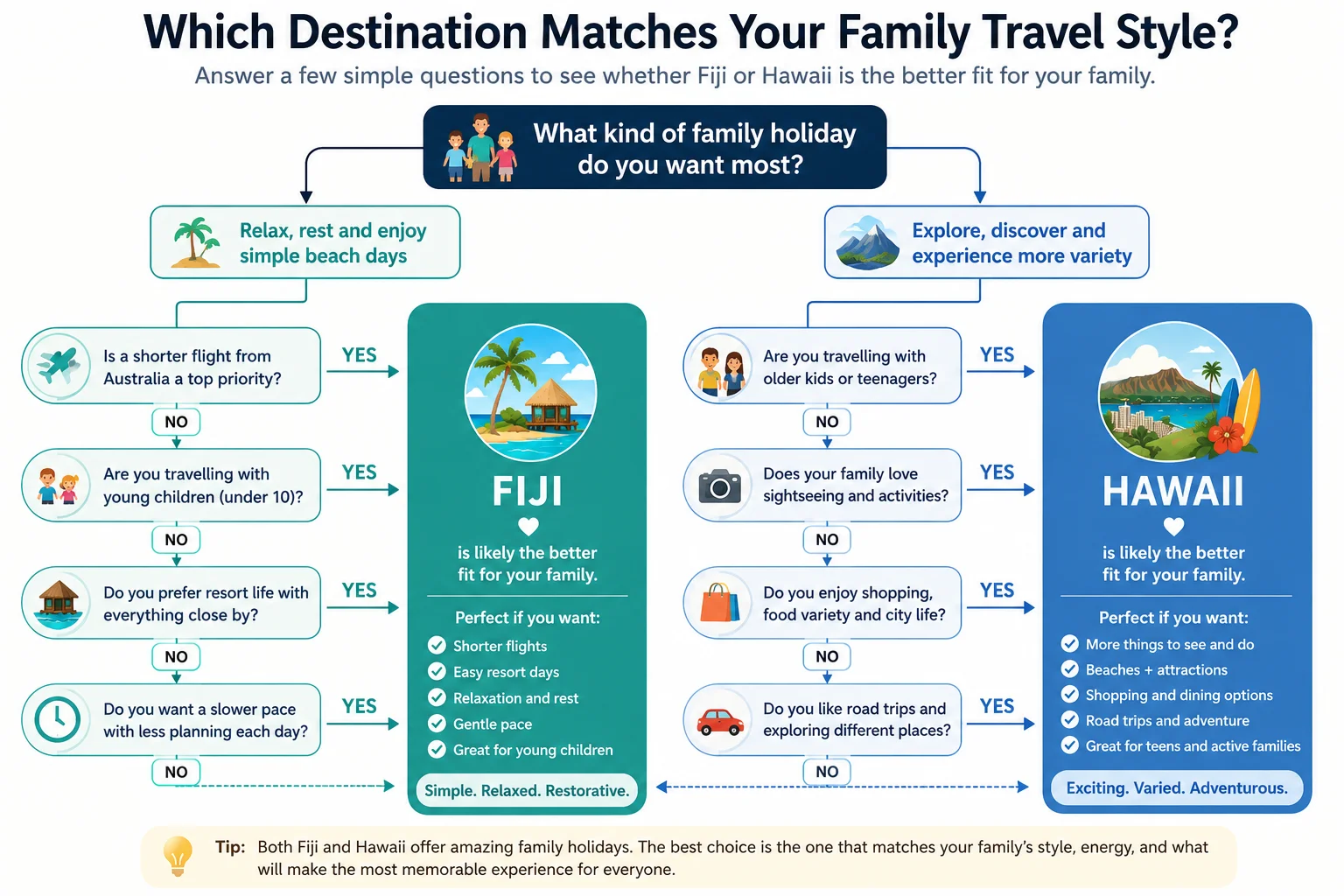
- Choose Fiji if your main goal is rest, easy swimming, shorter flights, and a gentle resort rhythm.
- Choose Hawaii if your family wants more variety, sightseeing, food options, shopping, and active days.
- Be careful comparing flight prices only, because daily costs can change the total family budget.
- Check school holiday pricing early, especially for families needing larger rooms or interconnecting rooms.
- For Fiji, compare meal plans, transfer costs, and island resort access before booking.
- For Hawaii, include car rental, parking, resort fees, meals, attractions, and longer travel time in your planning.
- Think about your children’s ages honestly. Toddlers and teenagers often need very different holidays.
- Leave space in the itinerary. Overplanned family holidays often feel less relaxing than expected.
If easy access from Australia is a major part of your decision, you may also find Which Pacific Islands Are Easiest to Reach from Australia? useful when comparing Fiji with other Pacific options.
Common Family Travel Misunderstandings
One common misunderstanding is thinking Fiji and Hawaii are similar because both are Pacific beach destinations. In reality, Fiji often feels more relaxed and resort-centred, while Hawaii feels more developed and activity-rich.
Another misunderstanding is assuming Fiji is always cheap. Fiji can be good value for Australian families, but imported goods, resort meals, transfers, and school holiday demand can still make the trip expensive.
Families also sometimes assume Hawaii is only about Waikiki. Waikiki is convenient and popular, but Hawaii has many different moods depending on the island, area, season, and travel style. A Waikiki holiday feels very different from a quieter stay on another island.
Another mistake is choosing based only on social media. Fiji may look like endless calm beaches, but weather can change and island logistics can feel slow. Hawaii may look like effortless adventure, but crowds, traffic, parking, costs, and long days can affect the family experience.
The most useful question is not “Which one is better?” It is “Which one suits our family this year?”
Seasonal and Local Context
Season matters for both Fiji and Hawaii, especially for Australian families tied to school holidays. Prices, crowd levels, room availability, flight costs, and weather expectations can change depending on when you travel.
Fiji has warmer tropical conditions throughout the year, but families should understand the difference between drier periods and wetter, more humid months. Rain does not automatically ruin a Fiji holiday, but it can affect boat trips, outdoor plans, and the mood of the trip.
Hawaii also changes by season. Ocean conditions, surf, crowds, accommodation rates, and activity demand can vary across islands and months. Some beaches may be calmer at certain times and rougher at others, which matters when travelling with children.
Australian school holidays can make both destinations more expensive. Families who can travel outside peak periods may find better value, calmer resorts, and more flexible accommodation choices.
If Fiji is still your preferred option and timing matters, our guide What Is the Cheapest Month to Visit Fiji? may help you think through budget and season together.
Pacific Worth Note: I think Fiji is often easier for tired families, while Hawaii is often better for curious families. That does not make one destination better than the other. It simply means the best choice depends on whether your family needs rest, variety, or a careful balance of both.
Frequently Asked Questions
Is Fiji or Hawaii better for families from Australia?
Fiji is usually better for Australian families who want shorter flights, easier resort days, and a slower pace. Hawaii is better for families who want more activities, sightseeing, food variety, shopping, and a more developed destination experience.
Is Fiji cheaper than Hawaii for a family holiday?
Fiji is often easier to budget for because flights from Australia are shorter and resort packages can make costs more predictable. Hawaii can cost more because of longer flights, accommodation, food, car rental, parking, and paid activities, although deals can vary by season.
Is Hawaii worth the longer flight with children?
Hawaii can be worth the longer flight if your children are older, enjoy active holidays, and want variety beyond the resort. For younger children or families needing rest, the longer journey may make Fiji feel more practical.
Is Fiji good for teenagers?
Fiji can be good for teenagers who enjoy swimming, snorkeling, kayaking, resort activities, and slower holidays. However, teenagers who want shopping, busy attractions, surfing options, and more independence may prefer Hawaii.
Which is easier for a first overseas family holiday, Fiji or Hawaii?
Fiji is usually easier for a first overseas family holiday from Australia because the flights are shorter, the resort experience is simple, and the pace is more relaxed. Hawaii may suit families who already feel comfortable with longer international trips.
Final Thoughts
So, when comparing Fiji vs Hawaii for Families from Australia, the better choice depends on what your family needs most from the holiday.
Choose Fiji if you want a relaxed island escape with shorter flights, warm hospitality, family-friendly resorts, easy swimming, and a slower pace. It is often the more practical choice for younger children, tired parents, and families who want rest without complicated planning.
Choose Hawaii if your family wants a bigger, more active holiday with beaches, shopping, food variety, road trips, cultural sites, scenic landscapes, and more things to do. It may cost more and feel busier, but it can be very rewarding for families with older children or teenagers.
The most important point is to avoid choosing based only on photos. Fiji and Hawaii both offer memorable Pacific holidays, but they reward different expectations. Fiji often feels worth it when your family needs calm. Hawaii often feels worth it when your family wants variety.
For real family travel, the best destination is not always the most famous one. It is the one that matches your budget, your children’s ages, your energy level, and the kind of memories you actually want to bring home.
Leave a Reply