
Rain can feel like one of the biggest uncertainties when planning a Fiji holiday. Flights from Australia, New Zealand, North America, or Europe can be expensive, and few travelers want to spend a long-awaited island trip watching heavy rain from a resort room. The difficulty is that Fiji’s tropical weather is more complicated than simply dividing the year into “good” and “bad” months.
Fiji’s rainiest period generally falls within the November-to-April wet season, with the middle of the season bringing the greatest combination of rainfall, humidity, tropical downpours, and unsettled weather. January through March are especially important months to consider if minimizing rain is a priority. However, rainfall varies considerably between Fiji’s islands and even between different sides of the same island, so a wet-season holiday does not automatically mean days of continuous rain.
This distinction matters. A weather app showing rain every day can make a Fiji trip look disastrous before you have even boarded the plane. In reality, tropical rain may arrive intensely, disappear again, and leave usable stretches of warm weather. At other times, a larger weather system can produce genuinely wet and disruptive days. Fiji’s official tourism information describes November through April as the wet season, with higher humidity and typically short tropical downpours, while the Fiji Meteorological Service tracks substantial year-to-year rainfall variability.
Understanding what the rainiest time to visit Fiji actually feels like is therefore more useful than simply finding the wettest month on a climate chart. This guide looks at the wetter months, regional differences, cyclone-season considerations, prices, resort atmosphere, and the tradeoff between better weather and better value so you can decide whether Fiji’s rainy season suits the trip you actually want.
When Is Fiji’s Rainy Season?
Fiji has two broad climate seasons rather than the four seasons familiar to travelers from temperate countries. The warmer wet season generally runs from November through April, while May through October is the cooler and drier part of the year.
Tourism Fiji describes November to April as Fiji’s summer and wet season. Temperatures remain warm, humidity increases, and afternoon downpours become more common. January and February are also among the warmest months. By contrast, average rainfall during the May-to-October dry season can be substantially lower.
That seasonal pattern is useful, but it should not be treated as a promise. Fiji’s Meteorological Service notes significant year-to-year rainfall variability, including influences from El Niño and La Niña. One January can therefore feel quite different from another.
| Period | Typical Weather Feel | Rain Risk | Traveler Experience |
|---|---|---|---|
| November | Warm, increasingly humid | Increasing | Transition into the wet season |
| December | Hot, tropical, humid | High | Wet-season conditions mixed with busy holiday travel |
| January | Very warm and humid | High | Greater chance of heavy tropical rain and unsettled periods |
| February | Very warm and humid | High | Similar wet-season tradeoffs, with weather flexibility important |
| March | Warm and humid | High | Still firmly within the wetter part of the year |
| April | Warm, gradually becoming more settled | Moderate to high | Transition toward the drier season |
| May–October | Warm, generally less humid | Lower overall | More dependable conditions, often with stronger demand |
These are broad seasonal expectations rather than daily forecasts. Fiji’s rainfall varies by location and from year to year.
So, What Are the Wettest Months in Fiji?
If your main goal is avoiding rain, it makes sense to be most cautious about January, February, and March. They sit deep within Fiji’s warm wet season, when high humidity, tropical rainfall, and the possibility of larger weather systems can overlap.
But naming one universal “rainiest month in Fiji” can be misleading. Rainfall is not evenly distributed across the country, and annual patterns vary. A particularly wet January in one year does not guarantee that January will produce the same experience the following year.
Recent Fiji Meteorological Service observations demonstrate how dramatic those differences can be. In January 2026, for example, monthly rainfall totals ranged considerably between monitoring locations, with some inland and wetter locations receiving several times the rainfall measured around parts of western Fiji.
For travelers, the useful conclusion is simpler: think in terms of a rainiest period rather than trying to identify one guaranteed rainiest week. Mid-wet-season travel carries more weather uncertainty, but your actual experience will also depend heavily on where you stay.
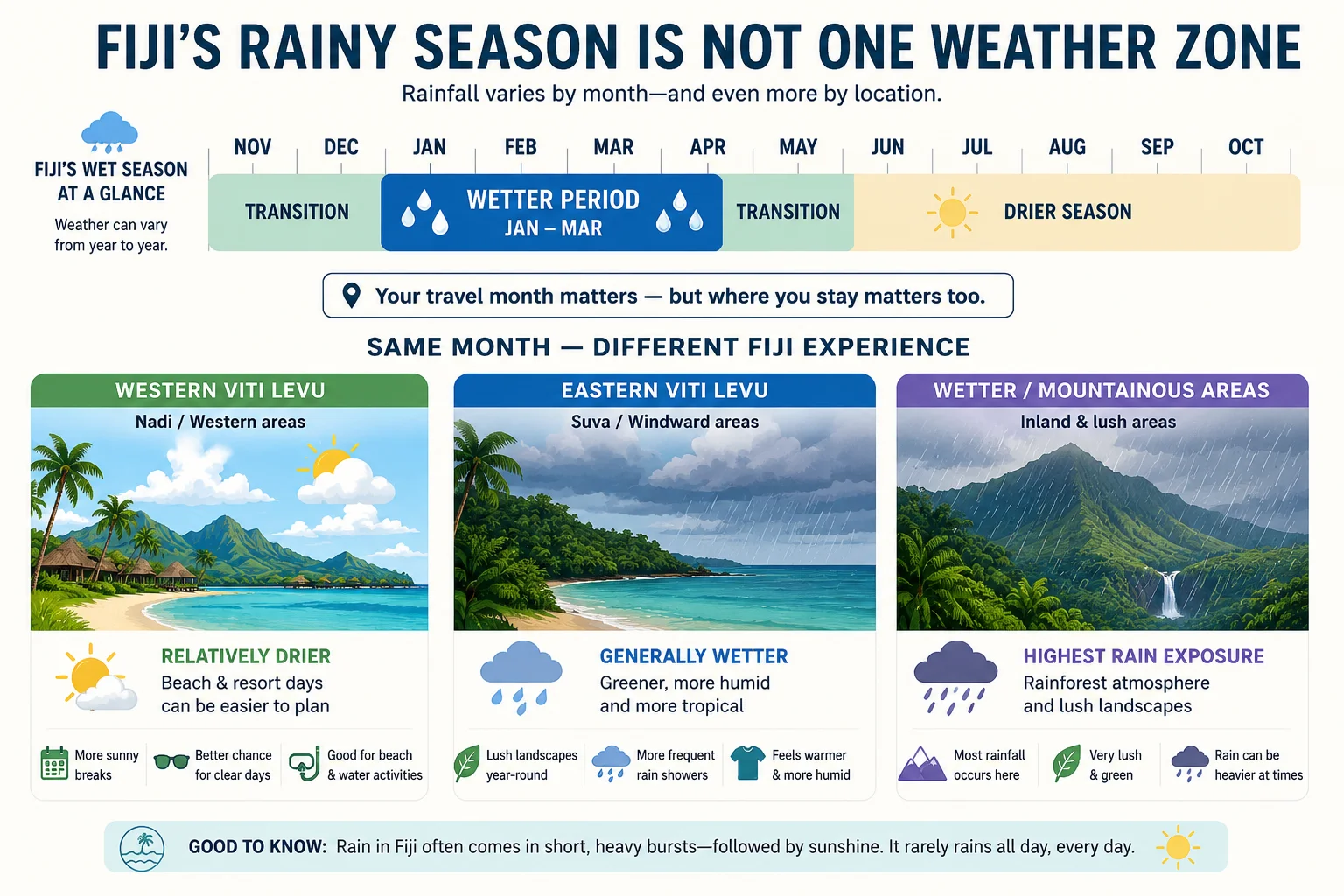
Why Fiji Can Be Rainy in One Place and Sunny in Another
This is one of the most useful things to understand before choosing where to stay.
Fiji’s larger islands contain mountains that influence rainfall. Moist southeast trade winds interact with the terrain, making some eastern and windward areas considerably wetter, while western and leeward areas tend to be drier.
On Viti Levu, this helps explain why a traveler staying around the western tourism areas near Nadi and the Coral Coast can have a different weather experience from someone spending the same week around Suva or wetter inland areas.
The difference also helps explain Fiji’s landscapes. Wetter regions support lush tropical vegetation and rainforest, while drier western landscapes can look noticeably different.
So when someone asks whether February is “too rainy for Fiji,” the answer should include another question: which part of Fiji?
A traveler mainly interested in resort pools, beaches, and outdoor dining may prefer a relatively drier area during the wet season. Someone visiting for waterfalls, rainforest, diving, local exploration, or a slower tropical experience may accept more weather uncertainty.
What Does a Rainy Day in Fiji Actually Feel Like?
The word rainy often creates the wrong mental picture.
Travelers sometimes imagine waking to grey skies followed by eight or ten hours of uninterrupted rain. That can happen during an unsettled weather system, but it is not the only form wet-season weather takes.
A tropical day can begin bright and warm, become increasingly humid, produce a strong afternoon shower, and then settle again. Another day might alternate between cloud, sun, short downpours, and calm periods.
Tourism Fiji specifically cautions that tropical forecasts can look worse than the actual day because an app may display thunderstorms even when showers occupy only part of the day.
There is an important other side to this, however. Sometimes rain is not merely a convenient twenty-minute shower. Persistent weather systems can bring prolonged rainfall, rougher seas, flooding, changed excursions, and transport disruption.
A realistic wet-season trip means being comfortable with both possibilities.
Expectation vs Reality: Fiji During the Rainy Season
| What Travelers Often Expect | What the Experience Can Actually Feel Like |
|---|---|
| Rain every minute of every day | Often a mixture of sun, cloud, humidity, showers, and occasional genuinely wet days |
| An empty Fiji because it is low season | Some periods are quieter, but Christmas and Southern Hemisphere school holidays can still bring demand |
| Bad weather everywhere at once | Conditions can differ noticeably between regions and islands |
| A ruined beach holiday | Many activities remain possible, but flexible plans become more valuable |
| Cheap prices throughout the entire wet season | Value can improve, but holiday periods and popular resorts may still be expensive |
| A gloomy tropical atmosphere | Wet-season Fiji can feel intensely green, warm, humid, dramatic, and very tropical |
This is why asking whether it is better to visit Fiji during the wet season is really a question about priorities rather than rainfall alone.
How the Rainy Season Changes the Feel of Fiji
Weather does more than determine whether you need an umbrella. It changes the mood of a destination.
During Fiji’s wetter months, the air can feel heavier and more humid. Vegetation becomes intensely green. Clouds build over mountains. Tropical showers can arrive quickly and loudly, especially around lush parts of the larger islands.
At a resort, this can create a surprisingly slow atmosphere. Travelers linger longer over breakfast, sit beneath covered terraces, book massages, read beside sheltered areas, or simply wait for the weather to clear rather than following a tightly scheduled itinerary.
For some people, that rhythm feels relaxing. Fiji already encourages a slower pace, and a passing tropical shower can make the destination feel even further removed from normal routines.
For others, especially travelers who have spent heavily on a short three- or four-night beach holiday, the uncertainty can become frustrating. When every afternoon matters, losing even one full day to poor weather feels significant.
This is an important difference between weather risk and travel risk. The same rainy forecast matters less on a relaxed ten-day trip than on a tightly planned long weekend.
What Social Media Usually Does Not Show About Fiji’s Weather
Travel photos naturally favor clear water, bright skies, sunset dinners, and perfectly lit beaches. They rarely show guests waiting beneath a covered walkway while a tropical downpour passes.
That can quietly create the impression that Fiji looks sunny every day of the year.
It does not.
Fiji is green because it receives rain. Tropical landscapes, rainforest interiors, waterfalls, and lush mountains are part of the same climate system that occasionally interrupts pool days and boat trips.
The opposite misconception is also unhelpful. Searching weather forecasts shortly before departure and seeing rain symbols across seven consecutive days does not necessarily mean seven ruined days.
The reality usually sits somewhere between the postcard and the weather-app screen.
Does Fiji’s Rainy Season Mean Cyclones?
Fiji lies within a region of the South Pacific where tropical cyclones can occur, and the warmer wet season overlaps with the period of greater cyclone risk. Tourism Fiji identifies November through April as the season when tropical cyclones may occur.
That does not mean a cyclone is likely to affect your particular holiday. It means the possibility is part of the seasonal risk and deserves sensible planning rather than panic.
A cyclone or significant tropical system is very different from ordinary wet-season showers. It can affect flights, ferries, roads, resort operations, excursions, and sea conditions.
If traveling during this period, comprehensive travel insurance becomes especially important. Read the policy carefully, because purchasing insurance after a weather event has already been named or identified may affect what is covered.
Closer to departure, rely on official weather information and follow instructions from local authorities and accommodation providers if significant weather develops.
Is Fiji Still Worth Visiting During Its Rainiest Months?
For the right traveler, yes.
The rainiest months are not automatically the worst months to visit Fiji. They simply involve a different tradeoff.
The dry season offers a stronger chance of settled conditions, but it also overlaps with popular travel periods. Wet-season travel can offer quieter surroundings and better-value flights or accommodation outside major holiday peaks.
Tourism Fiji itself recommends the low and shoulder seasons for budget-conscious travelers willing to accept additional rain and humidity. That fits with the broader price patterns discussed in our guide to the cheapest month to visit Fiji.
For travelers working within a realistic budget, those savings can matter. Fiji is not automatically an inexpensive destination once flights, transfers, resorts, meals, and activities are combined. Our breakdown of how expensive Fiji really is looks at those costs in more detail.
The important question is whether the savings compensate for the weather uncertainty for you.
Who Is Fiji’s Rainy Season Best For?
Best For
- Flexible travelers who are comfortable changing activities around the weather.
- Longer-stay visitors who can absorb one or two poor-weather days without feeling the holiday has been lost.
- Budget-conscious travelers who find meaningful savings outside holiday peaks.
- Repeat Fiji visitors who do not feel pressured to fit every major experience into one trip.
- Travelers who enjoy lush landscapes and do not need uninterrupted blue skies to appreciate an island.
- Resort travelers staying somewhere with good covered spaces, dining, spa facilities, or indoor activities.
Not Ideal For
- Travelers whose trip depends heavily on perfect beach weather.
- Very short-stay visitors with little flexibility if one day is lost to heavy rain.
- Travelers planning several weather-dependent boat excursions.
- Anyone uncomfortable with high humidity.
- Travelers who become anxious when forecasts are uncertain.
- Special-occasion visitors for whom weather reliability matters more than saving money.
This also helps explain why many travelers keep returning to Fiji. Once someone has already experienced the destination, there is often less pressure for the next trip to deliver a perfectly photographed version of Fiji every day.
Rain Matters More for Some Fiji Trips Than Others
Two travelers can visit during exactly the same week and have completely different opinions about the weather.
Imagine one couple staying seven nights at a resort. Their plans are mostly breakfast, swimming, reading, spa time, relaxed dinners, and perhaps two excursions. A wet afternoon might change very little.
Now imagine another traveler staying four nights and planning snorkeling, an island cruise, a waterfall excursion, a sunset sailing trip, and a full beach day.
The same rainfall becomes much more disruptive.
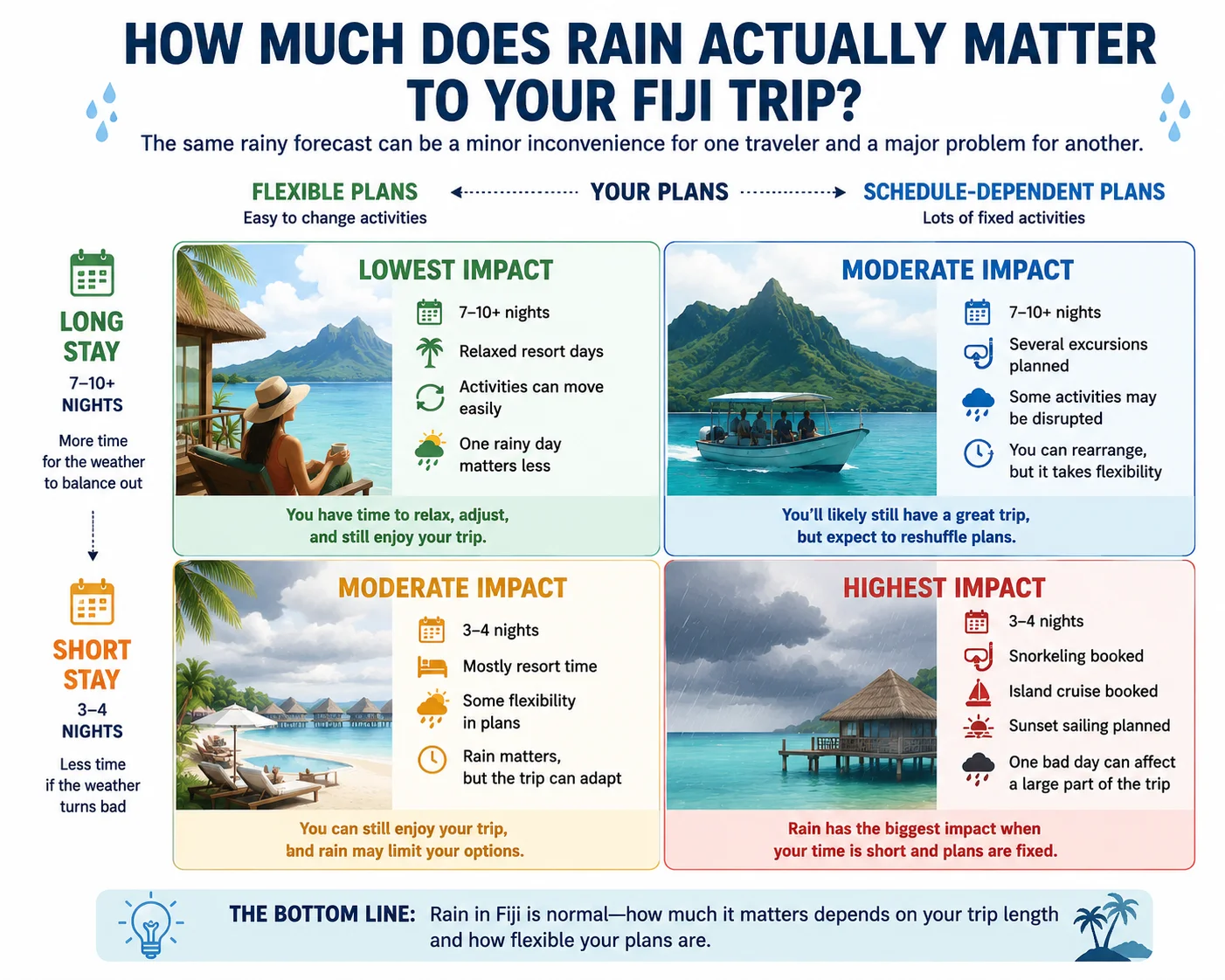
Your itinerary therefore matters almost as much as your travel month. If you are still deciding how Fiji fits into a broader Pacific trip, our guide to the best Pacific islands for a one-week trip can help put that time tradeoff into perspective.
Does the Rainy Season Make Fiji Cheaper?
It can, but not consistently.
Lower-demand periods within the wet season may produce better resort rates or flight deals. Fewer travelers can also make some resorts and tourism areas feel calmer.
But December and January complicate the simple “rain equals cheap” assumption. Christmas, New Year, Australian and New Zealand summer holidays, and family travel can create strong demand even though these months fall within the wetter season.
That means the best-value period is not necessarily the wettest period.
A cheaper room also has limited value if you spend the trip disappointed because your plans required reliable sunshine. Conversely, paying peak dry-season prices makes little sense if you would have been perfectly happy reading under a covered bure while an afternoon shower moved through.
Value is personal. Weather is part of the price decision, not separate from it.
Western Fiji vs Wetter Fiji: Where You Stay Matters
If you must travel during the wet season but want to improve your odds of usable beach weather, location deserves serious attention.
The western side of Viti Levu is generally drier than the eastern side because of Fiji’s mountainous geography and prevailing trade winds. This is useful for travelers considering areas around Nadi and western resort regions.
Meanwhile, wetter destinations can offer a different kind of experience: richer tropical vegetation, rainforest scenery, waterfalls, and a stronger sense of Fiji’s lush interior.
Neither is objectively better.
A traveler imagining long resort days may value the relatively drier west. Someone who wants rainforest, diving, waterfalls, and a greener, more natural atmosphere may happily accept greater rainfall elsewhere.
This is similar to the broader question explored in why some travelers prefer Fiji over Hawaii: choosing the better destination—or the better part of a destination—depends heavily on the experience you want rather than which place looks best in photographs.
What About Fiji in November and April?
The edges of the wet season can be interesting for travelers trying to balance weather, price, and crowds.
November marks the transition into Fiji’s wetter summer period. Tourism Fiji lists average November rainfall of roughly 125–157 mm and temperatures around 22–31°C, although actual conditions vary by location and year.
April sits at the opposite transition. Tourism Fiji lists average April rainfall around 230–287 mm while describing conditions as beginning to stabilize as the wet season ends.
Neither month guarantees good weather. Their appeal is that they sit outside the deepest part of the wet season while potentially avoiding some of the demand associated with Fiji’s most popular dry-season travel periods.
For travelers who dislike both peak pricing and maximum weather uncertainty, these transitional periods can be worth investigating.
How Rain Can Affect Island Transfers and Activities
Rain itself is not always the main problem. Wind, sea conditions, flooding, and reduced visibility can matter more.
Fiji involves boats, domestic flights, road transfers, and remote island logistics. When weather becomes unsettled, schedules can change.
A resort transfer by boat may become less comfortable. A snorkeling excursion might be postponed. A domestic flight can be delayed. Heavy rainfall can affect roads in some areas.
This is normal Pacific travel reality rather than evidence that Fiji is poorly organized. Island geography simply leaves some journeys more exposed to weather than a city holiday would be.
It is one reason travelers planning remote stays should avoid building extremely tight connections into an itinerary. The same principle applies when deciding how early to book Pacific island resorts: planning ahead matters, but so does leaving enough flexibility for the realities of island travel.
How to Plan a Fiji Trip During the Rainiest Time
You cannot control tropical weather, but you can build a trip that handles it better.
- Choose location carefully. If sunshine is a high priority, compare Fiji’s wetter and drier regions rather than looking only at national averages.
- Avoid an overpacked itinerary. Leave room to move weather-dependent activities to another day.
- Stay somewhere you would enjoy during rain. Covered communal areas, a good restaurant, spa, comfortable room, and sheltered views become more valuable.
- Consider a longer trip. Seven nights gives the weather more opportunity to balance itself than a tightly planned three-night stay.
- Allow breathing room around transfers. This becomes particularly useful when boats or domestic flights connect with an international departure.
- Check travel insurance carefully. Understand weather and cancellation coverage before a significant event develops.
- Use forecasts as planning tools, not guarantees. Tropical weather icons can make an entire week look wetter than the actual experience turns out to be.
Common Misunderstandings About Rain in Fiji
One common misunderstanding is that the wet season means it rains all day. Sometimes prolonged rain occurs, but wet-season weather can also consist of shorter tropical downpours separated by brighter periods.
Another misunderstanding is that the whole country gets the same weather. Fiji’s mountainous islands create significant regional rainfall differences, particularly between wetter windward and relatively drier leeward areas.
Travelers also sometimes assume the dry season means no rain. Fiji remains tropical, so rain can occur at any time of year, and individual dry-season months can still be unusually wet.
It is also easy to assume the rainy season is always the cheapest time. Christmas, New Year, and Southern Hemisphere school holidays can keep demand strong during part of the wet season.
Finally, a weather app showing thunderstorms every day does not automatically mean the holiday is ruined. Tropical forecasts often indicate the possibility of showers or thunderstorms rather than continuous rainfall. Short-range official forecasts become more useful as your travel dates approach.
Should You Choose Another Pacific Island Instead?
If weather reliability is extremely important and your only available dates fall deep within Fiji’s wet season, comparing alternatives can be reasonable.
But changing islands does not automatically remove tropical weather risk. Pacific destinations have their own seasonal patterns, and choosing solely from a weather icon can lead to the wrong trip for your personality.
Fiji offers a broad range of resort styles, local experiences, landscapes, and relatively straightforward access compared with some more remote Pacific destinations. That versatility is one reason it remains attractive even when conditions are not perfect.
If atmosphere matters as much as weather, our comparison of Fiji vs Samoa for a relaxing trip shows how differently two tropical destinations can feel despite appearing similar on a map. Travelers deciding between a resort-oriented trip and something culturally focused may also find Samoa vs Fiji for cultural experiences useful.
Pacific Worth Note: I would not treat Fiji’s wet season as a reason to automatically avoid the country. I would treat it as a reason to think more carefully about the kind of holiday I was booking. A long, flexible resort stay can absorb tropical rain surprisingly well. A short trip built around boat tours and perfect beach days has much less room for the weather to misbehave.
Frequently Asked Questions
What is the rainiest time to visit Fiji?
The rainiest time to visit Fiji generally falls within the November-to-April wet season, with January through March sitting in the heart of the wetter, hotter, and more humid period. Actual rainfall varies significantly between regions and from year to year.
What month gets the most rain in Fiji?
There is no single month that will be the wettest everywhere in Fiji every year. Rainfall varies by location, topography, and annual climate patterns. Travelers should think of January through March as a particularly wet part of the broader wet season rather than relying on one guaranteed “wettest month.”
Does it rain every day during Fiji’s wet season?
No. Some periods can be persistently wet, but many wet-season days include a mixture of sunshine, cloud, humidity, and tropical showers. Conditions also vary considerably across Fiji.
Is February a bad time to visit Fiji?
February is not automatically a bad time to visit, but it is a higher-risk month for travelers who need consistently dry weather. It can suit flexible travelers who accept humidity and rain in exchange for potential value and a quieter experience outside peak holiday periods.
Is Fiji better in the wet season or dry season?
The dry season is generally better for travelers prioritizing more reliable outdoor weather. The wet season can be worthwhile for travelers prioritizing lower prices, fewer crowds during some periods, lush scenery, and a slower trip with flexible plans. The better choice depends on your budget and how much weather uncertainty you are comfortable accepting.
Final Thoughts: Is Fiji’s Rainiest Time Worth Avoiding?
The rainiest time to visit Fiji is broadly the November-to-April wet season, with January, February, and March deserving particular consideration if rainfall is a major concern.
But knowing those months is only the beginning.
Where you stay matters. The length of your holiday matters. Your itinerary matters. Your budget matters. And perhaps most importantly, your expectations matter.
If your idea of Fiji depends on uninterrupted sunshine, calm seas, and a carefully scheduled list of outdoor activities, paying more to travel during the drier months may be worthwhile.
If you have a longer stay, flexible plans, a comfortable resort, and no problem watching a tropical shower move across the island while you slow down for an afternoon, the wet season can still provide a trip that feels genuinely worthwhile.
Fiji does not stop being Fiji when it rains. The pace remains slow, the islands remain warm, local interactions continue, and the landscape often looks especially lush. You simply experience a less predictable version of the destination.
And for some travelers, accepting that unpredictability is a perfectly reasonable tradeoff for experiencing Fiji with a little more flexibility in the budget and a little less pressure for every day to look like a postcard.


Leave a Reply